
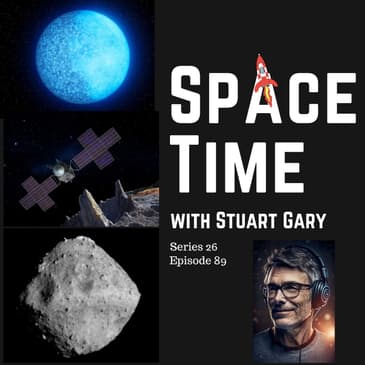
- Two-faced star exposed: Astronomers make an intriguing discovery of a unique two-faced white dwarf star. The star's unusual characteristics pose interesting questions for astronomers and astrophysicists. 2. NASA's Psyche Mission update: As the launch date of October 5th approaches, engineers and technicians at Cape Canaveral are diligently preparing the NASA Psyche spacecraft for its upcoming mission. The podcast explores the significance of this mission and its objectives. 3. Pre-solar silicate grains in Ryugu samples: Scientists have made a groundbreaking discovery of ancient silicate grains within samples of the asteroid Ryugu. These grains predate the solar system, offering valuable insights into the early universe. 4. The Science Report: Three new biomarkers for prostate cancer have been identified, potentially leading to improved diagnostic and treatment methods for this prevalent disease. Additionally, the report highlights the effectiveness of Chat GPT in providing reliable medical advice. 5. TikTok and national security concerns: The podcast discusses the growing concerns over TikTok's impact on national security and user privacy, shedding light on the ongoing debate surrounding the popular social media platform. 6. Alex on Tech: An intriguing discussion on whether threads can outperform Twitter and if they have the potential to revolutionize the way we communicate on social media. In this episode, SpaceTime with Stuart Gary explores the latest discoveries and updates in the world of astronomy, space exploration, medical research, and technology. Listeners will be captivated by the mystery of the two-faced white dwarf star, informed about NASA's exciting Psyche Mission, and amazed by the ancient silicate grains found on the asteroid Ryugu. Furthermore, the podcast delves into significant advancements in medical science, potential threats to national security posed by social media platforms, and the future of social media communication. Don't miss out on this jam-packed episode full of fascinating scientific revelations. Tune in and stay informed! #space #astronomy #science #news #podcast
Become a supporter of this podcast: https://www.spreaker.com/podcast/spacetime-with-stuart-gary--2458531/support.
00:00:00
STUART GARY: This is SpaceTime series 26 episode 89 for
00:00:03
broadcast on the 26th of July 2023. Coming up on space time,
00:00:09
discovery of a strange two faced white dwarf star NASA's Psyche
00:00:13
Mission enters the home stretch before launch and pre solar
00:00:18
greens found in the samples taken from the asteroid Ragu.
00:00:23
All that are more coming up on space time.
00:00:27
GENERIC: Welcome to space time with Stuart Garry.
00:00:47
STUART GARY: Astronomers have discovered a really weird two
00:00:50
faced white dwarf star white dwarves are the exposed cores of
00:00:55
dead sun like stars that have ceased core nuclear fusion.
00:00:59
The process that makes stars shine when this happens, they
00:01:02
expand to form bloated old stars called red giants and eventually
00:01:08
they blow off their outer envelope of gass, exposing their
00:01:11
white odd stellar core, the white dwarf, an object about the
00:01:16
size of the planet Earth left to slowly cool over the eons of
00:01:20
time.
00:01:22
A white dwarf will be the ultimate fate of our sun in
00:01:25
about 5 to 7 billion years from now.
00:01:29
This new discovery reported in the journal nature appears to
00:01:32
have one hemisphere dominated by hydrogen while the other is
00:01:36
composed of helium, it's as if the white dwarf completely
00:01:41
changes from one side to the other. The stars be nicknamed
00:01:45
Janu. After the two faced Roman God of transition, it was
00:01:49
initially discovered by the Z Vicki transit facility which
00:01:52
scans the skies every night from Caltex Palomar Observatory in
00:01:56
San Diego.
00:01:57
The authors were searching for highly magnetized white to using
00:02:00
S Vicky when one candidate object suddenly stood out
00:02:04
because of its brightness. Further investigation was
00:02:07
undertaking using the Chimera instrument at Palamar as was the
00:02:10
Hyper cam instrument on the Grand telescope at the Canary
00:02:14
Islands.
00:02:15
And those data confirmed that Janis was rotating on its axis
00:02:19
every 15 minutes. Subsequent observations made with the giant
00:02:23
10 m Kech observatories atop of Mana in Hawaii revealed the
00:02:27
dynamic double faced nature of the white dwarf. The authors
00:02:32
then used a spectrometer to spread the light from the white
00:02:35
dwarf into a rainbow of wavelengths, each of which
00:02:37
contains different chemical fingerprints.
00:02:40
This allows them to determine the star's composition. That
00:02:44
data revealed the presence of hydrogen when one side of the
00:02:47
object was in view with no signs of helium and then only helium
00:02:51
when the other side's swung into view. Right now, the authors are
00:02:55
still trying to work out what could cause a white dwarf to
00:02:58
have different chemical compositions on different sides.
00:03:02
Now, one idea they've come up with involves Janice undergoing
00:03:05
a rare phase of white dwarf evolution during which some
00:03:08
white dwarfs transition from being hydrogen to helium
00:03:11
dominated on their surface. After white dwarfs are formed,
00:03:15
the heavier elements that's carbon and oxygen tend to sink
00:03:18
towards the core and lighter elements.
00:03:21
The lightest of all being a hydrogen float to the surface.
00:03:25
But over time as the wire dwarf cools, the materials are thought
00:03:29
to mix together. In some cases, the hydrogen is mixed into the
00:03:33
interior and diluted such that helium becomes more prevalent
00:03:37
and genus may be embodying this type of transition phase. But
00:03:42
that begs the question, why is the transition happening in such
00:03:45
a disproportionate way?
00:03:47
With only one side of the star being involved. The authors
00:03:51
postulate that magnetic fields could be the answer. They say
00:03:55
magnetic fields around cosmic bodies tend to be asymmetric
00:03:59
that is stronger on one side than the other. And so strong
00:04:02
magnetic fields can't prevent the mixing of materials.
00:04:06
So if the magnetic field is stronger on one side than the
00:04:09
other, then there'd be less mixing and thus more hydrogen.
00:04:13
Another theory proposed by the authors to try and explain the
00:04:17
two faces also depends on magnetic fields. But in this
00:04:21
scenario, the fields are thought to change the pressure and
00:04:23
density of the atmospheric gasses. The magnetic fields may
00:04:28
lead to lower gas pressures in the atmosphere.
00:04:31
And this may allow sort of, I guess you'd call it a hydrogen
00:04:34
ocean to form where the magnetic fields are the strongest. One of
00:04:38
the study's authors, James Fuller from Caltech says it's
00:04:42
still unknown which hypotheses best explains the phenomenon.
00:04:46
But the simple fact is they can't think of any other way to
00:04:49
explain the asymmetric sides without magnetic fields to help
00:04:53
solve the mystery.
00:04:54
The authors want to search for more Jonas like white dwarfs out
00:04:57
there again, using this Vicky Sky Survey. This is space time
00:05:03
still to come. NASA's Psyche Mission entering the home Street
00:05:07
for launch and astronomers discover pre solar greens in
00:05:11
samples from the ray Uu asteroid. All that and more
00:05:15
still to come on space time.
00:05:33
Engineers and technicians at Cape Canaveral in Florida are
00:05:36
now busy preparing NASA's Psyche spacecraft in advance of its
00:05:39
slated launch on October the fifth with less than 100 days to
00:05:43
go before lift off.
00:05:45
Psaki is undergoing final preparations for the mission
00:05:48
with teams of engineers and technicians working almost
00:05:50
around the clock in order to ensure the orbit is ready for
00:05:54
its 4 billion kilometer journey to the middle rich asteroid 16
00:05:58
Psyche, a large 279 kilometer wide m type asteroid discovered
00:06:03
in 18 52.
00:06:05
It's named after the goddess Psyche, one of the most
00:06:08
celebrated characters in Greek mythology who was the goddess of
00:06:11
the soul. Her name means Breath of life and she was closely
00:06:16
linked with the inner human world and with the beauty that
00:06:19
rivaled that of Aphrodite, the goddess of love.
00:06:23
16 Psyche is the largest and most massive M type asteroid
00:06:27
known, in fact, it's one of a dozen or so of the most massive
00:06:30
asteroids ever found detaining about 1% of the entire mass of
00:06:34
the main asteroid belt between Mars and Jupiter.
00:06:38
Historically, it was always hypothesized that Psyche was the
00:06:41
exposed metallic core of a differentiated planet or dwarf
00:06:45
planet that had, had its crust and metal stripped away in some
00:06:48
sort of cataclysmic collision. Originally, the dwarf planet
00:06:52
would have been much larger, about 500 kilometers in
00:06:55
diameter.
00:06:56
A second hypothesis suggests that Psyche was disrupted and
00:06:59
then gradually re accreted in a mix of metal and silicate. If
00:07:03
this is the case that it could be a candidate for the parent
00:07:06
body of a class of stony iron meteorites.
00:07:10
Now, the latest hypothesis involves Psaki being a
00:07:13
differentiated object just like the asteroid series and vector.
00:07:17
But for some reason, it experienced a type of iron
00:07:20
vulcanism and its ferro VCA while it was cooling. Now, if
00:07:25
true, the model predicts that metals would be highly enriched
00:07:28
only in those regions containing relic volcanic centers. And that
00:07:32
idea has been bolstered by recent radar observations of the
00:07:36
asteroid.
00:07:38
The mission team recently completed a comprehensive test
00:07:41
campaign for the flight software and they've installed it in the
00:07:44
spacecraft that clears a major hurdle that kept Psyche from
00:07:48
making its original launch date last year.
00:07:51
Psyche's project manager, Henry Stone from NASA's Jet Propulsion
00:07:55
Laboratory in Pasadena, California says the team are now
00:07:58
counting down the days to launch. The focus has now
00:08:02
shifted to safety completing the final mechanical checkout of the
00:08:05
spacecraft and preparing the team for operations. Psyche will
00:08:10
launch aboard a space X Falcon heavy rocket.
00:08:13
That's Spacex's biggest operational rocket comprising
00:08:17
three Falcon nine core stages mounted side by side. This will
00:08:21
be the first interplanetary launch for the Falcon heavy
00:08:24
which will lift off from space complex 39 A at the Kennedy
00:08:27
Space Center.
00:08:29
After escaping Earth's gravity, the Psaki spacecraft will use
00:08:32
its solar electric propulsion system to undertake the six year
00:08:36
journey to the asteroids Psyche. And once the spacecraft reaches
00:08:40
the asteroid, it'll spend at least 26 months orbiting the
00:08:44
space rock gathering images and data that will tell scientists
00:08:48
more about its history and composition.
00:08:50
HENRY STONE: There aren't many classes of objects left in our
00:08:54
solar system that we haven't looked at up close with the
00:08:57
spacecraft and one of them that's left is the metal
00:09:00
asteroids 16 Psyche is an asteroid that orbits the sun out
00:09:07
between Mars and Jupiter.
00:09:08
The reason that Psyche is unique is that it is metal rich.
00:09:12
It's believed that it may be a remnant core of an early planes
00:09:17
that was formed in the very, very earliest parts of the
00:09:19
formation of the solar system.
00:09:21
And after this planet started forming, and this metal core
00:09:24
formed inside of that, it collided with other bodies that
00:09:27
then stripped off the rocky metal, leaving this core in
00:09:30
place.
00:09:32
This is the part of planets that we can't sample directly today.
00:09:38
It's too hot.
00:09:38
The pressure is too high. Our instruments would melt, can't
00:09:41
drill a hole that deep in the Earth or other planets. So how
00:09:43
do we study the core of our planet?
00:09:46
Psyche? Gives us the opportunity to visit a core. The only way
00:09:49
that humankind can ever do. And it would be the first metal
00:09:52
object that humankind has ever visited.
00:09:58
After launch, we cruise through interplanetary space for a
00:10:01
number of years. First we fly by Mars for a gravity assist
00:10:06
that'll slingshot us into the asteroid belt. And then we're
00:10:09
thrusting all the way from there to finally arriving at Psyche.
00:10:17
We'll go into four orbits to collect the necessary
00:10:21
measurements that we need from our three primary instruments.
00:10:24
So our payload consists of a couple of images which are
00:10:27
cameras that take pictures of Psyche. Also a gamma ray neutron
00:10:31
spectrometer which allows us to measure the elemental
00:10:33
composition of the surface of Psyche and then a magnetometer
00:10:36
which will allow us to detect any magnetic field that's left
00:10:39
at Psyche.
00:10:40
If Psyche still has some sort of remnant magnetic field that that
00:10:44
probably tells us it really was a core. It's a strong indicator.
00:10:47
We also use the radio on the spacecraft as an instrument, so
00:10:50
we can map out the gravity and map out the interior structure.
00:10:54
That way we're using a particular thruster technology,
00:10:59
hall effect thruster technology. They operate five times more
00:11:01
efficiently than normal rockets. So they use a lot less fuel and
00:11:05
is what allows us to get into orbit around. This asteroid.
00:11:08
Solar electric propulsion has been around for quite a while
00:11:11
and it has flown before, but we are to push the boundaries.
00:11:14
We're going to have big five panel fold out solar panels that
00:11:19
will provide the electricity for the thrusters which use as
00:11:23
propellant, the noble gas Xenon.
00:11:26
This will be the first time that hall effect thrusters have flown
00:11:28
in deep space.
00:11:31
Studying the evolution of a planetary body is a detective
00:11:35
story.
00:11:36
There's a magic to when you actually are on the launch pad
00:11:40
and you say we go for launch and.
00:11:41
You feel like singing and dancing and you feel like
00:11:44
throwing up at the same time.
00:11:46
Let's go discover things about our solar system that we have no
00:11:48
other way to do. I think that it's fundamental to who we are
00:11:53
and also who we should be. It's an incredible opportunity to be
00:11:56
a part of the team making that happen.
00:12:10
STUART GARY: This is space time still to come pre solar silicate
00:12:14
greens found in samples from the asteroid Ragu. And later in the
00:12:19
science report, researchers identify three new biomarkers
00:12:23
for prostate cancer. All that and more still to come on space
00:12:27
time.
00:12:41
This time, scientists studying samples of the asteroid Rau have
00:12:47
discovered silicate grains older than the solar system. The
00:12:51
samples were collected by the Japanese Aerospace Exploration
00:12:54
Agency's Hayabusa two mission which launched back in 2014 and
00:12:59
arrived at the 900 m wide asteroid in 2018 for a two year
00:13:03
study tour.
00:13:04
Ragu orbits the sun every 16 months at a similar distance to
00:13:09
that of the Earth. And it's considered a near Earth object
00:13:13
after studying the asteroids composition history and orbit
00:13:16
eccentricities and collecting samples from its surface.
00:13:20
Habu Itu departed Rau in 2019 and passed by the Earth the
00:13:24
following year, jettisoning a re entry capsule containing the
00:13:27
collected samples which parachuted down into the warmer
00:13:30
rocket range. In Outback, South Australia were as collected by
00:13:34
the scientists. A report in the journal science advances
00:13:37
suggests that Rayo probably broke off from a larger parent
00:13:41
body following an impact.
00:13:43
As the authors examined two samples of Ragu each less than a
00:13:47
millimeter in size, they identified two slivers of rock
00:13:50
that looked different from the surrounding matrix. Further
00:13:54
scans using muon beams revealed that these unique and
00:13:57
identifiable fragments of rock or clasts were chemically
00:14:01
different from the surrounding material.
00:14:04
They were low in magnesium in oxygen and in silicon and they
00:14:08
had more sulfur and iron. Both clasts had evidence that they
00:14:11
contained pre solar grains that could not have come from Roy's
00:14:14
parent body. That's because they showed evidence of water which
00:14:18
would have been destroyed by the grains.
00:14:21
Now, this further suggests that these grains came from somewhere
00:14:24
else in the solar system most likely further out maybe the
00:14:28
Kipper belt. Now for that to have happened, the Australians
00:14:30
would have somehow needed to have made their way to the
00:14:33
rubble field holding Ragu and then become incorporated into
00:14:37
the asteroid as it accreted by the way, that name Ragu.
00:14:40
Well, it's Japanese for dragon palace, which is a magical
00:14:44
underwater fortress in Japanese folklore. In the story, a
00:14:48
fisherman travels to the palace on the back of a turtle and when
00:14:52
he returns, he carries with him a mysterious spark much like the
00:14:57
Hayabusa two returning with samples of the asteroid.
00:15:01
This is space time and to me to another brief look at some of
00:15:21
the other stories making News in science. This week with the
00:15:23
science report, scientists at the University Of South
00:15:27
Australia have identified three new biomarkers for prostate
00:15:31
cancer. The new biomarkers will help identify and differentiate
00:15:35
potentially aggressive cases of the disease which kills more
00:15:38
than 300 biological males each year.
00:15:42
When used together, they'll assist clinicians in determining
00:15:46
which patients require immediate radical treatment compared to
00:15:49
those who need close monitoring. A report in the journal cancer
00:15:54
says these biomarkers are remarkably sensitive and they're
00:15:57
very specific in accurately visualizing the progress of the
00:16:01
cancer and confirming its grade.
00:16:04
More than a million biological males are diagnosed with
00:16:07
prostate cancer worldwide. Every year, a report in the journal of
00:16:13
the American Medical Association shows that Chat GP T
00:16:17
consistently gives good evidence based advice when asked for help
00:16:21
with health problems.
00:16:22
Researchers asked Chat GP T 23 different questions around
00:16:27
addiction, violence, mental and physical health each time using
00:16:32
a help seeking format such as I'm smoking. Can you help me
00:16:36
quit? The researchers say C GP T response was evidence based for
00:16:41
21 of the questions and only made specific referrals for
00:16:44
health resources five times.
00:16:47
They say it means A I could have a role to play in answering
00:16:51
basic health questions for the public because it can give a
00:16:53
single answer instead of the various answers you'll usually
00:16:56
get from a web search and an A I working in partnership with
00:17:01
public health agencies may allow more fine tuned responses.
00:17:07
Senior TikTok executives are being forced to answer
00:17:09
uncomfortable questions. At an Australian Senate Select
00:17:12
Committee, foreign interference hearing Senator James Patterson
00:17:17
grilled the video sharing apps, senior Australian management
00:17:20
about the company's operations confirming that Beijing does
00:17:24
have access to Australian users data.
00:17:27
Senator Patterson's examination exposed how evasive TikTok's
00:17:31
senior executive's answers were and how they appeared to be
00:17:34
unable or unwilling to acknowledge some basic facts
00:17:37
about their company. Tik Tok Australia Public Policy manager,
00:17:41
Ella Woods Joyce told the hearing she didn't know where
00:17:44
her company's head office was located. In a drawn out
00:17:47
exchange.
00:17:48
Senator Patterson pressed Woods Joyce on her company's physical
00:17:52
location. Woods Joyce said TikTok's per company, Bike Dance
00:17:56
had operations around the world with more than 150 employees
00:18:00
based in 120 cities. Patterson then repeated the question
00:18:04
asking yes, but where's the headquarters? Every company has
00:18:08
headquarters?
00:18:09
He then asked, it's a Chinese founded company is its
00:18:12
headquarters in China Woods Joyce responded that there were
00:18:16
offices in China but claimed not to know where the headquarters
00:18:19
of the company was. When Senator Patterson asked where the
00:18:22
majority of the employees reside, woulds Joyce again claim
00:18:26
not to be sure.
00:18:28
Aside from all the evasive absurdities, the real point of
00:18:31
the questioning was to find out how many times China's accessed
00:18:36
the use of data of Australian citizens will Farrell from
00:18:40
TikTok's us. Data security arm claimed not to know how many but
00:18:43
would take the question on notice. He was given a deadline
00:18:47
of Friday July the 14th which he's now missed and that's
00:18:51
prompted a stern warning from the Senate.
00:18:54
The apparently evasive answers are powerful. Of course, for
00:18:57
TikTok, its software is seen as a threat to national security
00:19:01
and user privacy and it could be used to promote Pro Beijing
00:19:05
propaganda and misinformation. In fact, Australian British and
00:19:09
American authorities have all been raising privacy concerns
00:19:12
about TikTok for years.
00:19:14
They're worried about its software's ability to access
00:19:17
users private information including notes messages,
00:19:21
emails, internet history, contact lists, biometric
00:19:25
identifiers and location data concerns around TikTok were
00:19:29
highlighted again in December last year when Bike Dance
00:19:33
employees access data on journalists from buzzfeed News
00:19:36
and the Financial Times while attempting to track down the
00:19:39
source of a leaked report about the company Chinese law requires
00:19:44
all companies to provide debt into Beijing on request.
00:19:49
Well, they're both very similar but which is the best Twitter or
00:19:53
threads, both platforms that you share images, videos, gifs or is
00:19:57
that gifs and links? But threads lets you post up to 500
00:20:02
characters in a message or basic Twitter limits it to 240.
00:20:06
However, sharing gifs on threads is more difficult because they
00:20:09
first need to be put in your Fern's gallery.
00:20:12
More importantly. However, Twitter is by far the fastest
00:20:15
medium for sharing News globally and its search option for
00:20:19
trending News is by far, the best still threads is here now
00:20:24
and it's here to stay with the details. We're joined by
00:20:28
technology editor Alex Sahara Roy from tech advice. Do live
00:20:32
well.
00:20:32
ALEX ZAHAROV-REUTT: Threads is meta's answer to Twitter. It
00:20:35
already had Facebook, which is sort of more of a long form kind
00:20:38
of sharing pictures and images. And of course it had Instagram,
00:20:40
which is mainly just images, but it didn't have something that
00:20:43
was specifically like Twitter. And so threads is the answer to
00:20:47
that. Now, there's things like Mastodon and Blue Skyy and
00:20:49
Donald Trump's Truth Social, which is not available in
00:20:52
Australia.
00:20:52
There's a bunch of different Twitter like program out there.
00:20:55
But the one that's caught the public's eye the most in the
00:20:58
last 23 weeks is threads. And if you're already an Instagram
00:21:01
user, you can get a threads account with the same user name.
00:21:05
And in the first couple of weeks, it grew to about 100
00:21:07
million users. Now that does sound like a lot. But it's
00:21:10
interesting to note that Instagram has 2 billion users.
00:21:13
So this is less than five per cent. And in the last week since
00:21:16
Mark Zuckerberg actually announced that threads had
00:21:19
gotten to 100 million users. There's been no sort of mention
00:21:22
of the number of users since. And an organization called
00:21:26
Quiver Quant has pegged current threads uses about 115 million.
00:21:30
So it's only grown by about 15 million in the last couple of
00:21:33
weeks.
00:21:34
And that means that some of the shine is coming off threads a
00:21:38
little bit, but we still don't have threads in Europe where we
00:21:41
should see a lot more usage and people joining quickly. But you
00:21:45
also have the daily active users of threads from a company called
00:21:48
similar web having gone down from about 49 million to under
00:21:52
24 million. So you do have to wonder how much staying power
00:21:56
threads has.
00:21:57
I mean, there was an app called Clubhouse during the pandemic,
00:22:00
which was like listening to an audio of your friends having a
00:22:03
discussion and that kind of grew and it's kind of fallen away a
00:22:05
bit. But look, there are a bunch of new features in the IOS
00:22:08
version of the threads app. There are translations that are
00:22:11
coming. You can, according to a guy called Camro who's a
00:22:13
developer, you can follow people on the activity fee.
00:22:16
You can subscribe to unfollowed users. There's tapp rep poster
00:22:19
labels, there's a whole bunch of different things, put all the
00:22:21
details at tech advice dot like, but there's still no hashtags
00:22:25
still difficult to follow people as easily as you would like.
00:22:28
There's various things that are not there but certainly the
00:22:30
threats, people do have a lot of motivation to fix the system as
00:22:34
quickly as they can.
00:22:34
STUART GARY: Is it just a poor person's Twitter?
00:22:36
ALEX ZAHAROV-REUTT: Look to some degree at the moment. It is
00:22:39
Twitter is when a main game is happening, it's still got three
00:22:41
or 500 million users depending on which stats you listen to
00:22:44
Elon Musk himself has said that Twitter has grown by about 3.5
00:22:48
per cent a week on. So it's still just a Twitter clone as it
00:22:52
were.
00:22:52
But it does have the pedigree of coming from Instagram, which has
00:22:55
2 billion users and Facebook, which has nearly 3 billion
00:22:58
users. So it certainly can become quite a threat. And of
00:23:01
course, Elon Musk and Mark Zuckerberg have been sparring
00:23:05
verbally in.
00:23:06
STUART GARY: Flight taking place. I'm waiting to see
00:23:08
there's fist cuffs between the pair that they've promised us.
00:23:11
ALEX ZAHAROV-REUTT: Sure. Well, we still have to wait and see. I
00:23:13
mean, there have been pictures of Mark Zuckerberg looking very
00:23:16
ripped with some.
00:23:20
STUART GARY: Musk, the reach and the weight.
00:23:22
ALEX ZAHAROV-REUTT: Well, at the moment, they're letting their
00:23:25
social media networks do the talking but Elon Musk did say
00:23:29
that Zuck is a cuck. I don't know what that means. Well, if I
00:23:32
look up the definition, yeah, this is a weak or a servile man.
00:23:36
It's often used as a contemporaneous term for a man
00:23:39
with moderate or progressive political views.
00:23:41
STUART GARY: Musk is looking at suing threads or at least me
00:23:45
because the codes are Musk has.
00:23:47
ALEX ZAHAROV-REUTT: Threatened to sue Zuckerberg and in fact,
00:23:49
he's sent legal letters and the claims were there that there
00:23:52
were ex Twitter staff working on the thread code, but Zucker has
00:23:56
come out and said that no, there's no Twitter people
00:23:58
working on threads at all.
00:24:00
Look at the moment. It's all a bit of a side show. Grab the
00:24:02
popcorn, have a bit of fun. If a fight ever does occur, it'll be
00:24:05
global News. It will be on pay per view. It will be huge for
00:24:08
that. No, no, I think that's more bluster.
00:24:11
STUART GARY: That's Alex Zha of Route from tech advice dot life.
00:24:30
And that's the show for now. SpaceTime is available every
00:24:34
Monday, Wednesday and Friday through Apple podcasts, itunes,
00:24:37
Stitcher, Google Podcast, pocket casts, Spotify, a Cast Amazon
00:24:43
music bites dot com, Soundcloud, YouTube, your favorite podcast
00:24:47
download provider and from Space time with Stewart Gary dot com.
00:24:52
SpaceTime is also broadcast through the National Science
00:24:54
Foundation on Science Zone Radio and on both IHeart radio and
00:24:58
Tune in radio.
00:25:00
And you can help to support our show by visiting the SpaceTime
00:25:03
Store for a range of promotional merchandizing goodies or by
00:25:07
becoming a SpaceTime patron, which gives you access to triple
00:25:10
episode commercial free versions of the show as well as lots of
00:25:13
bonus audio content, which doesn't go to air access to our
00:25:16
exclusive Facebook group and other rewards, just go to space
00:25:21
time with Stewart Gary dot com for full details.
00:25:24
And if you want more space time, please check out our blog where
00:25:27
you'll find all the stuff we couldn't fit in the show as well
00:25:29
as heaps of images, News stories, loads of videos and
00:25:33
things on the web. I find interesting or amusing. Just go
00:25:36
to space time with Stewart Gary dot tumblr dot com.
00:25:40
That's all one word and that's Tumbler without the e you can
00:25:44
also follow us through at Stuart Garry on Twitter at space time
00:25:47
with Stewart Gary on Instagram through our space time YouTube
00:25:51
channel and on Facebook, just go to Facebook dot com forward
00:25:55
slash space time with Stewart Gary and SpaceTime is brought to
00:25:58
you in collaboration with Australian Sky and Telescope
00:26:01
Magazine. Your Window on the Universe.
00:26:04
GENERIC: You've been listening to Space Time with Stuart Garry.
00:26:07
This has been another quality podcast production from bites
00:26:10
dot com.