
This episode of SpaceTime is brought to you with the support of Incogni. If you worry about where your online data is going, you need Incogni. Worry no more. Check out our special SpaceTime offer (with 30 day money back guarantee) by visiting https://www.incogni.com/stuartgary
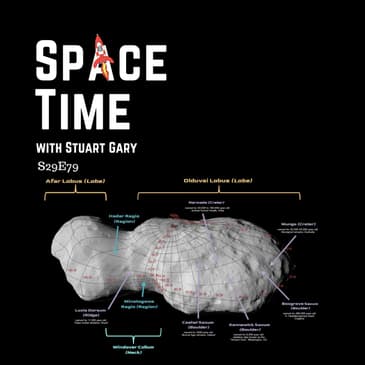
SpaceTime Series 29 Episode 79 How Neutron Stars make heavy elements Physicists have achieved a significant breakthrough in understanding how Neutron Stars forge heavy elements. Aleutian subduction zone older than thought A new study has found that the subduction zone between the Pacific and North American tectonic plates are older than previously thought. The wobbling peanut asteroid Astronomers studying the inner main belt asteroid Donaldjohanson have found that its rotation wobbles. July Skywatch Planet Earth at its greatest distance from the Sun, the constellations Regulus and Leo, and one of the biggest known stars in the universe Antares are among the highlights of July’s night skies on Skywatch. Our Guests This Week: Uk Space Agency Programme Manager Rosemary Young Principle Investigator MIXS Instrument Emma Bunce Leicester University Planetary Geoscientist David Rothery The open University And our regular guests: Alex Zaharov-Reutt from techadvice.life And Senior science writer and Sky and Telescope magazine contributor Jonathan Nally 🌏 If you’d like to support the podcast and gain access to bonus content by becoming a SpaceTime crew member, you can do just that through The Big Bang editions on Patreon, Spotify and Apple Podcasts. Details on the Support page on our website https://www.bitesz.com/show/spacetime/support/ For more SpaceTime and show links: https://linktr.ee/biteszHQ If you love this podcast, please get someone else to listen to. Thank you…
This is Space Time Series twenty nine, episode seventy nine, for broadcast on the third of July twenty twenty six. Coming up on Space Time, how neutron stars make heavy elements, the illusions subduction zone looks like it's older than we thought, and the wobbling peanut asteroid. All that and more coming up on space Time. Welcome to Space Time with Stewart. Gary businesses have achieved a significant breakthrough in understanding how neutron stars forge heavy elements. The findings reported in the Astrophysical Journal show that a perceived roadblock preventing the formation of high mass elements is far weaker than previously thought. Stars shine by fusing a hydrogen into heal him in their core through a process called nuclear synthesis. When they run out of core hydrogen, they begin fusing helium into oxygen and carbon. Now, for low mass stars like our Sun, that's pretty well where the process ends, and the stellar remains then turn into a stellar corpse called a white dwarf, surrounded by an ever expanding planetary nebula. But for higher mass stars, this nuclear synthesis can continue producing increasingly heavier and heavier elements until ultimately iron is produced in the stellar core. Now, no matter how big a star is how much mass it has, no star is large enough to fuse iron into heavier elements, and so the process ends and gravity takes over, crashing the entire mass of the star down into its core, which then rebounds, exploding outwards in what's called a core collapse supernova. This blast produces many of the elements heavier than iron on the periodic table, and it leaves behind a stellar core called a neutron star. These are the densest objects in the universe other than bl holes. In fact, just a t spurt of neutron star material would weigh billions of tons, so an object with more than eight times the mass of the Sun can be crammed down into a ball just twelve or so kilometers wide. But the story doesn't end there. The heaviest elements in the universe are generated with two neutron stars in a binary system merge in what's called a killer Nerver explosion. This violent event triggers a rapid neutron capture process, which creates elements like gold, platinum, silver, uranium, thorium, and idene. But it doesn't have to be two neutron stars. In some binary systems, neutron stars pulled material off conventional stars, creating extreme temperatures and pressures which trigger powerful bursts of X rays. Recreating these sorts of processes in the lab would not explain many unanswered questions about the universe and how it works, The studies lead author just S. Prett Radoa from Mississippi State University says, by identifying how stellar explosions build heavier elements, scientists can gain a picture of how the elements that formed planets and support life are distributed through the cosmos. Redowa and colleagues wanted to know whether nature had a built in roadblock that stopped heavier elements from forming during X ray bursts on neutron star surfaces, but the authors showed that this roadblock is much weaker than expected, meaning the processes that build heavier elements can continue. Scientists long suspected that the processes forming heavier elements in these bursts could stall at the element copper fifty nine, a short lived isotope that decays in less than two minutes. Redowa says that brief window has made it difficult for its searchers to study the reaction in laboratory, and that's supposed a major challenge for direct measurements. In this new study, Radawa and colleagues produced the beam of copper fifty nine, accelerated it, and then directed it onto a frozen hydrogen target before it decayed. The experiment at Canada's National Laboratory for Nuclear Particle Physics was the first direct laboratory measurements for this key reaction, and it helps solidify I underst standing of how the universe works. This is space time still to come, the Illusions subduction zone found to be much older than previously thought, and the wobbling peanut asteroid done Johansson. All that and more still to come on space time. A new study has found that the subduction zone between the Pacific and North American tectonic plates is far older than previously thought. The findings reported in the General Nature Communications. Based on rock samples collected from key parts of the Allusion Arc island chain. The authors determine the age of the rocks using two independent dating methods uranium lead dating from zircon crystals and agon argon dating of volcanic rocks and minerals. They found the oldest traces of subduction are at least fifty six million years old, showing that the process began much earlier than many previous models had suggested. This earlier age is important because it places the birth of the Allusion subduction zone at the start of a major chan of tectonic events and a reorganization of plate motions right across the Pacific. During this interval, several seduction zones and volcanic arcs around the Pacific were formed, a spreading center, mid Ocean Ridge was subducted, and a large igneous province collided with the North American margin. The Illusion arc therefore appears to represent one piece of a much larger tectonic puzzle. This is space time still to come. The wabbling Peanut asteroid and planet Earth at its greatest distance from the Sun. The constellations Regulars and Leo, and one of the biggest known stars in the universe, Antaris, are among the harlots of July and night skies on SkyWatch. Okay, let's take a break from our show for a word from our sponsoring Cogni. If you're anything like me, you're probably concerned about your privacy online, and for good reason. Did you know there are hundreds of data. Brokers out there quietly collecting, buying, and selling your personal information. Now I'm talking about your phone number, your home address, your browsing habits, even your location history. And that's where Incogniti comes in. In cognis a service that acts on your behalf requesting the removal of your personal data from these shady data brokers. And they don't just send a one off email. They follow up, track responses and ensure that your data actually does get deleted. Think of it as having a digital privacy agency constantly working for you behind the scenes. And the best part, it's all incredibly easy. You just sign up, give them the go ahead, and Incognitate tech care of all the rest, and within just a few weeks you'll start seeing the results. There'll be fewer spam calls, less targeted advertising, and a genuine sense of relief knowing that your private data is no longer being traded like a commodity. Now as a spacetime listener, we're offering you a special discount. Dear, Just go to incognit dot com slash stuard Gary. That's Incogniti dot com slash steward Gary and if you're not completely satisfied, no worries. Incogniti offers a thirty day money back guarantee so you can try it out risk free. You know, protecting your privacy really shouldn't be optional in this digital age, so letting Cogni help you by keeping your personal information where it belongs with you. That's in cogniti dot com. Slash Steward Gary to access this exclusive discount offer and learn more. Stay safe, Stay Private within Cogni. Astronomers studying the Inner meant astroid Donald Johansson have found that its rotation wobbles rather than rolling through space in a steady pattern, Donald Johansen turns on two separate axes, rotating end over end once every ten and a half earth days, well wappling around its horizontal access every twenty six and a half earth days the steadies. Lead author Smirn Marchi from the Southwest Research Institute says it's just one of the many surprising things learned by NASA's Lucy spacecraft as it flew by Donald jo Hansen back on April the twentieth, twenty twenty five. Marchie, whose deputy principal investigator on the Lucy mission says Lucy's images confirmed the asteroids elongated shape, which was initially suggested through Earth based telescope observations. The Lucy flyby revealed that this small kilometicized asteroid really does resemble a peanut, with a two lobe structure connected by a narrower neck. Lucy also detected rich iron clay minerals formed long ago the presence of liquid water now these fightings could indicate the asteroid form from fragments of a larger carbon and water rich asteroid, which would have broken apart some one hundred and fifty five million years ago following a collision with another object in the main asteroid built a region between Mars and Jupiter. Lucy's KATA with Don Jo Hansen was considered a test run for its primary mission to explore the Trojan asteroids to swarms of ancient objet that lead and trailed Jupiter as the Jovian Giant orbits around the Sun. Astronomers think these two populations of space rocks have been preserved since they formed in the early history of our Solar system. Marchy says, once we start learning more about the Trojans, a completely different population of space rocks are with very different histories sciences understanding of our Solar System's formation is likely to be changed forever by the way the asteroid Donald Johnson well. It's named after the palaeontologist Donald Johansson, who discovered the famous Lucy fossil, an earlier Australopithecus hominid found in Ethiopia back in nineteen seventy four. Lucy was one of the oldest human ancestors ever found and was the inspiration for the Lucy Mission's name. This space time. And time that had turn our eyes to the skies and check out the celestious fere for July on SkyWatch. July is the seventh month of the year in both the Julian Angagorian calendars, and he's named after the Roman emperor Julius Caesar, who was born during the month. Before being called July, the month was called Quintillus, which is Latin for fifth. The addition of the months January and February brought an end to that. On average, July is the coldest month in the year in the Southern Hemisphere, which is experiencing winter, and also marks the time when Earth is at a filion its furthest orbital position from the Sun. Of course, temperatures are more accurately. Seasons on Earth aren't dictated by the distance from the Sun, but rather the length of a day and hence the amount of sunlight a given part of the Earth receives, which is governed by the tilt of Earth's axis. Consequently, that's why July is on average the warmest month in the Northern Hemisphere, which is currently experiencing summer. Billion will happen at three thirty in the morning of July the seventh Australian Eastern Standard time. That's one thirty in the afternoon of July the sixth the US Eastern daylight time, and seventeen thirty in the afternoon Greenwich meantime. During this years a philion Earth will be one hundred and fifty two million, eighty seven thousand, seven hundred and seventy five kilometers away from the Sun. That's about five million kilometers further away than during perihelium back in January. Over cosmic time, these dates change. That's due to variations in Earth's orbits, such as eccentricity, as well as axial children procession, which all follow regular cyclic patterns known as Melankovitch cycles. Eccentricity involves changes in how elliptical Earth's orbit is around the Sun. None of the planets actually orbit the Sun in perfect circles, although then Aue and Neptune are the closest. Instead, they all have elongated orbits which vary over time. As well as that Earth spins on an axis which is currently tilted at twenty three point four degrees compared to the ecliptic Earth's orbital plane around the Sun. But this angle of tourt also changes over time, influenced by, among other things, the distribution of the Earth's mass, and just like a spinning top, the rotational axis of the Earth also changes its orientation through a process called precession, changing its position in relation to fixed background stars over a twenty six thousand year cycle. Now, all these effects impact the amount of solar radiation reaching the Earth and what time it reaches the Earth, and consequently the planet's seasonal and climatic patterns. Right now, the Southern Cross is at its highest point in the southern sky and is pointing directly towards the southern celestial pole. The Southern Cross falls within the constellation Centaurus. The centaur the half human half horse of Greek mythology, and the creature is holding a bow loaded with an arrow. The centaur's front legs are marked by the two pointer stars are from Beterson to Trus at four point three light years. Alpha Centauri is the second of the two pointer stars from the Southern Cross, and is also the nearest star system to the Sun. The centaur's back arches over the Southern Cross, and just above this is Amigasentaury, a spectacular globular cluster visible with the unaided eye from dark locations. Globular clusters are tightly packspees containing thousands to millions of stars. They're thought to have all originally been born at the same time from the same elecular gas and dust cloud, or the cause of small galaxies which have been consumed by bigger galaxies through galactic cannibalism. Amiga Centauri is about sixteen thousand light years away. A light year is about ten trillion kilometers. The distance of foton can travel in a year at three hundred thousand kilometres per second, the speed of light in a vacuum, and the ultimate speed limit of the universe. Amigasentaury is one of the largest and brightest of the one hundred fifty or so globular clusters known to orbit around our Milky Way galaxy. Centaurus was one of the forty eight constellations listed by the second century Astronomatolemy, and it remains one of the eighty eight modern day constellations. Turning to the right or. West and you'll see the constellation Leo the Lion, just above the western horizon. Its brightest star is Regulus, or the Little King, located about seventy nine light years away. Regulus, designated Alpha Leonnes, is actually a five star system organized into two pairs. Regulus A is a spectroscopic binary comprising a special type B blue white main sequence star some four times the mass and two hundred and eighty eight times the luminosity of the Sun, and a faint companion star thought to be a white dwarf the stellar corpse of a sun like star. Spectroscopic binaries are stars that can be resolved by optical telescopes into two separate objects, and can only be set breaded by observing their individual spectroscopic Doppler shifts as they orbit each other. Astronomers describe stars in terms of spectral types, a classification system based on temperature and characteristics. The hottest, most massive, and most luminous stars are spectual type O blue stars. They are followed by spectual type B blue white stars, then spectual type A white stars, spiritual type A F whitish yellow stars, specual type G yellow stars. That's where our Sun fits in spectual type K orange stars, and the coolest and least massive known stars are special type M red dwarf stars. Each specual classification is also subdivided using a numeric digit to represent temperature, with zero being the hottest and nine the coolest, and a Roman numeral to represent luminosity. So put all that together, and our Sun is a spectual type G two V or G two five yellow dwarf star. Also included in the stellar classification system are spectrotypes LT and Y, which are assigned to failed stars known as brown dwarves, some of which were actually born as special type M red dwarf stars but became brown dwarfs after losing some of their mass. Brown dwarfs fit intel category between the largest planets, which can be about thirteen times the mass of Jupiter and the smallest special type m red dwarf stars, which can be seventy five to eighty times the mass of Jupiter or zero point zero eight solar masses. Located further away a Regulus BCND, which it did mean sequence stars. At the opposite end of the constellation from Regulus is the star Beta Leernes or Dinnibola, the Horse's tail. It's also a luminous blue white star, about half as bright as regulars, and the third brightest star in the constellation. Leo Beta Leernes has about one point eight times the Sun's mass and about fifteen times the Son's luminosity. It's suspected of being a dwarf Cepiot or Daughter Scootie variable star, meaning its luminosity very slightly over period of several hours due to pulsations on its surface. Algebra or Gamma Lions is a binary system with a visible third component. The two primary stars are located about one hundred and twenty six light years away and can be resolved in small backyard telescopes. Both are yellow giants, orbiting each other every six hundred earth days. The unrelated tertiary star named forty Lines is a yellow ting star that can be seen through binoculars. The star traditional name Algebra means forehead. Doughtnes or Zosma is a blue white star fifty eight light years from Earth. Epsilon the Earths is a yellow giants some two hundred and fifty one light years from Earth, and Zetalynes is an optical triple star. The brightest component is a white giant about two hundred and sixty light years from Earth, while the second brighter star, thirty nine Lines, is widely spaced and located to the south of the primary. The third and faintest star system thirty five Lionuses to the north. Lotal Litis, is a binary star system visible in medium sized backyard telescopes. Located some seventy nine light years away. Lotal Leonis appears to be a yellow tin star with two components orbiting each other every one hundred and eighty three earth years. Finally, in leo Let's look at Taoleonus, visible as a double star through binoculars, It includes a yellow giant located some six hundred and twenty one light years from Earth, and binary secondary star fifty four Lioners, which is actually a pair of blue white stars. The visible in small telescopes and located some two hundred and eighty nine light years away. The constellation Leo also contains many galaxies, including the spiral galaxy Messia sixty six, as well as Messia sixty five and NGC thirty six twenty eight, which are known as the Leo triplet. Located some thirty seven million light years away. The Leo triplet is a somewhat distorted shape due to gravity potentionial interactions between Messia sixty six and the other two galaxies, which are cannibalizing stars from Messia sixty six. Eventually, the outermost stars may will form a dwarf galaxy orbiting M sixty six. Both M sixty five and M sixty six are visible in large binoculars or small backyard telescopes, but they concentrated nuclei and elongation are only visible in larger instruments. Other bright, well known deep sky galaxies in Leo include Messier ninety five, Messier ninety six, and Messia one hundred and five. Messier ninety five and Messier ninety six are both spiral galaxies, each about twenty million light years from Earth. Both look like fuzzy objects in small telescopes, but display their spectacular structures in larger instruments. M ninety five is a barred spiral. Another bard spiral, NGC twenty nine oh three is thought to be similar in size and structured to our own Milky Way galaxy. It was discovered by William Herschel in seventeen eighty four. Close to the M ninety five M ninety six pair is the elliptical galaxy M one oh five, which is also about twenty million light years away. The constellation also contains the Leo Ring, a cloud of hydrogen and helium gas orbiting two of the galaxies in the constellation. A gravitationally lensed object known as the cosmic horseshoe is also found in Leo. Above Leo, you'll find the constellation Virgo, the Greek and Roman goddess of wheat and agriculture. Virgo's brightest star, Spiker, is visible above the western horizon. It's located some two hundred and fifty light years away. Spiker is Latin for era of wheat, which Virgo is holding in a hand. Spiker, or Alpha vir Genus, is the sixteenth brightest star in the night sky and is both a spectroscopic binary and a rotating epsiloidal variable, a close binary system who stars are not eclipsing but caused a parent fluctuations in brightness because of changes in the amount of light emitting area visible to the observer. Spike is Two main stars orbit each other once every four Earth days and are so close their egg shape rather than spherical, and can only be separated by their spectra. The primary is the blue giant variable Beta Cepheid star. It undergoes small rapid variations in brightness. These are caused by pulsations of the star's surface, thought to be caused by the unusual properties of iron at temperatures of two hundred thousand degrees in the stellar interior. It has about ten times the Sun's mass and about seven times its diameter. The secondary star and spiker, is smaller than the primary, but it's still some seven times more massive than the Sun and has three point six times the Sun's diameter. Turning to the north now and the constellation boites the herdsman or plowmen, they'll see the bright orange red star are Taurus or Alpha Boeti, just above the northern horizon. It's a red giant located just thirty six light years away, a bloated aging star some seven point one billion years old, nearing the end of its life. Although not much more massive than the Sun, it's now expanded out to some twenty five times the Sun's diameter and will soon puff off its outer gases envelope as a planetary nebula, revealing its white hot stellar core, a white dwarf which will then slowly cool over the eons of time. Another bright, reddish looking star, this time in the east, is the red super giant and Taris, meaning the rival of Mars because of its appearance and location in the sky, which appears to be opposite of Mars in the sky, and Taris is one of the biggest known stars in the universe. It's enormous eighteen times the Sun's mass, ten thousand times its luminosity, and eight hundred and eighty three times the Sun's radius. As we mentioned in last month's SkyWatch, were placed at the center of our solar system, its surface would extend out close to the orbit of Jupiter. Despite being some five hundred and fifty light years away, and Tari's is still the fifteenth brightest star in the night sky. Unlike the Sun or Arcturus. The death of Antaris will be far more spectacular, and Tari's is destined to explode as a core collapse or type two supernova. When it does so sometime in the next few hundred thousand years, it'll appear as bright in the Earth's sky as the full moon and be quite visible even in daytime. And Taris has a companion star, and Tari's b a special type blue white main sequence star more than seven times the Sun's mass and five times its diameter. And Tari's is the heart of the scorpion in the constellation Scorpius. Below Scorpius is the constellation Sagittarius, the archer, which points the way to the center of the Milky Way Galaxy. Sagittarius is commonly represented as a wing centaur. The center of the Milky Way Galaxy and its super massive black hole, Sergetarius A star lie at the westernmost part of Sagittarius. Sittarius a star is about twenty seven thousand lie years away and has some four point three million times the mass of our Sun. It was in July back in twenty sixteen that the Solar system's Barry center moved outside the Sun, where it will remain until twenty twenty seven. A barry center is the gravitational center of mass of a celestial system. For example, in our Earth Moon system, the Earth and Moon actually orbit each other around a common center of gravity, a Barry center. Because the Earth is so much more massive than the Moon, the Barry center is always inside the Earth's radius. If it were outside the Earth's radius, the Earth and Moon would instead have been classified as a binary planetary system, like Pluto and Sharon. The Solar systems center of gravity or Barry center, is usually located inside the Sun's radius. After all, the Sun contains over ninety nine percent of all Solar System's mass, but actually the mass of the Solar System is orbiting around the Solar System's Barri center, which means the Sun also has a very slight, spiraling twelve year orbit around the Barri center. And every now and then, when. The planet's orbital positions are just right, especially when Jupiter and Satura nearest each other, they combine gravitational interactions move the Solar System's Barri center ever so slightly outside the Sun's radius. And because Jupiter and Satin reached this salime at every eleven years. Some scientists are speculated whether this could trigger the Sun's eleven year solar cycle. And before you ask, the Barri center isn't named after some Guyana Bay Safari suit called Bari, but rather it's the ancient Greek word for heavy or center of mass. We also have two meteor showers, both of which peak in late July. There's the Southern Delta Acorids, which are visible from mid July to mid August each year, with peak activity on Lie the twenty eighth and twenty ninth. The shower originated either from the breakup of what are now the Marsden and crack sungrazing comets, or from the parent comet P. Ninety six Malcoltz. The Delta Acrids get their name because the radiant appease the line and the constellation Aquarius he one of the constellation's brighter stars, Delta aquery. There are two branches to the Delta Acrods meteor shower, the Southern and Northern. The Southern Delta Acrids are considered a strong shower, with an average between fifteen and twenty meteors an hour between midnight and dawn. Listeners in the southern hemisphere usually get the better show because the radiant is higher in the southern sky. Since the radiant is above the southern horizon. For northern hemisphere listeners, meteors will be seen to fan out in all directions east, north, and west, with few meteors heading southwards unless they're really short near the radiant. The northern Dota Acrids. Are the weaker shower, peaking later in mid August, with an average peak great of about ten meteors per hour. Meanwhile, the nearby slow and bright Alpha cap Recorded's meteor shower will take place from as early as July the fifteenth and continue until around August tenth. The medial shower has infrequent but relatively bright meteors and even some fireballs. It's generated as the Earth passes through a debris trail left by the comet one sixty nine p Neat, which was originally identified as the asteroid two thousand and two EX twelve. However, it was shown to be weekly active during perihelion and was then reclassified as a comet. The meteor shower was created about three thousand, five hundred to five thousand years ago, when about half of the parent body disintegrated and fell into dust. The cloud eventually evolved into Earth's orbit, causing a shower with peak rates of about five metials an hour and some outbursts of bright flaring comets radiating out from the constellation Capricorn towards the south. The bulk of the comet's debris won't be an Earth's path until the twenty fourth century, by which time the Alpha Capricornas are expected to become a major annual meteor storm, stronger than any current annual shower. And joining us now for the rest of our tour of the July night skies. You're seeing your science writer and the Sky and Telescope magazine contributor Jonathan Nally. Today, Stuart. Yeah, well, it's July and amateur astronomers actually love this time and you're for stargazing because those who live in the northern half of the planet have the advantage of it being summer at the moment, so the weather is usually pretty nice and warm and quite pleasant, although it does mean, of course, the summertime means you have fewer hours of darkness because of the daytime is longer, but you know, your nighttime weather is generally a bit nicer for going out in stargazing. That's pretty good. And those of us who live in the Southern hemisphere we love July as well, even though it's colder, but the nights are longer, and particularly down here, we have an advantage of the fact that the center of our milky way o looky ways our galaxy for the inside, and when we look in a particular direction, we're looking into the center, the core of our milky way, and that means there's lots of things to see there. And that region is the region in and around the Sagittarius constanational Sagittarius, and also the neighbor in constellational Scorpius. Scorpius is not directly in line of the center and de gality, but there's still a lot of great stuff to see there. This area in the stars full of amazing astronomical objects, all the usual things that amateur astronomers like to see. A star clusters of both kinds. You've got globular stark clusters and open star clusters, and there are nebulae, both bright ones and dark ones. There are lots and lots of interesting star patterns nebularly, for instance, Sagittarius has the famous lagoon Nebula, which is really really pretty, and there's the equally famous Trippet Nebula. People might have seen pictures of the Triffet Nebula. It's a reasonably hard under spot. The really hard under spot in the night sky is in a rye which can't be seen at the moment, and it's called the horsehead nebula. And when you look at pictures of it, you think it's really fabulous and looks really big and everything, but it's actually tiny in the sky and it's very very hard to spot. But the Trifet Nebula lagoon Nebula, up and sanitary, is really really good down in the southern part of the sky at list for us. Near in the southern hemisphere, we've got the Southern Cross. It's up nice and high standing almost upright with a pair of bright stars nearby. We talk about these a lot on the paragram. They're called the pointers because if you draw a line between the pointers and get the line going, it heads basically straight towards the Southern Cross, so it's an easy way to find the Southern Cross. One of those point of stars is the star system called Alpha cent Toy was a closer system Drowser, which has two bright stars that are quite like our Sun, and they're fairly close together, and there's a third, very very dim start that's further away. That one is actually the closest start of our solar system. It's very hard to see that one as you know exactly what you're looking for and you've got a big telescope. So to the unaided eye at Alpha sent Tauri, the opposite dry system looks like just a single star. But even a small telescope, you can't just give it a small refractor, a small telescope, cheap one. Let'll split those two main stars you see in the separate entities. So that's that's pretty neat. You look over, oh that's one star, and when you have a first take a closer look, it's two stars. And there are plenty of examples of those up in the night sky. So over to the right of the Southern Cross, also within Milky Way is a fantastic area to see. Right next to the Cross. For example, there's a large dark patch in the Milky Way. Now this is pretty hard to see under city sky because you've got not much hope of seeing the Milky Way at all up under shitty stars. But if you do give an opportunity to get out somewhere dark away from light, and you can if you literally eyes get dark adapted and you can see the looky way. We'll have a look just to the side of the Selling Cross and you'll see this dark patch and it's called a coal sack for obvious reasons. But it's black, and it's just a big cloud of interstellar gas and dust that is out there in our galaxy. It's interesting that you go back to you know, not too long ago really in terms of fifty you know, the one hundred and fifty years or so, or maybe a bit less. People really didn't know whether that was a big hole in our galaxy and where we're looking straight through out to the other side, or could it be a big dark cloud of something. And so it turns out to be a big dark cloud because even to the naked day you can see a few stars in there. So when you get tell us scouts under it, you consider are stars in front of it, them behind it and everything. So it's just a big cloud of dark gas and dust. Now in the northern half of the sky. For this time of year, at least for where I am. Where I am when I'm looking for the north, it's pretty bare. But there are a couple of bright stars. We've got one called Spiker, which is the brighter star in the constellation of the Ergo. And there's another one called ar Kurus, which is the bright star in the constellation the Burgons, And that's not a constellation most people are familiar with. It's spelled bat e s and it means the herdsman or the plowman tourists. Is actually the fourth brightest star in the night sky, and Spiker is the sixteenth brighter star. So they're pretty brighter the stars and spanning all across the all that half of the sky as seen from down here in the south. We've got the zodiac regions, a dar called Veg and so Virgo is one of those, a guy called constellation. It's a very large star pap in Virgo, and it seems quite bare to the naked eye, but to amateur astronomers they love it because once you get a telescope in there and start looking around that region, there are stacks of stacks of stacks are galaxies, including that big one, and maybe seven, and that's the one that they as a big black hole in the middle of it. And they've made that famous picture a few years ago of the black hole. First the direct observation of the black hole. I think it was called the event horizon telescope has a combination of telescopes. Yeah, and they made a people people will say, we'll happen to see the black hole if no life is getting out of it, we're really you're seeing what's around the black hole and there's a gap in the middle. So that was that was the black hole, So that was pretty amazing. There's another really fantastic galaxy in Virgo too. Now this one also is really small. You see pictures of it, you think, well, it's of galaxy, it's got to be big, but when you go hunting for the telescope, it's really small. It's called the Sombrero galaxy because it's this almost side on spiral galaxy with. A dust plan, beautiful looking galaxy. Oh, it's a wonderful galaxy. It's really superb and it looks like a sombrea looks like I have slightly tilted towards us. You can see the planes and areas of yeah, Earth, it is stunning. It's a fantastic thing. But as I say, the pictures taken with big telescopes look really impressive, but through a backyard telescope it's actually quite small, very small in fact, and you need to take a good long look to get in in detail at all, because these things are small and be they're dim, and our eyes are not good at night time compared the daytimes, which is why things look so much better in pictures when you're taking pictures of the night start, because cameras can do a lot better than our eyes do. Anyhow, that's what's happening all the constellations of things of the planets now. So there's quite a bit going on about the northwestern horizon at the moment it's July. Things. They've got Mercury, Jupiter, and Venus in that order going upwards from the horizon, and they can all be seen quite easily. Mercury is very low, have to say, and looking at it looks a bit like a small intense dot of light. Jupiter and Venus above it are much bigger and much brighter. Mercury, though, is soon to disappear by about the eighth or ninth of the month, it will have dropped below the horizon. It's getting lower each night, and so it's going to fade into the sunset below and then be below the horizon. Jupiter too is doing the same thing. It's getting lower and lower down on horizon as each night goes past this month, and by about the middle of the month sixteenth seventeenth or so, it'll be down below the horizon. Venus, on the other hand, is climbing higher and higher each day during July, so you have plenty of opportunities to see it. You can't miss it. Big and bright, the biggest, the brightest thing around in that part of the sky, apart from when the moon is nearby. So if you want to have a look at Venus, get out and out this month and do it. It's a really good time because it's going to be up nice at high miround for several hours after sunset, so that's a pretty well time to see it. Get the two bright planet that we can normally see a Saturn and Mars. These are a bit later in the night. Saturn will pop its head over the eastern horizon just after midnight at the beginning of the month, but earlier by the end of July about ten thirty pm, so it's fitting higher and higher. That means as the days are passed, and about four hours behind Saturn, only probably an hour and a half two hours before dawn. I suppose we've got Mars. I will follow up over the east of horizon as well, more to the northeast. Saturn's pretty much directly east. Mars be a bit more to the northeast, and it's much smaller in dinner than Saturn. Chattern looks big and bright and maybe with a slightly yellowish orangeish sort of kinge or yellowish kinge. Mars is smaller and as a definite orange red sort of color. That's one of the ways you can often tell Mars, because there are that many bright stars up there that are that kind of color. So Mars is pretty easy the spot. And if you are up early to take a look at Mars at the beginning of the month, like in the first few days of the month, you're in for an added treat in fact, because only about five degrees away will be the same as star cluster known as the Plea. He's on the seven Sisters. This is a fantastic little clutch of stars. Most people can see six, maybe maybe seven, but easily six of these little stars. There are hundreds and hundreds and hundreds of stars in this plaster. Two d into the Anid guy. So yeah, Mars will be about five degrees away. Five degrees is about ten wedths of the moons about half a degree wide, so that's pretty close. You certainly should get a good view of that. But as I say, you've got to be up pretty early, a couple of hours before dawn, or if you're a night out you know, anyone like that Stewart who stays up all night and yeah, yeah, yeah, Well, well, we want to report next next month, we want to report on how Mars looked. That the plead is right. Next Look, I'm. Still getting over the last month's spectacular conjunction between Jupiter and Venus. I was going to ask you about that. How did you go? That was beautiful, absolutely stunning. And speaking of the play it Is, which you were a moment ago, the latest speculation is that super and Ova in the play it Is may have been what caused the birth of owen Son, at least that's the latest speculation. By compressing gas and getting a chain reaction going to. Guest very young stars and the play is I wish I. Was a young star against but now I'm collecting. And that's Stuart is. That senior science writer and skyte tell Us Get Magazine contributed Jonathan Elli, and this is Spacetime. And that's the show for now. Space Time is available every Monday, Wednesday and Friday through at bites dot com, SoundCloud, YouTube, your favorite podcast download provider, and from space Time with Stuart Gary dot com. Space Time is also broadcast through the National Science Foundation on Science Own Radio and on both iHeartRadio and tune In Radio. And you can help to support our show by visiting the space Time Store for a range of promotional merchandising goodies, or by becoming a space Time Patron, which gives you access to triple episode commercial free versions of the show, as well as lots of burnus audio content which doesn't go to weir, access to our exclusive Facebook group, and other rewards. Just go to space Time with Stewart Gary dot com for full details. You've been listening to space Time with Stuart Gary. This has been another quality podcast production from bytes dot com