
🌏 Get Our Exclusive NordVPN deal here ➼ www.bitesz.com/nordvpn . The discounts and bonuses are incredible! And it’s risk-free with Nord’s 30-day money-back guarantee! ✌ If you’d like to support the podcast and gain access to bonus content by becoming a SpaceTime crew member, you can do just that through The Big Bang editions on Patreon, Spotify and Apple Podcasts. Details on the Support page on our website https://www.bitesz.com/show/spacetime/support/
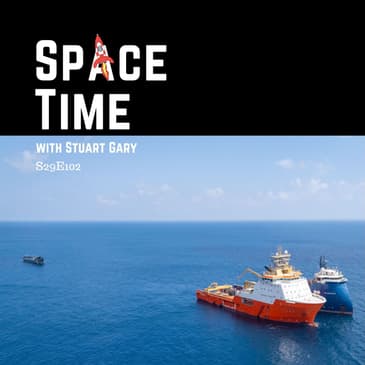
This is Space Time, Series 29, Episode 102, for broadcast on the 26th of August, 2026. Coming up on Space Time. SpaceX's Starship arrives at Christmas Island. A new study looking at how old our universe really is. And despite more tests, Albert Einstein's general theory of relativity still stands the test of time. All that and more coming up on Space Time. Welcome to Space Time with Stuart Gary. After some 24 days at sea, a SpaceX recovery team has successfully towed Starship 40 into sheltered waters on the leeward side of the remote Australian Indian Ocean territory of Christmas Island. The unplanned operation had been hastily put together after the spacecraft unexpectedly held together following its splashdown off the western Australian coast. Starship 40 had been launched into orbit on Test Flight 13 from SpaceX's Boa Chica Starbase on the Texas Gulf Coast. The hour-long test flight saw the world's largest and most powerful rocket, a 122-meter-tall Starship Super Heavy, successfully blasted into space and achieve all its major test goals. The flight used the latest Block III incarnation of the rocket, together with a new ignition sequence for its 33 new more powerful Raptor III version engines. The successful stage separation saw the launch vehicle's first stage, known as the Super Heavy, carry out a textbook boost-back burn, returning to Earth and splashing down off the Texas coast. However, only 10 of the planned 13 Raptors lit up for the landing burn, with a further two failing shortly afterwards. Now that meant Super Heavy descended too quickly, and consequently hit the water much too hard. Meanwhile, the Starship Upper Stage, known simply as the ship, continued to climb to its planned suborbital altitude, where it successfully deployed 20 Starlink Version 3 broadband test satellites and also successfully undertook a Raptor engine restart. It then re-entered the atmosphere, performing a perfect descent and water landing, gently splashing down and toppling over into the ocean. However, surprisingly, rather than sinking, it remained buoyant, bobbing up and down on the waves. Now, that's never happened before. but it gave SpaceX an opportunity to recover the vehicle for more detailed examination. See, usually SpaceX engineers only end up with data from onboard instruments and cameras, so having the actual spacecraft to look at was a huge bonus. SpaceX boss Elon Musk quickly organized a recovery operation with a SpaceX splashdown monitoring ship, Go Astralis, remaining stationed near ship 40. The splashdown occurred roughly 1,300 kilometres off the western Australian coast, and so required specialised ocean-going tugs for the operation. Two tugboats, Norman Ranger and Skimmer Tide, were contracted and quickly set out from the Australian port of Dampier to undertake recovery efforts. Norman Ranger is a big anchor-handling tug. It's used to. Dealing with huge quarter-million and half-million tonne iron ore bulk carriers, so an empty 200-tonne spacecraft shouldn't be a problem. The problem is Starship wasn't fitted with any anchor points to attach a tow rope to, and that's where Schematide came in. It delivered a string of large Yokohama rubber buffer fenders which would be placed around the spacecraft, encircling it like a lasso and cushioning it from damage so it could be towed. These buffer fenders used compressed air to absorb impact energy during ship-to-ship or ship-to-dock operations, protecting vessels and port structures from damage. However, the ocean currents and winds proved to be a major challenge for maneuvering the spacecraft, which was sitting high in the water. That meant slow progress and an awfully long journey back to Port Ampere. Making matters worse, the fenders were damaging the spacecraft's heat shield tiles, which was one of the key items engineers wanted to examine. So it was eventually decided to change plans. Remove the fenders and attach a tow line to one of the spacecraft's Raptor vacuum engines. and there was still that ongoing fight against the prevailing winds and swell. Eventually, SpaceX decided to change course. Instead of heading east to the Australian mainland, they'd head north to Christmas Island instead, arriving there a few days ago. The heavy lift ship Forte has now arrived at Christmas Island to load and transport Starship. Forte is a semi-submersible, meaning it will flood its ballast tanks to submerge just enough to allow Starship to be positioned above its deck. It'll then empty its ballast tanks again and refloat, lifting the spacecraft out of the water for transport back to the United States. Needless to say, NASA's monitoring these events closely, with a version of Starship called the HLS to be one of the vehicles used to transport Artemis crew from the Orion spacecraft down to the lunar surface and back again once manned operations to the lunar south pole get underway. A test of those capabilities is slated for next year in low-Earth orbit using the Artemis III mission, which will attempt docking a manned Orion capsule with the Starship. And if that goes well, then a manned lunar landing is likely to happen in 2028. This is Space Time. Still to come, a new debate on how old the universe is, and Einstein's general theory of relativity passes yet another test. All that and more still to come on Space Time. Astronomers think they've come up with a new way to work out the age of the universe, finding it to be 13.6 billion years old. That's some 200 million years younger than previously thought. The findings reported in the journal Astronomy and Astrophysics are based on comparing estimates of the universe's age rather than its expansion rate as a new way to address the Hubble tension. This question of the Hubble tension, how quickly the universe is expanding and therefore how old it is, is one of the most debated topics in modern cosmology. Local measurements show a faster expansion rate than predictions calculated from the early universe. And that creates a statistical mismatch that standard physics simply can't explain. So what are these two methods? Well, the early universe cosmic microwave background radiation method uses telescopes to measure the cosmic microwave background radiation emitted when the first hydrogen atoms formed 280,000 years after the Big Bang, which has now cooled down to just 2.7 degrees above absolute zero. Running this data through standard cosmological models predicts an expansion rate, or Hubble constant, of around 67 to 68 kilometers per second per megaparsec. On the other hand, the Late Universe Distance Ladder method uses stars known as Cepheid variables, which all pulsate at given rates based on their size and hence luminosity, and Type Ia supernovae, which are all roughly the same mass and hence explode with the same level of luminosity, thereby allowing astronomers to use the inverse square law to determine cosmic distances. It's a bit like looking at a row of streetlights down a road. They're all the same brightness, but they look progressively dimmer and dimmer the further away they are, or in cosmic terms, how fast things are moving away from you. This shows a faster Hubble constant of around 73 to 74 kilometers per second per megaparsec. And no matter how much scientists have tried, they haven't been able to reconcile the difference between these two measurements. That's the Hubble tension. Using precise stellar data, the study's authors determined ages for carefully selected very old Milky Way stars and concluded the most likely age for the universe as a whole would be 13.6 billion years. Now that's much younger than assumptions under standard cosmological models. The age is inconsistent with a younger universe, implied by Cepheid variable and supernova-based expansion measurements. But it is compatible with the older age inferred by observations of the cosmic microwave background radiation, the leftover heat from the Big Bang. Cosmological models link the current rate of expansion of the universe directly to its age, with a higher value of the Hubble constant implying a younger universe, while a lower value corresponds to an older one. Of course, the universe can't be any younger than the oldest stars it contains. and the authors of this new study use that as their guidestone. So if the ages of the older stars in our galaxy can therefore be measured with a high degree of precision, a robust lower limit for the age of the universe can be established. The project was initiated by an unusual collaboration between two research fields that have traditionally been very separate, a cosmology group from the University of Bologna and a stellar archaeology group from the Leibniz Institute of Astrophysics in Potsdam. The work was based on an existing catalogue of stellar ages from a previous study in which precise ages were measured by combining multiple pieces of information on the brightness, position and distance of more than 200,000 stars in the Milky Way. A crucial element for this study was the use of the third data release from the Gaia mission, which provides exceptionally accurate parallaxes and spectra and thus improved stellar parameters for a large number of nearby stars. From this combined dataset, a carefully selected group of the oldest stars with the most reliable age estimates was compiled. The focus was on quality over quantity, using only stars whose ages could be determined robustly and by removing potential contaminants. And with the NEXTGUIDE data release on the horizon, stellar ages could become a fundamental anchor of cosmology. Now, although these results are not yet conclusive due to remaining uncertainties in stellar age estimates, they are providing an important independent constraint on the debate over the Hubble tension, and consequently, the age of the universe. This is Space Time. Still to come, yet another experiment showing Einstein's general theory of relativity stands the test of time. Later in the science report, a new study shows how dogs have learnt to understand human facial expressions. All that and more still to come on Space-Time. More than a hundred years after Albert Einstein published his iconic general theory of relativity, it remains science's best understanding of gravity in the universe on the cosmic scale. And it's consistently withstood the very best tests scientists can devise. A report in the journal Science looked at one of the most comprehensive tests of general relativity near a supermassive black hole ever undertaken. The study's lead author, Andrea Gentz, from the University of California, Los Angeles, admits, based on her data, Einstein is still right. However, she points out that general relativity still can't fully explain gravity inside a black hole, and at some point, science will need to move beyond Einstein's theories to a more comprehensive understanding of gravity that explains exactly what a black hole is. Einstein's 1915 general theory of relativity holds that what we perceive as the force of gravity arises from the curvature of space and time due to mass. Light from a star is bent by the mass of that star, as well as any other stars or objects as photons of light pass by. And it's not just light, even time changes due to mass and velocity. So Einstein's theory remains the best description science has of how gravity works. And these laws of physics, including gravity, should be valid everywhere in the universe. To test that, Jensen colleagues observed a star known as SO2 as it orbits Sagittarius A-star, the supermassive black hole at the center of our galaxy, the Milky Way. Located some 27,000 light-years away, Sagittarius A-star has some 4.3 million times the mass of our Sun, and it's the pivot point around which our entire galaxy revolves. The star SO2 takes some 16 years to complete each orbit around Sagittarius A star, travelling at speeds of over 26 million kilometres an hour during its closest approach to the black hole. So Goetz and colleagues watched as this star undertook its orbital voyage, and they analysed the spectra coming from the star as it made its closest approach to the black hole. Spectra is the rainbow of light produced by the star, and it displays a series of so-called spectral lines, which provide a signature of the chemicals that make up that star. As well as its composition, spectra also tell you how luminous a star is. The thicker the spectral lines, the hotter the star. It can even tell you how fast the star is moving towards or away from you thanks to a Doppler shift in its spectral lines. Objects moving away have their spectral lines shifted towards the red end of the spectrum, redshifted. While objects moving towards you have those lines shifted towards the blue end of the spectrum, blue shifted. And how far those lines are shifted tells you how fast that object's moving towards or away from you. Goetz and colleagues took measurements of SO2 roughly every four nights during crucial periods of the star's orbit over a 24-year period, using observations from the Keck Observatory at Topamanakeo as well as the Gemini and Subaru telescopes. Combined, this data allowed the authors to test general relativity to an unprecedented level. The authors were able to see a commingling of space and time near the supermassive black hole. Now, in Newton's version of gravity, space and time are separate. They do not commingle. But under Einstein, they get completely commingled near the black hole. Einstein had reported that in this region close to the black hole, photons have to do extra work. Their wavelength as they leave the star depends not only on how fast the star is moving, but also how much energy the photons expend to escape the black hole's powerful gravitational pull. Gett says while this tells us what happens on the universe side of the event horizon of a black hole, it doesn't explain what's going on between the event horizon and the singularity, the point of infinite density in zero volume. Black holes are deceptively simple and yet incredibly complex. A black hole is a region of space where the pull of gravity is so intense that nothing can escape, not even light. Music We don't have the physics to describe what a black hole is because it leads to a paradox, a breakdown in our understanding of how the universe works. We only have four fundamental forces to describe how the universe works. Gravity of those four is probably the one that we have the most intuition for. You throw something up, it comes back down. but it's actually the least explored. Einstein really recognized that gravitational fields are equivalent to talking about space and time not being separate entities. Einstein noticed that in certain situations, Newtonian laws of physics don't seem to hold. And that's why Einstein developed his theory of general relativity. We know that general relativity may not be a complete description of physics, and so in order to figure out where it's incomplete, you want to test it in regions that people haven't tested before. So people have tested general relativity on Earth, in the solar system, but never around a black hole that's four million times the mass of the Sun. The first question I was interested in was, is there a supermassive black hole at the center of our galaxy? If you had asked me would I still be doing this project, 20 odd years later when we first started, I would have just laughed at you. I grew up hearing the word no all the time. You're a girl, you can't do it. You're a girl, there's no way you can get into MIT. There's no way you can get into Caltech. I think I developed a passion for proving people wrong. We have been able to increase the evidence for supermassive black holes by a factor of 10 million. And we have done this by watching how stars move. My favorite star, its name is SO2, and it makes its journey every 16 years. We're at this point where it's closest to the black hole and is experiencing the strongest pull of gravity. So we have this first opportunity to get a direct measurement of how Einstein's theory of general relativity works near a supermassive black hole. What we've found this summer is that general relativity does actually describe the motion of the stars around the supermassive black hole. That's a transformational change in our understanding about not only the existence of supermassive black holes, but the physics and astrophysics associated with black holes. Andrea, to me, is a brilliant scientist. Her dedication and her persistence really has been at heart of this project in order to have the patience and the level of detail required to do this work. When I was young I wanted to be the first woman on the moon, but I think at the same time I also wanted to be a ballerina. I just became much more infatuated with the ideas rather than the physicality of moving myself. It's very poetic that we actually see the stars in motion doing this dance around the black hole. So what we want to do is we want to improve our ability to see a star like our sun at the center of the galaxy. Because I think that's when we'll have the full view of how this dance really works. That's Andrea Goetz and Tuan Du from the University of California, Los Angeles. And this is Space Time. And time now to take another brief look at some of the other stories making use in science this week with a science report. A new study has shown that carrying a little extra weight could be beneficial as you get older, but not if it's a bigger tummy. A report in the Journal of the American Geriatric Society claims the new findings are further pushing the disparity between body mass indexes and waist circumference. They say having a higher body mass index when you're older has been linked to a significantly lower risk of dying, whereas a bigger belly is linked to the opposite. The researchers looked at data from 7,000 adults aged 65 or older finding overweight men and men with obesity, that's a BMI of 30 to less than 40, had a 46 to 51 percent lower risk of mortality compared to those of normal weight. However, a higher waist circumference was linked to a 24% increased risk of mortality in men, with similar patterns seen in women. A new study claims that people who lack human connections tend to be more likely to use an artificial intelligent chatbot for companionship. A report in the journal Nature Human Behavior looked at 237 people's use of AI chatbots, specifically character AI, a widely used platform, and found people with fewer friends were more likely to end up using chatbots for companionship, which was in turn linked to worse self-reported well-being. The link between AI companionship and poor well-being was strongest among people who had more intense relationships with the AI and those who disclosed their most personal information during their chats. A new study has found that the Great Southern Ocean, as well as parts of the Pacific Ocean near the equator, may be the best places on Earth to fertilize if humans want to remove most of the carbon dioxide in the atmosphere while minimizing the impact on the environment. Fertilizing the ocean involves adding iron to stimulate photoplankton to grow, which in turn removes carbon dioxide from the atmosphere. The authors compared the most likely amount of carbon that could be removed by fertilizing different parts of the oceans around the world, and they also looked at the environmental impact fertilization would have. The findings, reported in the journal Nature, claim that the Southern Ocean offers the best balance between ecological disturbance and carbon dioxide removal from the atmosphere, followed by the equatorial Pacific. Well, if you have a four-legged friend with a waggly tail and a wet nose, you probably already know dogs can distinguish quite well between different facial expressions, including anger, sadness and fear. And now new research has finally worked out what's going on. The findings reported in the journal iScience are based on brain scans of 12 dogs showing that specific regions of their brains were active when they saw happy faces compared to neutral negative ones. Now, one of these brain regions is also associated with reward, which the authors think suggests that happy human faces may be emotionally significant to dogs. They also found differences in dogs' brain activity when they saw angry and fearful faces, small as sad versus fearful faces, but no difference between sad and angry expressions. The study shows that man's best friend has evolved the social skills necessary to understand and cooperate with people. The best way to know who's a good boy. Samsung's new passport-sized Galaxy Z Fold 8 has outsold its more conventionally proportioned Galaxy Z Fold 8 Ultra during its first weeks on the market with 51% of sales. With the details, we're joined by technology editor Alex Saharov-Royd from TechAdvice.life. It just went on sale and already in Australia, the passport size one with the widescreen version as opposed to the one that's square, that has narrowly outsold the square one. And that's because it's wider. Think of a wider iPhone mini style device that can then unfold into the 7.6 inch widescreen tablet. I went out and purchased the Z Fold, and it is fantastic, the Z Fold 8, not the Ultra, which is the one that's square. So it's been really, really cool. I mean, everyone marvels at it. The crease is effectively no longer there. I mean, you can still see it if you hold it to the lightness. a certain way, you can just feel it. But compared to foldable phones from a couple of years ago where you could really feel this dip in the center of the screen when you moved your finger across, effectively the crease is gone. And this is what Apple has been waiting for for the last eight years for screens to get into this state. Now, interestingly, Apple will launch its iPhone Fold or iPhone Ultra, whatever it's going to be called, in about three weeks' time. But the latest rumors say, because of the rampocalypse, because of the super high expensive prices for SSDs, that Apple will showcase it. They'll launch it in the U.S. first, but it won't come to the rest of the world until the first quarter or the second quarter of next year. And we've got Omdia, who's predicting that by 2028, shipments of these phones will double to 36 million units. So there's going to be a huge boom. I mean, already you see people with these folding phones, but there's going to be so many more of them. And gone are the days when the folding phones feel like two smartphones stuck together, this big, thick thing in your hand. The current smartphones, when they fold shut, the foldable phones, will feel like an ordinary smartphone. Phone. They feel like the thickness of a normal phone. And then they open up into this glorious landscape. And I'm just in love. I love this phone factor. It is stunningly good and cool. What about the trifold? Well, with the trifold phones, I was in Shenzhen in 2024, and I actually saw one of these phones in a Huawei store. That gives you the same aspect ratio as what you've got with the passport size phone, I take it? Well, yes and no, right? So you've got a phone that's 6.5 inches or thereabouts in size. And because there's three panels, when you unfold it, it sort of unfolds into a 10-inch tablet. And I guess it is, yes, it is more rectangular than it is square. But of course, it's a lot thicker. And Samsung actually had one of these at the EES earlier this year, 2026. And their phone, when it was unfolded, was quite thick. slim. Obviously, when you have three panels put together, it does feel thicker. And actually, Samsung stopped selling this phone because they launched it in South Korea first. And it's very expensive. You're talking $ 4, 000, $ 5, 000 Australian dollars to get one of these phones. Now, Samsung is apparently going to launch a second generation of this particular phone and hopefully will actually be much flatter. You'll still have the two creases, but they'll effectively be flat. And, you know, having that was extremely cool as well. You could go from a normal phone size into a tablet size in the single device. You could also, with the Huawei, you could actually have it as a two-panel display, so like a smaller tablet, and then unfold it into a three-panel display. How are phones being affected by the price of SSDs and memory? Well, the prices have had to go up. Apple had to raise the price of its MacBook Neo, its Mac range. It held the price of its current iPhone 17 range. But all the rumors say that Apple is going to be forced to increase the price of its smartphones later this year because even though Apple has fat margins, the price has gone up so much that this has caused the phones to come out with less memory. I mean, with the Google Pixel range, Pro and Pro XL, the entry-level model, which is 256 gigabytes, that only comes with 512 gig of RAM. You need to buy the 512 gig or the one terabyte model to go back to 16 gigabytes of RAM, which is what they had last year. So we're seeing phones that have less memory than they had last year because the prices are so expensive. Demand is expected to last until 2028, 2029, 2030. What's going to change that is that the on-device AI the capabilities of the chips that are in our phones, tablets, and computers, and also the models that can run locally, not just on the GPU, but on the CPU, this is going to mean that you have advanced AI capabilities equal to the best of today in your laptop, phone, or tablet as standard by the end of the decade. At the moment, I'm already running models on my computer that they're slow. It's a little bit like seeing a 28.8K or 36K dial-up modem as opposed to the gigabit broadband speeds that we all take for granted today. That's Alex Haravroyd from techadvice.life. And this is Space Time. And that's the show for now. Space Time is available every Monday, Wednesday and Friday through bytes.com. SoundCloud, YouTube, your favorite podcast download provider, and from spacetimewithstuartgarry.com. Space Time's also broadcast through the National Science Foundation on Science Zone Radio and on both iHeart Radio and TuneIn Radio. And you can help to support our show by visiting the Space Time store for a range of promotional merchandising goodies. or by becoming a Spacetime patron, which gives you access to triple-episode commercial-free versions of the show, as well as lots of bonus audio content which doesn't go to air, access to our exclusive Facebook group, and other rewards. Just go to spacetimewithstuartgary.com for full details. You've been listening to Spacetime with Stuart Gary. This has been another quality podcast production from Bytes.com.