
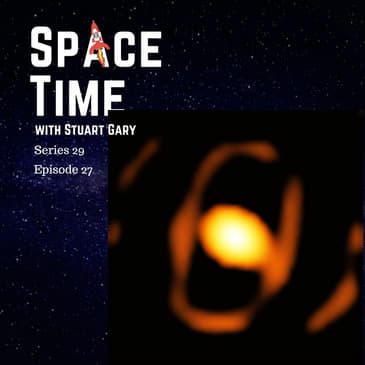
In this episode of SpaceTime, we explore the potential explosion of a massive star, NASA's innovative mission to study Earth's auroras, and the latest setbacks for the Artemis 2 lunar mission.
Supernova on the Horizon
Astronomers are buzzing with excitement as WOHG 64, one of the largest stars known, shows signs of impending supernova activity. Located 163,000 light years away in the Large Magellanic Cloud, this red supergiant is shedding its outer layers and transitioning toward its explosive end. With a luminosity 282,000 times that of the sun and an estimated size 1,500 times greater, WOHG 64's dramatic evolution raises questions about the lifecycle of massive stars and the nature of supernovae.
Nasa's CINEMA Mission to Study Auroras
NASA is set to launch the CINEMA mission in 2030, aiming to unravel the mysteries of Earth's auroras and the role of the magnetotail in their formation. This innovative mission will consist of nine small satellites designed to gather data on the dynamics of auroral activity and the magnetosphere. By combining particle measurements and imaging, CINEMA will provide insights into auroral substorms and their connection to explosive magnetic events, enhancing our understanding of space weather and its impact on technology.
Artemis 2 Mission Delayed
NASA has rolled back the Artemis 2 moon rocket into the vehicle assembly building due to issues with the helium system, further delaying the mission aimed at returning humans to lunar orbit for the first time in over 50 years. This rollback follows earlier delays related to the liquid hydrogen fuel system and other minor technical issues. With the crewed mission now facing additional setbacks, NASA continues to work diligently to ensure a successful launch.
www.spacetimewithstuartgary.com
✍️ Episode References
Nature Astronomy, PLOS ONE
Support our podcast: Become a supporter.
This is Spacetime Series twenty nine, Episode twenty seven, for broadcast on the fourth of March twenty twenty six. Coming up on Spacetime is a supernova about to explode in U s gies, NASA's new cinema mission to study auroral activity, and NASA moves Artemis two back into the Hangar. All that and more coming up on space. Time Welcome to space Time with Stuart Gary. Astronomers are breaking up the popcorn and slurpees as one of the largest known stars in the universe is starting to show the first signs of getting ready to explode as a supernova. Supernova mark the cataclysmic death of stars the result and explosions so bright it can easily outshine and entire galaxy. In this case, the star being watched is WHG sixty four. It was first discovered back in the nineteen seventies one hundred and sixty three thousand light years away in the large Magellanic Cloud, a satellite galaxy orbiting around our own galaxy the Milky Way. WHG sixty four is one of the brightest and most massive stars known, with the luminosity around two hundred and eighty two thousand times that of the Sun and roughly twenty times the Sun's mass. Right now, the star is a red supergiant, the end result of a former mean sequenced blue star that ceased fusing hydrogen into helium in its core and has begun fusing helium into progressively heavier and heavier elements. Eventually, the star will try to fuse iron, which it can't no matter how big it is, and so the great balancing act between gravity crashing the star's mass inwards and energy from nuclear fusion pushing outwards suddenly ceases and gravity winds, causing the entire mass to the star to quickly collapse down into the stellar core, resulting in a supernover explosion. Back in twenty fourteen, WHG sixty four was seen to undergo dramatic transformation, turning from a red supergiant into a rare yellow hypergiant. The findings were reported in the journal Nature. Astronomy suggests that this may well be a sign of an impending super and over explosion. Now this star is not only extremely luminous and massive compared to the Sun, it's also one of the physically biggest ever discovered, some fifteen hundred times the size of the Sun. The star is right now, shedding off its outer layers, shrinking as it heats, and moving closer to the end of its life. In twenty twenty four, WHG sixty four was the first star beyond our galaxy ever photographed in detail using the interferometer on the European Southern Observatory's Very Large Telescope, the VLT in Chile. That image showed a clear, dusty cocoon around the giant star, confirming that it was losing masses it aged. WHG sixty four has an estimated age of a bit less than five million years. Now, that's far younger than the four point six billion year age of our Sun. You see, Big stars like this one are often referred to as the games Deans of the universe. That's because they live fast and die young, burning through their nuclear fuel supplies far quicker than they're less massive counterparts. Now, not all supergiants become hypergiants. It's hypothesized that this only happens when really extremely massive stars burn through their core hydrogen, and usually quickly. During this transition, the stars start to shed off the outer layers while the cause begin to shrink inwards. Once a star becomes a hyperstar, it's destined for a quick supern over death. The changes seit in WHG sixty four back in twenty fourteen thought to have been caused by a large part of the original supergiant's surface being ejected into space away from the stolen core. Now this may have been caused by some sort of gravity national perturbation following a close encounter with a companion star. Another idea is that the changing color and size is caused by a pre supernova wind caused by strong internal pulsations as the fuel in the core is quickly spent. As for when the blast occurs, well it could be today, maybe tomorrow, or in a few thousand years from now. We'll all just have to wait and see. This is space time still to come. NASA's new Cinema mission to study auroral activity and the Itemis two mission to bring humans back to the Moon suffers another setback as the massive rocket is moved back into the hangar. All that and more still to come on space time, NASA has announced the new mission to explore spectacular auroras and how the planet's mysterious magnetotail affects them. The cross scale investigation of Earth's magnetotail and aurora, or cinema for short, will launch in twenty thirty. The Earth's northern and southern aurora lights, the Aurora Borealis and Aurora Australis, are generated by chants particles from the Sun slamming into the Earth's upper atmosphere and interacting with the atoms and molecules located there. That causes the kaleidoscope of colored curtains observed with the different colors generated by different gases being hit in the atmosphere. But Earth's mysterious magnetotail also plays a part in the celestial sky show. Much of what we see as auroras near the northern and southern magnetic poles begins as plasmic currents in its magnetotail, the part of the planet's magnetosphere that stretches behind the Earth sort of like a wind sock generated by the solar wind. Thoroughly understanding how processes that occur hundreds of thousands of kilometers away can create specific auroral formations in the app atmosphere will require measurements of particles and electric currents flowing in from the magneto hotail combined with orbital auroral imaging, and that's where the Cinema spacecraft come in. Cinema principal investigator Robin Milan from Dartmouth University says explosive magnetospheric phenomena can have major impacts on our technological systems. She says science fundamentally doesn't understand when the magneto hotail's going to release magnetic energy or how much impact that might have. Cinema will comprise a constellation of nine small satellites, the first to focus on remote sensing of the magnetotail. Milan believes that the measurements and images that Cinema gathers will lead to a better understanding of the conditions that initiate substorms and how they create specific auroral forms. When energetic particles from the soil or wind strike the sunward facing bow shark of the magnetosphere, they wind up being captured by the magneto hotaeil, where some are cycled back towards the Earth, creating a constant plasma convection pattern known as a Dungee cycle. Energy accumulated by this cycle is frequently disrupted by explosive magnetic events known as substorms, which caused plasma flows to surge towards Earth, generating intense auroral activity. Science's conception of substorms began back in the nineteen fifties and sixties, driven largely by measurements of ground based all sky imaging of auroral activity and particle measurements taken by satellites. All sky cameras use very wide angle lenses, allowing them to capture almost one hundred and eighty degrees of the sky from horizon to horizon. Early models, which took long monochromatic exposures on film, were only sensitive enough to observe broad trends. Cinema's nine spacecraft will use advanced digital cameras capable of capturing dim auroral activity from a probe moving at some seven kilometres per second. They'll take modible, short exposure images and sequence slightly shifting each shot to compensate for the spacecraft's motion, and then combining the images into a single picture. The Cinema will focus on different auroral forms, and they'll attempt to determine how they link to the structure of the magneto hotail. Then there's the issue of poleward boundary intensification. That's a sudden brightening of the poleward edge of an aurora. It's thought to be the first sign of a magnetic reconnection event within the magnetotail itself. These are events which occur when magnetic field lines in the magnetosphere encounter oppositely magnetized plasma in the solar wind. Another auroral form Cinema will study is what's known as auroral streamers. These long auroral arcs oriented north to south as opposed to the more common it's to west formation. Finally, there are things called auroral beads, which, as the name suggests, look like beads on a necklace. Now, all these different auroral forms, which can be seen with the naked eye, may be signatures of intense plasma flows in the magneto hotail, but to find out for sure, Cinema will employ a remote sensing technique to monitor the magnetic structure of the distant reaches of the magneto hotail. Cinema's magnetometers will measure electric currents flowing between the magnetosphee and the ionosphere, and at the same time, particle detectors will measure electrons and ions flowing in from the magnet hoteil. The angle of these particle flows compared to the orientation of its magnetic field will reveal the structure of the magnet hotael along the same magnetic field line, which will then allow the Cinema team to study how the magnet hotel changes before explosive events like substorms. Now it may well turn out that localized magnetic fields in the ionosphere play a much larger role in shaping auroral forms than the magnetospheric plasma flows, but there's still a lot of disagreement among physicists over this point. Cinema's proximity to the ionospheric magnetospheric plasma system will allow for detailed study of this region and should clarify which magnetic structures are most important to auroral formation. Persons standing at Earth's equator at midnight might be directly beneath an intense plasma flow, but the associated aurora wouldn't emerge it equator. The energy would follow a magnetic field line to the northern or southern pole, where the magnetic field lines are all bottlenecked into a zone called the auroral oval. Each Cinema spacecraft will pass through the night side auroral oval about thirty times a day. In the first phase of the science mission, the ninth spacecraft will follow one another in line. This will allow observation of the evolution of plasma flows and aurora over a forty five minute period. This series of images will then serve as a short video with associated magnetic measurements for each frame. In the next phase of the mission, a spacecraft will reform into a three x three grid constellation, which will allow for broader spatial measurements and images. This report from That's a TV and the Johns Hopkins Applied Physics Laboratory. CINEMA is a small explorer mission and its nine small satellites. The goal of CINEMA is to study the dynamics of Earth's magnitosphere. So we're looking at the night side magnitosphere where the magnetic field gets stretched out and the idea is to study what are called a rural substorms when we see big ural displays and. Aurora is essentially a glow of light that you see in the sky and it's created when charged particles electrons or ions stream in from out in space and impact Earth's upper atmosphere. When they impact it, they heat it up and cause it to glow. The whole magnetosphere is full of plasma, so charged particles, and the energy is kind of moving through the magnetosphere. When the energy is moving through the system, it can either move kind of in a steady way or it can move explosively, and also that's when we get the most spectacular auroral displays. CINEMA is designed to study three different kinds of aurora. The first one is called a poleward boundary intensification, and we think that this is kind of the first step to that large scale energy transfer in the magneta twol. The second type is called an a rural streamer, and these are interesting because they're aligned north south rather than east west, and these are thought to be connected to intense plasma flow out in the magneta tail. And finally, auroral beads, and those two often happen right before sort of the most explosive energy releases. Cinema is the first mission that is combining auroral imagery, magnetic field measurements, and particle detections on a constellation of satellites in low Earth orbit. The particle detector in the magnet cometer is going to measure the dynamic of the of the same magnetic field line that is stretched all the way to the magnetal tail. And at the same time, our camera is gonna take a picture on those aura plane. It's going to be really amazing what we learn about our magnetosphere. But the data set that we're generating is going to enable the whole heliophysics community to do lots of other kinds of science. And in that report from That's a TV and the Johns Hopkins Supplied Physics Laboratory, we heard from Cinema Mission Principle Investigator Robin Milan, Cinema Mission Aural Imaging Instrument Team member Claire Gasco, and Cinema Mission Aural Imaging Instrument operator Hi Ng you woo. This is space time still to come. Well, a't scrub for now, as NASA moves the giant Atomis two Moon rocket back into the hangar, and later in the science report, a new study shows that climate change is even affecting tropical plants. All that and more still to come on space time, NASA has been forced to roll its giant ninety eight metatol Artomis two Moon rocket back into the Vehicle Assembly building at the Kennedy Space Center in Florida. NASA had targeted March the sixth as the launch date for the Atomis two mission, which will return to humans to lunar orbit for the first time in more than half a century, but it wasn't to be. The rawback follows the discovery of a problem with the helium system the space launch system s less rockets upper stage Helium is an inert gas. It's used to maintain pressure in the liquid hydrogen and liquid oxygen propulsion systems as the fuel is used up. This LAUDS had already been delayed by problems with a liquid hydrogen fuel system, which was allowing the cryogenically cooled liquid to leak out. There are also minor issues with a pressurization valve that needed replacing on the Orion spacecraft's crew hatch, as well as both communications and camera dropouts, and while all of these issues have now been sorted out following a second successful wet launch dress rehearsal on the pad, the new helium problems have come out of the blue. The system had worked nominally during both wet dress rehearsals, but during a routine repressurization operation, mission managers suddenly discovered they couldn't get helium flow through the vehicle. Interestingly, a similar issue developed during the Atomus one mission. Now the problem could be a filter in the ground to vehicle umbilical or it could be a quick disconnect interface or an internal check valve rocket itself. That's what happened to Atomus one. Problem is all these components are inaccessible on the launch pad, meaning repairs can only be done once the rockets back inside the vehicle assembly building, hence the rollback well. The Atomis one mission was an unmanned test flight around the Moon and back. Atemis two will carry a crew of four. After they launch, they'll spend a day in Earth orbit testing systems aboard the Orion spacecraft, including life support, avionics, maneuverability, and docking ability, as well as crew radiation protection. If all that goes well, they'll ignite the Orion's main engine and undertake a translunar injection burn, which will send them on a four day journey to the Moon. A number of experiments and the deployment of five satellites will take place during the flight. Orian will then travel around the Moon, swinging out between six and a half and nine and a half thousand kilometers beyond the lunar far side, which will be the furthest humans have ever traveled from Earth. They'll have several hours to study in image the lunar Farcide four, under taking another engine burn to bring them back home again. Well in all, the mission will last ten days, with splashed out taking place in the North Pacification off the California coast. This is space time, and time that to take another brief look at some of the other stories making use in science this week with the Science Report, A new study is shurt that climate change is even affecting tropical plants, which won't expected to be influenced because tropical temperatures don't fluctuate that much over the course of a year, despite global warming conditions. The findings were reported in the Journal Plus One. Examined data from museum collections comprising thirty three species from across more than two centuries. Scientists found some tropical plants and now flowering i've earlier or later than what they used to, in some cases by a matter of weeks or even months. The authors say this shift is similar to changes previously found in plants that live in cooler climates. While the ecological impacts are not yet fully understood, scientists worn there's a growing risk of mismatches between tropical plants and the animals that spread their pollen or eat their fruit. Fossils of an ancient marine amphibian that once stalked the coasts of western Australia two hundred and fifty two million years ago have been rediscovered after having gone missing from museum collections for over half a century. The fossils were originally discovered back in the nineteen sixties and seventies and identified as a species of marine amphibian called Euterbractus in cabinensis, a crocodile like relative of modern salamanders and frogs that grew to over two meters in length and lived at the beginning of the age of the dinosaurs. The fossils who were found mislabeled in a museum collection in California. Our report in the journal Vertebrate Pateontology says are analysis of the fossils says they actually belong to two different marine amphibians. You throw back Ractus and at Famarama, The authors say, you throw Apractis has a roughly forty centimeter ahead, and I was likely a broad headed top predator, while at Famorama was similar in size but with a long, thin snout designed for catching small fish. A new study claims that people really do consider deeper voices more attractive. The findings, reported in the Journal of the Royal Society Open Science, show both women and gay men find deeper, more masculine voices to be hot. The authors say most studies in the vercal preferences have been done using straight people only, finding that men prefer more feminine voices while women prefer more masculine ones. So in two experiments testing how different these preferences were for gay people, researchers recruited two sets of one hundred and eighty adults with equal numbers of gay women, gay men, straight women, and straight men. They asked the first group to rate the attractiveness of a series of voice recordings digitally altered to sound more masculine or feminine, while the second group rated recordings of people who altered their own voices to sound more masculine or feminine. The results show that gay men and gay women, as well as straight women, were all more likely to prefer masculine voices or straight men preferred feminine ones. Samsung's new S twenty six ultra smartphone has just been released and it's loaded with a range of upgraded features, but its new privacy display, which can be turned off and on depending on your preferences, is what's getting all the attention. With the details, we're joined by technology editor alex A. HaRav Roight from Tech Advice Start Life. The world has been waiting for Samsung to launch its next generation flagship models, the Galaxy S twenty sixth range, and they're saying that it's the most intuitive Galaxy AI phone yet Now clearly you would expect things like improved camera system and intuitive AI experiences. I mean, one of the things I've done, besides continue their efforts with Google's Gemini, is to integrate Perplexity. Perplexity is one of the AI services that started off by showing you the sources and really making an effort to show where it got its information from. And now all of the AI companies do that. They have had to, I mean, they needed to match what Proposity was doing. The chip in started to snap Dragon eight Elite Gen five and this is a special version four Galaxy. This has been the case for the past few years where there's an extra special version made for Chamsung's top tier devices. Now there's also a redesigned vapor chamber inside. This is with thermal interface material position along the side of the processes. This allows heat to spread more efficiently across a larger service area. And you want to see improvements in this heat dissipation because heat is one of the things that causes the CPU and I guess the GPU and the NPU the new're processing unit to throttle, you know, when things get too hot. Now we do have she two charging that. Unfortunately, there's no magnetic ring as you've got with the Pixel series where they call their version of Apple Smacks, they call it Pixel Snap. On the Pixel range, Sabsan is telling the case that has the rings and you can buy any number of cases that have that ring. But it's just a shame they didn't build it in. But then we have the camera system. They've got enthanced itography video Sabasan has always been very good, as has Google pixel it recording a video at night. This has improved. There's the super steady capabilities which effectively tries to do away that you needed to have a gimbal. It also supports the APV professional grade video codecs that they're trying to get their device used by more cinematographers and people who want to make more serious videos more than just the happens maps that people take. There's a creative studio that's built in. This is where you can start from a sketch or a photo or a prompt, and then you can turn those ideas into a polish results. So it's like having the ability to use some of the text photo capabilities of various AI systems, but it's just built in. And there's also a thing called now Nudge. This is a copy of what Gorgles Pixel did with the Pixel ten, where you get these timely and relevant suggestions that just pop up so you can stay in the flow they say, without being distracted. So if you've got a friend that's asking for photos from a recent trip inside of messages, then the Galaxy has twenty six can automatically suggest to recent photos from the galery, so you don't have to switch between apps or search through all sorts of different photos to find that. It's trying to be helpful and give it in surfacing information you need when you need it. There's also a better version of now Brief, which was part of the S twenty five range, where you can get a briefing of things you had to do during the day, meetings that were coming up, traffic conditions, other things that have thought you needed to know. You've still got the Circle to search with Google. There's an upgraded Vixby, which is Samsung's own intelligent assistant, and they're trying to make this easier to interact with Galaxy devices by voice, because I don't want to just hand it all off to Gemini or to Perplexity. I mean, they want to have their own AI system too, and that's how you can also control the various Samsung devices that are part of the whole Samsung ecosystem, fridges and washing machines and various other things that they have. Now, probably the big feature that everyone's talking about is this privacy display. So at the moment, if you want to have a screen protector that has a privacy shield, and you've got to buy that, it's separate, You put it on there, and then if someone's picking over your shoulder or looking from the side, they just see effectively a dark image. They can't really see what's going on, which is why it's called privacy display. But here this has been built in directly into the device and you can turn it on, you can turn it off. So it's hardware and software that are working together to protect privacy without compromising the viewing experience, and it effectively controls how pixels are dispersing the light, and unlike the regular stick on privacy films, you can actually switch it off. I wish I could do that on my own piphone because I'm showing something to somebody and that's Saturday. Look, you have to look at it in a certain way because I've got the privacy shield on and if you're looking at it too far from the side, you'll just see this black image. So I wish I could switch it on and off. So it's cool to have that feature. They also have things like call screening to identify unknown callers and summarize the intent of the call before you have to actually addswer the call, and privacy alerts to show you in real time when that's so using privileges to unnecessarily attempt to access sensitive data. I mean we see that on iPhones where you have the little I think it's the orange dot showing you when the camera is on. I think it's a green dot when the microphone is on. Then you've got this private album which is supposed to have post quantum cryptography protection, so that when quantum computers become standard, the encryption that's on your phone, even though quantum is supposed to break it, this is supposed to stop quantum of technology of breaking it. I mean, exactly how they're doing that, I don't. I hope they talk about it. So look, there's lots of different things. The actual devices will be on sale from March eleventh in Australia. That's Alexahara Rut from Take Advice, Dart Life and this is space Time and that's the show for now. Spacetime is available every Monday, Wednesday and Friday through at bytes dot com, SoundCloud, YouTube, your favorite podcast download provider, and from space Time with Stuart Gary dot com. Space Time's also broadcast through the National Science Foundation, on Science Own Radio and on both iHeartRadio and tune In Radio. And you can help to support our show by visiting the Spacetime Store for a range of promotional merchandising goodies, or by becoming a Spacetime Patron, which gives you access to triple episode, commercial free versions of the show, as well as lots of bonnus audio content which doesn't go to weir, access to our exclusive Facebook group, and other rewards. Just go to space Time with Stuart Gary dot com for full details. You've been listening to space Time with Stuart Gary. This has been another quality podcast production from bytes dot com.