
Become a supporter of this podcast: https://www.spreaker.com/podcast/spacetime-with-stuart-gary--2458531/support.
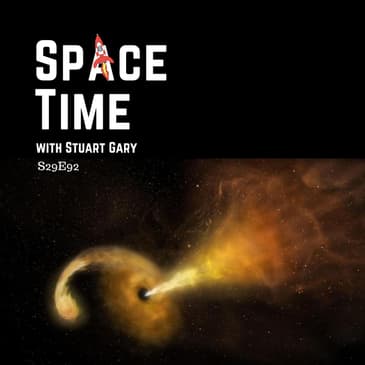
This is Spacetime Series twenty nine, Episode ninety two, for broadcast on the third of August twenty twenty six. Coming up on Spacetime, The Monster That's been let out of its cage, counting down to next week's solar eclipse, and a major setback for NASA Swift Space Telescope Rescue mission. All that and more coming up on space Time. Welcome to space Time with Stuart Gary. Astronomers have for the first time discovered a monster as super massive black hole wandering alone near the edge of a galaxy. These giants of the universe, which can be millions to billions of times the mass of our Sun, are usually found at the centers of galaxies, are reporting. The Astrophysical journal Letters claims the newly identified behemoth was only discovered as a released a flash of light while destroying and consuming a nearby star in a tidal disruption event. It's the first time scientists have detected a super massive black hole so far away from a galaxy center. The studies lead author, Robert david Stein from the Joint Space Science Institute, says the new discovery will have huge implications. Until now, the assumption was that super massive black holes always reside at the centers of their galaxies. The new discovery means astronomers will be able to better understand how galaxies and their black holes merge and how they build up over time. Theorists have predicted that wandering black holes would exist roaming along the outskirts of galaxies as a result of galaxy collisions and mergers. But the thing is, many of these black holes would be quiescent, meaning they're not swallowing material and consequently not emitting any light, literally tiptoeing around the universe undetected. This newly discovered black hole was detected by this Vicki transient facility, which searches the skies looking for transient objects. Vicki scans the entire northern sky every two days using a pair of telescopes at the Palomar Observatory in San Diego. Mind you, it's virtually impossible to check for black holes in each of the hundreds of thousands of celestial events at Ziki documents every evening. So astronomers developed an artificial intelligence program which identifies a characteristic light signature that occurs when the black hole shreds a star. These title disruption events are well documented at galaxy centers, but the AI looked for similar flares elsewhere in the sky. The authors launched the artificial intelligence program back in August twenty twenty five, and made their first black hole discovery using it just three months later. In this case, the super massive black hole was located some thirty thousand light years from the galactic center. It's around four million solar masses, about the same as set us a star. The super massive black hole at the center of our own galaxy, the Milky Way. It likely ended up at its current location following a collision between two galaxies. One possibility is that a larger galaxy cannibalized a smaller one and then slowly stripped away all its stars until only the core remained. But a more intriguing second possibility is that one galaxy already had two black holes orbiting close to the center in a binary system, having already merged with another galaxy. Then if a third black hole from yet another galaxy merger enters the mixed complex, three body interactions could kick the smallest one out. Continued observations of this title disruption event but eventually favor one of these two hypotheses. Characterizing how quiesce and black holes behave is important because most black holes, including the one at the center of the Milky Way, are dormant for most of the time. In other words, you only know they're there when they start feeding. The authors in asking the Skies for more wandering black holes so they can determine just how common they really are. This is space time still to come, counting down to next week's solar eclipse and a major setback for NASA Swift Space Telescope Rescue mission. All that and more still to come on space Time. Spain, Portugal, Greenland, Iceland, Russia, and the Arctic are about to experience a total solar eclipse as the Moon's shadow sweeps across the surface of the Earth. Other parts of Europe, from the British Isles and France across to Greece, Italy and Lithuania, as well as northern Africa, will experience a partial eclipse during the event. Depending on where you are, the celestial spectacular will begin around three point thirty four in the afternoon of August the twurth, with totality occurring at five four and the show ending just before eight o'clock in the evening Solar eclipses happen when the Moon passes directly between the Earth and the Sun. You see, the Moon's orbit around the Earth is inclined by five degrees compared to the Earth's orbit around the Sun, so normally the Moon appears to cross the sky slightly above or below the path of the Sun. But about every eighteen months or so, the lunar orbit places the Moon directly between the Sun and Earth, resulting in a solar eclipse. Eclipses happen because the Moon is four hundred times smaller than the Sun, but it's also four hundred times closer to the Earth, and so the two appear to be about the same size in the sky as seen from Earth, and when the Sun, Moon, and Earth line up exactly, the Earth experiences a total solar eclipse. As this occurs, the Moon begins to slowly pass in front of the Sun and the partial lunar shadow or penumber, crosses the surface of the Earth. This can last for more than an hour as more and more of the Sun is hidden by the face of the Moon. Then, just before totality occurs, the crescent Sun converges into a single, bright white diamond of sunlight as the last bit of the Sun's bright disk shines along the edge of the Moon, and the first glimpses of the fake corona create a ring around the Moon, an effect known as the diamond ring. In the last fleeting moments before totality, the diamond ring breaks up into a string of beads created by the Sun's rays shining through the low lying valleys between the mountains along the limb or edge of the Moon. Once this effect, known as Bailey's beads, comes to an end, the Moon has completely covered the entire disk of the Sun and ear in totality. During totality, the largest part of the Moon's shadow, the umbra, crosses the Earth's surface. People along the path of totality view a total eclipse, which can last up to seven minutes and thirty one seconds, but is usually far shorter. During this period, the sky goes down, stars will appear, and it will suddenly get noticeably cooler. Birds will start roosting, shadows will take on an unusual crescent shape, and you'll be able to see the Sun's tenuous outer atmosphere, The corona, glowing milky white. Often explosions on the Sun's surface, called prominences, will appear as spectacular bright pink or red clouds stretching above the lunar limb. The path of totality can be up to two hundred and seventy two kilometers wide, although it's usually a lot less, and the further away you are from the center of the path, the shorter the eclipse duration will be. Now, if you're outside the line of totality, either to the north or south of it, you'll only see a partial eclipse, in which only part of the Sun's disk will be covered by the Moon. The reason each eclipse is only visible over a small part of the Earth is because the Moon's shadow is relatively small when it falls on the Earth's surface. Now, another important factor is that, on average, the Moon orbits about three hundred and eighty four thy four hundred kilometers away from the Earth. But the Moon's orbit around the Earth is in a perfect circle, it's slightly elliptical. That means one part of the orbit may be a bit closer to the Earth, maybe three hundred and fifty seven thousand kilometers that's known as perigy. Well, another part of the orbit will be a bit further away, around four hundred and six thousand kilometers, known as apergy, and when the Moon's orbit takes it a bit further away, the Moon looks a bit smaller in the sky, and if that coincides with the solar eclipse, it doesn't cover the entire face of the Sun, so instead of a solar eclipse, the Moon's passage across the Sun creates an annulus, a ring of fire, as light from the Sun surrounds the dark Moon, resulting in an annular eclipse. Solar eclipses are accompanied by a lunar eclipse, occurring either two weeks before or after the main event. That's due to the same alignment which caused the solar eclipse, so lunar and solar eclipses occur with equal frequency, but lunar eclipses are seen over a far broader area because the Earth's shadow is far larger and therefore covers more of the lunar surface. A lunar eclipseccurs during full moon, when the Sun, Earth, and Moon a line. During this event, the Moon passes completely through the Earth's dark shadow or umbra. Even though the Earth completely blocks out sunlight from directly reaching the surface of the Moon. The Moon is still visible. During a total lunar eclipse, you'll see the Moon gradually get darker than take on a rusty or blood red color as the light from the Sun refracts through Earth's atmosphere and undergoes rarely scattering, leaving only the longer red wavelengths as all the Earth's sunsets and sunrises happen at once to indirectly reflect on the lunar surface. A total lunar eclipse and also look yellow, orange, or even browning color depending on how different types of dust, particles, and clouds in Earth's atmosphere allow different wavelengths of light to reach the lunar surface. During next week's event, science teams will be chasing the Moon's shadow with one of NASA's high altitude WB fifty seven research jets and with scientific balloons. They'll investigate the Sun's dynamics the temporary darkening of our skies affects the atmosphere. A squeed of four cameras mounted in the nosecone will take high resolution images of the Sun's corona in different wavelengths of visible and infrared light. The cameras will capture at least twenty images per second. Recording structures, outflows, and rapid changes in the corona during the total eclipse. These images will allow scientists to learn more about the formation of prominences, better understand the corona and how it gets heated to nearly a million degrees, and the relationship between material and the corona and in the Solar wind, a continuous stream of charged particles flowing out from the Sun and bathing the Earth and rest of the Solar System. By chasing the Moon's shadow, the jet will extend how long cameras can observe the corona. See On the ground, the longest anyone will be able to see the corona is two minutes in eighteen seconds, but by flying along the eclipse path of totality, the WB fifty seven's view of the corona can last nearly three minutes. NASS WB fifty seven will flight fifty thousand feet that's above any clouds that might obscure the view of the Krona from the ground. The altitude will also allow cameras to observe some of the infrared wavelengths that get absorbed by the lower atmosphere before reaching the ground. The crone has only been observed at those wavelengths a few times before. The key instrument is called a multi spectral able in imager. It was developed by the Southwest Research Institooting Boulder, Colorado, and was also used during the April twenty twenty four solar eclipse, where it provided valuable observations this report from MESSATV. For most people, a total solar eclipse lasts just a few minutes, but NASA's pilots find a way to make it last longer by trying to outrun the Moon's shadow with an airplane. The truth is it's actually chasing us. We get out in front of it and let it overtake us. Once we're in totality, then we'll advance to artles to max and try and stay in totality for as long as we can. Making that happen takes extreme precision. Scientists calculate exactly where the airplane needs to be at each moment. We do a lot of missions where being in the right point and time and space are critical, and this is one of them. On eclipse Day, the WB fifty seven aircraft climbs more than fifty thousand feet into the stratosphere that's above most of Earth's atmosphere where clouds, dust, and water vapor could obscure the view. Viewing an eclipse from fifty thousand feet provides a really clear shot of the Sun, and that allows the scientists to have confidence of the data that they're seeing is on the Sun rather than distortions from the atmosphere. When the Moon's shadow arrives, it engulfs the aircraft. It's weird. Right where you're at is dark, but everywhere you see is twilight, and the temperature of the cockpit drops, so it's very noticeable. As the eclipse unfolds. The pilot keeps the aircraft on course while the sensor operator fine tunes the cameras, capturing every second of data. You're very, very, very busy, and it's very high pressure because of course there's no du overse. You only get one opportunity to get all these instruments trained on the rate spot. For the aircraft crew, it's a chance to witness one of nature's most spectacular events while helping scientists better understand our son. I'm sitting in the best seat in the house. It's pretty excited. And in that report from Massa TV, we heard from WB fifty seven Parlot, Tom Parnett, and WB fifty seven censor equipment operator carry CLAM. Meanwhile, a NASA funded nationwide eclipse ballooning project by Angelo de Jardines from Montana State University will be sending students from several American universities to Iceland and Spain to launch scientific balloons before, during, and after the eclipse in order to better understand how an eclipse affects the atmosphere. In Iceland, two teams will launch eighty balloons starting eighteen hours before the eclipse until eight hours after the event in order to study how the eclipse affects Earth's boundary layer. That's the part of the atmosphere that touches the ground. You see. The thickness of the boundary layer changes depending on factors such as surface temperature and a humidity. Previous balloon flights during solar eclipses in Octo twenty twenty three and April twenty twenty four showed that the boundary layer either collapsed or decreased in thickness in locations with clear skies. But not where there were cloudy skies. Scientists want to see if that will be any different in Iceland next week changes in the boundary layer are driven by the day nights cycle. However, in Iceland in August, the days are long and the nights are short, so the nighttime influences might not be as strong as in twenty twenty three or twenty four. Meanwhile, in Spain, three balloon teams launch a total of six balloons with threendre and sixty degree cameras in order to image the eclipse shatter from above. These balloons will also include instruments designed to measure levels of ozone in the atmosphere, which requires sunlight to form. Previous balloon experiments in April twenty twenty four showed that ozone decreases during totality, and scientists want to determine if there are any differences with this eclipse, especially as it's happening much later in the day and during a different season. Teams of students from across the United States have a unique vantage point of total solar eclipses thanks to scientific balloons. The Nationwide Eclipse Fluting Project is a NASA mission like adventure and collecting data from balloons that go high up into the atmosphere. Started in twenty fourteen, the project engages college students and high schoolers in one of two distinct paths. One is the engineering track that has mostly engineering students that get to tinker on different payloads, and the other track is an atmospheric science track where they'll actually be launching weather sensors to study the impact of the eclipse. Atmospheric science teams launch helium filled weather balloons the same as those used by the National Weather Service every hour for hours before and after an eclipse. Engineering teams fly larger balloons laden with cameras and experiments. They build themselves one hundred thousand feet up into the stratosphere. From there, they study a variety of things such as incoming cosmic radiation and ozone levels, as well as offering dramatic views of the Moon's shadow on our planet. The project is really a unique one in that it's both an education but also doing amazing science that's both about the eclipse itself and also the atmospheric response of the eclipse. Student balloon teams made a historic first during the twenty nineteen eclipse. They measured eclipse driven atmospheric gravity waves in Earth's stratosphere, or large ripples in the air caused by the temporary cooling due to the drop in sunlight. What excites me the most about this project is thinking about the experiences that the students have that fell remember forever. And in that report from Messa TV, we had from Nationwide Eclipse Blue and project principal investigator Angela Deja Deen and this is space time still to come. NASA's Swift Space Telescope rescue mission suffers a major setback. Later in the science report form of Biden Administration CHAEF Health Advisor Anthony found faces the US Senate and pleads the Fifth all that and more still to come on space time. NASA's Link mission to try and save the Swift Space telescope has suffered a major setback with a sudden loss of attitude control, putting the rescue craft into an uncontrollable spin. Link is on a mission to run the vous with Swift and boost the orbiting observatory back up to a higher altitude. Launched in two thousand and four, Swift was designed to survey the skies looking for short lived events like gamma ray bursts. Although they're the most powerful explosions in the universe, gamma ray bursts only last a few seconds before fading away. Swift acts like an early warning system, detecting the burst first and then quickly messaging astronomers to turn their telescopes towards the location of the blast. However, recent space weather events like solar flares and chronal mass ejections have blasted charged particles from the Sun towards the Earth, causing our planet's atmosphere to wobble like a jelly blubber, expanding one way, contracting another. As Swift travels through the expanded part of the atmosphere, a process called atmospheric drag slows the spacecraft down, decaying its orbit. The thing is, engineers weren't expecting the impact of the current space where the cycle it'd be as big as it is, and so the probe wasn't equipped with the repulsion system in order to boost itself back up into its intended six hundred kilometre high orbit. Without help, Swift will fall back into its atmosphere and burn up in a matter of months. The Link spacecraft was launched last month on a Pegasus rocket with the aim of catching up to and then locking onto Swift using its three robotic arms, and then firing its onboard engine to boost the telescope back up to its original orbit. However, mission manager say Links now started experiencing attitude control problems, causing the spacecraft to spin uncontrollably and sporadically losing communication with mission managers. Preliminary investigations suggest that two of Link's three reaction wheels, which control the spacecraft's attitude and orientation in space, have stopped working, and there's also some loss of functionality with its cold gas thruster system, but neither LINKS operator, Catalyst, or NASA at giving up hope, at least not yet. Mission managers are working on the plant to stop Link spin using the spacecraft's electric propulsion thrusters, and once they've re established a stable attitude and better understand the spacecraft's status, they'll then uplink a new set of guidance, navigation, and control commands to accommodate the spacecraft's new configuration. They'll then evaluate revised plans to approach and capture Swift, depending on the safety of the approach and Link's health. And needless to say, we'll keep you informed. This is space time, and time that to take a brief look at some of the other stories making news in Science this week with the Science Report. The former Biden administration National Institutes of Health Chief Advisor Anthony Fauci has faced a United States Senate Homeland Security Committee hearing, accused of repeatedly lying to the American public about the causes and origins of the deadly COVID nineteen pandemic. Is part of his interaction with Senator to Josh Harley. Well, nothing says honesty like taking the fifth hun dark. Let's try something. What day of the week is it today? On the divisive Council? I respectfully declined to answer, based upon my rights under the Fifth Amendment of the Constitution. What color tiere you wearing? On the advisive Council? I respectfully declined to answer based upon my rights under the Fifth Amendment to the Constitution? What color is the carpet in front of you? On the advisive Council? I respect declined to answer based upon my rights under the Fifth Amendment to the Constitution. Let's just get one thing straight. You don't have any rights under the Fifth Amendment because you've been pardoned, as you very well know, as a Supreme Court has been clear for a century and more. Brown versus Walker eighteen ninety six. When he has been pardoned, he may not stand upon his privilege. You know that your lawyer are sitting behind you now, shifting nervously in their chairs. They know it. This isn't about the constitution, This isn't about the law. This is about contempt, contempt for this body, and contempt for the American people. With the threat of real jail time now hanging over his head like the proverbial sort of Democles, Fauci pleaded the fifth and no less than one hundred and eleven occasions in order not to incriminate himself. However, statements he wrote in his personal diary have already done that for him. Fauci's diary confirms that he was funding gain of function research into the Corona bat virus at China's Wuhan Institute of Virology, and that ten scientists from his own team supported the lably hypothesis that is, a biologically engineered COVID nineteen virus escape from the Chinese lab and quickly spread globally. Over more than ten thousand pages, the diary, retrieved from government computer servers in recent months, exposes Fauci's deepest thoughts and darkest secrets, his obsession with the media, his infatuation with his own growing fame and perceived importance, and his schoolgirl like becited giddiness with celebrities. But more importantly, Fauci's diary entries confirmed that he knew, or at least suspected COVID nineteen didn't originate in the local wet markets despired him continuously and vigorously pushing that line publicly. Fauci's January twenty twenty diary entry states categorically in his own words, that we know the market was not the source. About a week later, he referenced the conference call in which several top infectious disease experts all thought the coronavirus might not have originated in nature. He even writes the possibility of a lablique as the likely source of the virus, but kept that opinion to himself as millions of people died. In fact, Fauchi's notes show that he deliberately covered up evidence supporting this labla hypothesis. Fauci's diary entries also confirm that he personally recommended lockdowns and closing schools politicians and their advisors during the pandemic. Something he publicly strenuously denied doing. These included California Governor Gavin Newsom's chief of staff, Anna Leary, New York City Mayor Build the Blasio, and Mark Gaily, the deputy director of Community Health for the La County Department of Health Services. Earlier testimony by doctor Richard Ebright, a professor of Biologier Rutgers, says Fauchi will have to answer way his own advisors told him was a lab origin, and yet he publicly went against that. Why Fauchi pleaded the fifth of the hearing makes no sense, as he's already been given an autopen pardon by President Joe Biden for his actions during the pandemic, raising questions about what he's been up to since that time. Unusually, that pardon goes all the way back to twenty fourteen. That's the same year he began funding gain of function research into the SARS via In China, The World Health Organization says over seven point one million people have now been killed by the COVID nineteen coronavirus since it was first detected among workers at China's Wihan Institute of Virology back in September twenty nineteen, The Lancet Medical Journal estimates the true global death toll is likely to be more than eighteen million and with over three quarters of a billion confirmed cases globally. A new studi is warning that antimicrobial resistance in children is rising globally. The findings, reported in the Journal of the American Medical Association, suggests the level of superbug resistance will worsen over the next decade, threatening the effectiveness of life saving antibiotics. The findings, led by the Murdoch Children's Research Institute in collaboration with the University of Sydney, analyze more than one hundred and six thousand infection samples from kids up to the age of eighteen across eighty two countries, discovering that resistance has increased in every region between two thousand and four and twenty twenty two. New aerial imaging surveys of the southwestern Amazon have revealed four hundred and thirty two earthwork patterns in the ground, which scientists say may represent the footprint of an ancient civilization. The findings, reported in the journal Nature, show earthworks were found in an area previously inhabited by the ancient ariculture. The authors extrapolated their findings with existing satellite evidence to suggests that this region may have as many as thirty thousand earthworks that could have supported between one and a quarter and three million people between the years one hundred and three hundred. They say this small area appears to have more earthworks than previously predicted for the entire Amazon Basin. Paleontologist in our Back Queensland of on Earth the spectacular new fossil discovery displaying a Cretaceous era marine food web involving a giant mercisore, a large hexiosaur, and a flying reptile known as a pterosaur. This amazing one hundred million year old snapshot depicts life and death at its most brutal during the age of the dinosaur. The finds, reported in the journal gond Wonder Research, use neutron scattering to image what is a complicated find showing the remains of a dolphin like marine reptile called an ixiosaur, which contained the preserved remains of its last meal fish, cephalopods, and fragments of the lower jaw of a pterosaur, and the ixiosaur itself appears to have been attacked and preyed upon by an even larger reptile amosasaur, an enormous marine apex predator, possibly the giant philos or Chronosaurus Queenslandicus, which could reach lengths of ten meters thirty three feet. The ixiosaur vertebrae were split, ribs were missing, and numerous sperons displayed large crushing bite marks. One vertebrae even preserved a rib jammed against a broken margin strolling in, suggesting forceful jaw processing rather than simply post mortem damage. A fossils were uncovered at the Aremanga Sea dig site near Richmond. So called paranormal psychic Dolly Anderson has won the Australian Skeptics twenty twenty six Ben Spoon Award as the most shocky practitioner of the Adamson claims to be able to talk to the ghosts of murdered children and their killers. She beat a colorful clutch of equally illustrious runners up, including the Perth Vivacious Living Center, which charged people to diagnose and treat their illnesses using an unregistered dodgy body scanning device from Russia, which apparently could scan a bunch of non existent frequencies. There was also Monica and Lisa Smith, who was selling orgone energy devices that claimed to protect you and your home from electromagnetic frequency radiation. Then there were David the Medium and Chezi Danya, who claimed to be able to talk to the dead. Past winners for displaying their own lack of scientific understanding include the Australian Broadcasting Corporation for demonstrating new lows in journalistic standards with their ever faithful motto never let the facts get in the way of a good story. There was the University of Woollongong for proving you don't need to be smart, or right or even scientifically accurate in order to get a doctorate, Adelaide Psychic and Dankbar for her discovery the Colossus of Rhodes, which created something of a media frenzy till it was shown to be nothing more than modern builder's rubble. The ABC wanted again for their television show Second Opinion, which promoted so much unscientific quackery it really should have sought a few more opinions. Southern Cross University was also a past winner, offering a degree course in naturopathy. Former csirochif Flowry Marshall was also a past winner, receiving his Bentz Spoon for supporting water divining, and the ABC one yet another ben Spoon for spending lots and lots of taxpayers money on psychic investigators. Then there was racing car driver Peter Brock, who was highly tarted energy polarizer generated more heat in the murdering media than what it did energy in his car, and the Special Broadcasting Service SPS once won a bent Spoon for their TV program Medicine or myth Or, promoting alternative medical treatments as if they actually had some scientific credibility. There was Melbourne's Metropolitan Board of Works, who hired a US psychic archaeologist to de take a non existent electromagnetic photo field. The ABC won another Benz Spoon, this time for their television show The New Inventors, which seriously considered the pseudoscientific benefits of so called anti bio water conditioning system. The ABC that's one point four billion dollars annually of taxpayer money. But of course, one of the ben spurn winning stars of the past is Paleo Pete Evans is promotion of the bio charger, which claims to restore health, vigor, stamina, coordination, and mental clarity. Evans also won a ben Spurn for his paleo diet, which included the promoting burn broth as a formula replacement for babies, and his campaigns against fluoridation vaccination skeptics. Tenmendum says, You'll always find people out there with claims that fly in the face of science, the face of reason, the face of logic, simple common sense. It's one of the least sought after awards in the austrain world. It's given every year by strained skeptics, been given the scenes nineteen eighty one, and it's for the most preposterous piece of paranormal pursudo scientific people. Are you've rehearsed that, I have rehearsed that. It's very hard to say three times after drink, but basically it means anyone who's making ridiculous claims in the pseudo scientific or paranormal world, sometimes silly, sometimes quite serious is up for the running. And this year for the twenty twenty sixth award, there are quite a few candidates. People changing for a particular medical equipment gear that doesn't really do a lot all going energy machines which don't really do a lot, couple of people talking to the dead, which don't really do a lot. The person was in that last field, actually, but it was a particularly noteworthy person called Dolly Adamson. She was the winner of the twenty twenty sixth Bent Spoon Award. The Ben's spinnerward is obviously on a pluck that may have a gopher wood from Noah's Ark Bent Buggy Regella. So this lovely award went to Dolly Adamson of Kinds and Paranormal in Victoria. Very formal, doesn't it. Paranormal sounds like it. It does organization obviously, the kitchen table in the back, and I. Think it is. Yeah, it does sound like a law firm. But anyway, she's a lady who's been promoting the fact that she can talk to the dead. There are a number of people who come out here and claim they can talk to the dead, And basically what the dead say is the mostly name stuff you've ever heard, nothing like I buried the money under the floorboards as dead. They was forgive you, and they say it was always You're always one of my favorites. And you know, I'm really nice up here, down there, wherever they are, and don't do a way about me something you can just make up and say to anybody, which I think they do anyway. Dolly specializes in high profile dead children. Australians will know some of these cases of kids they went missing, the Beaumont children, three of them disappeared in an Adelaide beach in nineteen sixty six. William Terrell a little child who disappeared in New South Wales. And isn't it it is? It's not just entertainment. It's the pretty low low blow that they're doing. They also talk to their killers. Shea to claim either to get messages from their killers as well, which is even worse right, this. Is what they call actually identify themselves. It's exploitation, insulting to the grieving families, their friends. It's referred to as grief vampires, people who come to people who are who are mourning, especially in little kids cases, and they just take advantage of it and say that I can speak to the your child. She only deals with famous people, famous cases. He doesn't. And there with the ord kid down the road who's disappeared to be someone as a high profile owner Michael Jackson, Heath Ledger, Malon Munroe, Nancy Guthrie, who went on even tried to Harold Holstrain, Prime Minister. Joan of Art is a good one and the crew of the Maris left Kelly Ned Kelly's the other one. Yeah, so the passengers of the Malaysian Airlines flight there mate three seventy that disappeared in the indianaceans. I mean, that would have been handy to have to know where they are. But one of the best ones that she's spoken to was someone who's well known in the Australian media, a sovereign citizen by the name of Desi Freeman who some police were investigating him, so he shot two of them, killed them and they went on the run. Dolly got in touch with Desie and was saying, you know how you know where are you in trouble is he was still alive. He was shot later, but she was talking to a dead person who wasn't dead. Some of the people who've got the awards in the past are quite fun things, the UFO fanatics and psychic dentists and that sort of stuff, but some of them are quite serious and she's definitely in that area. So she was a very well deserved winner of the twenty twenty sixth Ben Spoon Award. You actually get in touch with these people and to know that won the award and know they do know. Some of them react very quickly. Pete Evan, he's one of twice the famous chef and the new ager. He was quite dismissive. Loss Coulter, the journalist who is now a UFO fan boy, he was pretty upset. He's become very famous in the States for all that too. Now he has he's got regular programs and he's positioned himself as a leading commentator of a field in which there has no new evidence to talk about. See it is. This is where you can end up if you win a Walkley Award. That's right. He's the award winning journalists who was several times Walkley Award being the top award for journalists in Australia, and he's one of the couple of times at least, and. That Australian talent in terms. Of people don't like pulling journalists out of to highlight them because other journalists don't like covering that. That's because they're all scared that they're about to be named themselves. The same probably, but there are people out there who are health practitioners who can actually hurt people. There's some news is out there unfortunately, so but we keep sort of pointing them out. That's the skeptics, Tim Indum, and this is space Time, and that's the show for now. Spacetime is available every Monday, Wednesday and Friday through at bytes dot com, SoundCloud, YouTube, your favorite podcast download provider, and from space Time with Stuart Gary dot com. Space Time's also broadcast through the National Science Foundation, on Science Own Radio and on both iHeartRadio and tune In Radio. And you can help to support our show by visiting the Spacetime Store for a range of promotional merchandising goodies, or by becoming a Spacetime Patron, which gives you access to triple episode commercial free versions of the show, as well as lots of bonnus audio content which doesn't go to air, access to our exclusive Facebook group, and other rewards. Just go to space Time with Stuart Gary dot com for full details. You've been listening to space Time with Stuart Gary. This has been another quality podcast production from bytes dot com