
Become a supporter of this podcast: https://www.spreaker.com/podcast/spacetime-with-stuart-gary--2458531/support.
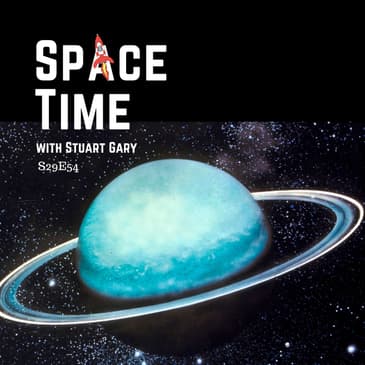
This is Spacetime Series twenty nine, episode fifty four, for broadcast on the sixth of May twenty twenty six. Coming up on space Time, new evidence shows that the two outer rings of the ice giant Uranus have starkly different origins. Scientists warned that the African continent is now breaking apart much faster than previously thought, and rocket engine issues have been blamed for the failure of the maiden flight of Gilmore Space's EIRIS rocket. All that and more Coming up on space Time. Welcome to space Time with Stuart Gary. Astronomers have discovered that two of the planet Uranus's outer rings at very different compositions and so must have come from completely the different origins. The findings, reported in the journal Geophysical Research Planets, show that the epsilon and the U rings have different colors and are reflecting light differently. The discovery is based on new spectroscopical observations by the Keck Observatory on Monarch Kayu and Hawaii, and by the Hubble and webspased telescopes. These two rings are peculiar because they're extremely faint and orbit within the planet's crowded system of fourteen inner moons. By decoding the light from these rings, astronomers can trace both their particle size distribution and their composition, and that in turn sheds light on their origins, offering new insights into how the Uranian system and other ice giant planets like it formed and evolved. The studies lead author M. Kidpata from the University of California, Berkeley, says the findings point to very different origin stories. Though they allbit the same planet, Uranus's epsilon and new rings are fundamentally different. Prior observations with Keke and Hubble showed to the eppsiloon ring appeared blue, a signature characteristic of extremely small particles, while the anew ring's reddish hue points to a more typical dusty origin. However, exactly why the rings were so different as remained a mystery. But then when the web Space Telescope came online and observed Uranus, the authors used all its data taken at different wavelengths, in combination with the Keck and Hubble data to construct a new complete spectrum from visible through to infrared. By analyzing how sunlight reflects off the rings, the authors identified a strong absorption feature near a wavelength of three microns three millions of a meter, and it was visible in the infrared for both rings. Beyond that shed feature, the differences became clear when simulating the detailed spectra. The epsilon ring closely matches the spectral signature for water ice or the new ring is clearly composed of rocky material mixed with approximately ten to fifteen percent carbon rich organic compounds, which are commonly found in the Outer Solar System. The epsilon ring appears to be made up of tiny ice greens knocked off the planet's small, twelve kilometer wide moon MAB as a result of micro meteorite impacts. Interestingly, the icy composition of the epsilon ring also confirms that the moon mab is also composed mostly of water ice. The patter says, in contrast, the a new ring material is sourced from micrometeorite impacts and collisions between unseen rocky bodies rich in organic materials, which must be in orbit between some of Uranus's known moons. One interesting question is why the parent bodies sourcing these rings so different in composition. Uranus's rings were first discovered back in nineteen seventy seven, when astronomers observed to star dim several times as the planet passed in front or occulted it, indicating a surrounding ring system. At that time, only Satin was known to have rings, making Urinus only the second known ring planet in our Solar system. Since then, we've discovered that all the giants have rings, Jupiter, Satin, Urineae, and Neptune, But unlike Satin's bright, easily visible rings, those on the other giants, including Urinus's rings, are faint and narrow, making them far more difficult to study. Over the decades, additional rings have been identified using NASA's voy T two spacecraft and Hubble observations, gradually revealing a far more complex system. The giant ten meter Keck telescopes, together with Hubble, a key role in science is understanding of the Uranian system. Hubble's observations between two thousand and three and twenty oh five to the discovery of the epsilon and a new rings, and Keck helped characterize them, including providing the first evidence that the epsilon ring is blue whereas the ANW ring appears red. These color differences hinted at fundamental variations in particle size and composition, but the data was limited at the time. The only ring in our Solar System that was blue was Satin's E ring, and this ring is produced by geyser activity on the Saturnian Iceman and Solidus, which orbits Satin in the E ring and its that spew out tiny icy grains from the Moon's south polt tiger stripes. These grains originate in a global subsurface ocean beneath Enceladus's frozen crust. But Uranus's MAB appears too small to be cryo volcanically active, and so the new results raise an interesting question. Why is MAB the source of the epsilon ring and why is it so different to Urinus's other rockia inner Moon's. Needless to say, ongoing studies of the system will play a crucial role in answering this mystery. This report on the Many Mysteries of Uranus from massatv. Uranus is the seventh planet from the Sun and the third largest planet in the Solar System. It also may have the coldest interior, emitting far less heat and its counterparts Jupiter, Saturn, and Neptune. It is known as an ice giant because it contains more ices, including water, methane, and ammonia than Jupiter or Saturn, and while NASA's learned a great view about this planet over the last three decades, there's a lot more waiting to be discovered. Back in nineteen eighty six, NASA's Voyager II spacecraft flew by Uranus, making it the first and only spacecraft to visit this distant planet. Previous observations showed that Uranus has a unique tilt of its axis, so it rotates almost on its side, causing its poles to actually face the Sun. No other planet in our Solar System has this feature. In its quick sprint past Uranus, Voyager discovered ten new moons orbiting the planet that had not been seen before, and in the decades since, even more have been found. During its encounter, Voyager also saw new faint rings and explored the complex magnetosphere. Voyager only briefly viewed the planet's five major moons, Aerial, Miranda, Titanium, Oberon, and Umbrio. These moons have a wide variety of terrains and geological features to indicate possible subsurface oceans. Small Miranda has chaotic terrain with deep canyons and tall mountains, but is likely now frozen solid. An Aerial appears to have the youngest surface with few impact craters, while Titania has a very old surface. The lack of large craters and presence of a large canyon system may indicate ancient resurfacing. Oberon is also covered with craters and has valleys in large mountains. Umbril surface is the darkest of the Iranian moons and it sports a strange polar ring. The origin of this ring is still a mystery, but scientists believed that it may have been formed by an icy impact. Since Voyager, ground based telescopes and the Hubble Space Telescope have played the leading role in our understanding of Uranus since nineteen ninety two. Hubble has watched the slowly changing Uranian seasons, including changes in its unusual pale blue colour and polar hazes. Telescopes have also revealed that Uranus has a complex weather system, with massive storms that can last for months or even years, with wind speeds over five hundred miles per hour. The ongoing search for ocean worlds and life beyond Earth makes Uranus an exciting target for the James Webb Space Telescope and for future up close exploration. New data will help scientists to understand the formation and evolution of Uranus, as well as its moons and rings, and provide clues as to whether liquid water may reside beneath their icy crusts. If the fascinating properties of this planet discovered in just the span of a few decades reveal that unlocking mysteries here can help scientists learn even more about our Solar System and our place in it. This space time still to come. New evidence show that Africa is breaking apart much faster than side is the previously thought. An engine failure has been blamed for the loss of the Ares rocket on its maiden flight from North Queensland. All that and more still to come on space time. A new study claims Africa is much closer to being physically torn apart into two separate continents than previously thought, possibly as soon as a few million years from now. The findings are reported in the journal Nature. Show part of the Great East African Rift valley system, known as the Tacana Rift, is far thinner than scientists had previously understood. The Tacana Rift is a five hundred kilometer wide, low lying region that spans Kenure in Ethiopia, which is splitting apart at a rate of about four point seven millimeters a year, causing the underlying planetary crust to thin significantly. The Great East African rift system runs from the Afarda pressure in northeastern Ethiopia down to Mozambique in the south, with the African Nubian tectonic plan on one side and the Arabian and Somali plates on the other. Along the rift's axis. The crust, the rocky outermost layer of the planet, which rests on the earth shifting mantle, is just thirteen kilometres thick. That's significantly thinner compared to the more than thirty five kilometa thick crust further away from the rift center, and is a telltale sign of a processed geologist called necking. Scitists believe that a Kanna rift began pulling apart about forty five million years ago, and it's coursing the Earth's crust to stretch horizontally, resulting in it buckling and fracturing, releasing magma from deep below. The author's estimate that the necking started after widespread volcanic eruptions around four million years ago, they say, maybe just several million years before the next phase, known as oceanization begins. At that stage, magma will rise through the fractures to form new seafloor, and water from the Indian Ocean to the north will flow in. The authors also uncovered science of an earlier rifting episode that didn't lead to a full continental split. However, instead it left the crust thinner and weaker, and that set the stage for the current face of activity. This is space time still to come. Engine issues blamed for the failure of the maiden flight of the area's rocket, and later in the science report, scientists have discovered a new way for some coronaviruses to infect humans. All that and more coming up on space time. The investigation into the failure of the maiden flight of the AIS rocket last year has traced the problem to two of the launch vehicle's hybrid rocket engines. The ARES one launched from the Bow and Spaceport on the Queensland Pacific back on July the thirtieth last year, marking what should have been Australia's first orbital rocket launch since flights from the Woma Rocket Range in out back South Australia ended in the early nineteen seventies. The investigation by Gilmore's Space included that the vehicle experienced an inflight anomaly with one of its full first stage rocket engines, which last thrust just nine seconds after liftoff. Then a second rocket engine exhibited a similar problem at around T plus seventeen seconds. The combination dramatically reduced vehicle performance, bringing the mission to an early end. Investigators say they've identified two independent failure modes originating from the oxidizer pump subsystem. Electrical and thermal faults were observed in the electric pump morders and associated inverters, indicating component source from an external supplier. Mission managers say the findings provide a clearer understanding of the underlying causes. They say that based on the findings of the investigation, design, qualification and process improvements are now being evaluated and implemented. As with all first test flights, the Area's one mission was designed to generate flight data and uncovered conditions which can be fully replicated in ground testing. Data from Flight Test one will provide updates to vehicle design and operations as Gilmore Space prepares for a second areas test flight sometime later this year. A final report based on the investigations findings has now been submitted to the Australian Space Agency in coordination with the Office of the Space Regulator. This is space time, and time now to take another brief look at some of the other stories making us in science this week. With a science report, scientists have discovered a new way for some coronaviruses to infect humans. The findings, report in the journal Nature, could be a potential new threat to human health. Of all the types of coronaviruses, scientists know the most about how beta coronaviruses into human cells. That's the same group that Chinese government scientists genetically engineered, resulting in the COVID nineteen pandemic. However, researchers know far less about alpha coronaviruses, although both rely on spike proteins to get into human cells. The authors were testing a variety of alpha coronaviruses and found that one virus spike protein from a virus isolated from hart nosed bats in Kenya, could enter human cells using a receptor in the human cells called CACAM six. Related to alpha coronaviruses from Africa, Europe and East Asia also used the same receptor. While blood samples from people living near the bat sampling site showed no evidence of widespread infection, the authors say these findings do identify a potential threat to human health, as well as identifying one of the details needed to enhance pandemic preparedness and prevention efforts. The Australian Armies acquiring an additional two hundred and sixty eight bush Master infantry mobility vehicles under a new one point two billion dollar contract. The armored troop transports, which are built in the Victorian town of Bendigo, will be equipped with directed energy weapons, in other words, laser cannons, and they'll have more powerful engines compared to earlier versions of these vehicles, which were highly successful in Australian Defense Force operations in both Iraq and Afghanistan thanks to their ability to survive land mines in AEDs. More than thirteen hundred bush Masters are already deployed with the Australian Defense Force. They're fitted with a range of weapons ranging from turret mounted machine guns to rocket missile launchers. The vehicles are also used by the defense forces of Britain, the Netherlands, New Zealand, the Ukraine, Fiji, Japan, Indonesia and Jamaica. The new deal will also see the Australian Army purchase additional Hawkeye light protection mobility vehicles. There are eleven hundred Hawkeyes already in ADF service. While at fifteen ton bush Masters designed to carry ten troops, the much smaller sevent on Hawkeye carries four and is also designed to withstand land mines and AEDs. A new study has found that most teenagers aged sixteen and eighteen have been sent texting messages, often from strangers. The findings, reported in the journal's Sexual Behavior, were part of a long term Norwegian study involving seven hundred and forty three teens. Subjects were first asked how often they had sent intimate images or videos of themselves in which they were undressed and exposed their breasts of genitalia. The authors found that around eight percent of fourteen year olds, thirty one percent of sixteen year olds, and thirty nine percent of eighteen year olds had engaged in such texting, usually to a romantic acquaintance. Most teens sexted on their preferred social media platforms, such as Snapchat or Instagram. But the study also found it was far more common for teens to receive sexting d messages, with thirty nine percent of fourteen year olds and seventy percent of sixteen and eighteen year olds having been sent such messages, and these mostly came from strangers. The authors say girls were far more likely to receive texting messages from strangers, well, boys were more likely to get them from friends. Samsung are urgently trying to fix a bad update that's affecting millions of Samsung cell phones, causing their batteries to drain quickly. With the reports, the batteries in some ferns are also overheating. With the details, we're joined by technology editor Alex Sahara Rout from Tech Advice Start Life. Yeah, this is what the Samsung goal is. The S twenty four and S twenty five, and there was an April update that had forty seven five patches and fixtures inside. You know it's important to install updates. Well, this particular one is causing the battery to drain thirty to sixty percent in just a few hours, and the phone is getting, according to people who've got it, noticeably warmer. Samsung has sadly had battery problems before with the Note seven series, which they had to recall because was exploding. Literally, that's not something we hear about too much with phones anymore. I mean, there's been no major scandal since. We do hear a lot about exploding batteries in the scooters, and you know it can be the case when an electric vehicle crashes. If the battery gets damaged, it can cause a runaway thermal reaction that emits chemicals like a jet. That's not happening here with this update. There will obviously be a fix at some point. But if you've got a Samsung Galaxy S twenty fours twenty five and you have installed the update and the battery is draining really fast, you're not imagining it. It's something that's really happening and the users just have to wait for the fix. That's a scary thing. The battery is overheating, there's always the potential of failure. Yeah. Heat is the enemy of batteries. That's why you shouldn't leave any devices that batteries in a hot card during summer, for example. So battery technology is one of those things where the processing power of chips and the amount of port the transistors that chip has, according to Moore's law, doubles every eighteen months. I was in at an Intel events in two thousand and seven in Beijing, a session there on batteries. I mean, this is nearly twenty years ago now that we're talking at the time about using silver in batteries. The silver could be recycled and reused once the battery had gone through enough charging cycles. And what struck me was that they said that battery technology doubles in its performance and capability every eighteen years. And of course today's batteries are far more advanced, but what we really need to see is a change in battery chemistry. Lysium titan eight is an alternative to lithium ion that can have tens of thousands of recharge cycles. It can operate in much colder and hotter temperatures, and if it's damaged, it does not explode. There's also technologies like sodium ion, which is being used in home batteries, and it too is effectively impervious to this sort of destruction. So we're in a time where lysium ion is more widely used than ever, but it can be extremely dangerous, and thankfully, over the next decade or so, we're going to start seeing lithium on being phased out and these other better battery technologies being intured. And they're already being used in the military. Well yeah, I mean, lithium partner had actually been used in the military four decades, but it was just not commercially viable to be used in phones at the time, and people were using it in the military because it wouldn't easily be an internal ballm if it was damaged. If military equipment was being powered by lythium tid nite batteries, it was much safer. But now that has changed, we're going to be seeing home appliances that use luthium tid nape batteries. That's Alex saharav Rout from Take Advice, Start Life, and this is space Time, and that's the show for now. Space Time is available every Monday, Wednesday and Friday through at fyites dot com, SoundCloud, YouTube, your favorite podcast download provider, and from space Time with Stewart Gary dot com. Space Time's also broadcast through the National Science Foundation on Science Own Radio and on both iHeartRadio and tune In Radio. And you can help to support our show by visiting the Spacetime Store for a range of promotional merchandising goodies, or by becoming a Spacetime Patron, which gives you access to triple episode commercial free versions of the show, as well as lots of burnus audio content which doesn't go to weir, access to our exclusive Facebook group, and other rewards. Just go to space Time with Stewart Gary dot com for full details. You've been listening to space Time with Stuart Gary. This has been another quality podcast production from bytes dot com.