
#space #astronomy #science #news #spacetime #podcast
Become a supporter of this podcast: https://www.spreaker.com/podcast/spacetime-with-stuart-gary--2458531/support.
00:00:00
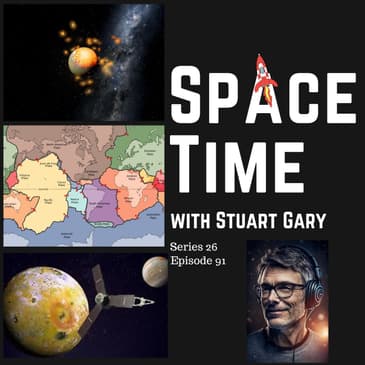
STUART GARY: This is Space Time series 26 episode 91 for
00:00:04
broadcast on the 31st of July 2023. Coming up on Space Time
00:00:10
could ancient asteroid impacts have fueled Volcanism on Venus.
00:00:15
A new date for the start of plate tectonics on planet Earth.
00:00:19
And NASA's Juno spacecraft undertakes its latest and
00:00:22
closest fly by yet of the volcanic Jovian moon. Io all
00:00:27
that and more coming up on Space Time.
00:00:31
GENERIC: Welcome to Space Time with Stuart Garry.
00:00:51
STUART GARY: A new study claims the early impact history of
00:00:54
Venus might explain how Earth's sister planet has maintained its
00:00:57
youthful surface despite lacking plate tectonics. The findings
00:01:02
reported in the journal Nature astronomy compared the early
00:01:05
collision histories of the two planets and concluded that Venus
00:01:09
likely experienced higher speed, higher energy asteroid impacts.
00:01:14
The authors say these would have created a superheated core that
00:01:18
promoted extended Volcanism and resurfaced the planet with
00:01:21
floods of magma.
00:01:23
The study's lead author Simone Mary from the South West
00:01:26
Research Institute in Boulder Colorado says one of the
00:01:29
mysteries of the inner solar system is that despite their
00:01:33
similar size and bulk density, Earth and Venus are distinctly
00:01:36
different planets, especially when it comes to the processes
00:01:40
that move materials through each planet. And the whole thing's
00:01:43
really funny because let's face it.
00:01:46
Both planets were made at the same time in the same part of
00:01:49
the solar system, out of the same materials. And yet they've
00:01:52
gone on to very different destinies. Earth shifting plate
00:01:57
tectonics continually reshapes its surface as chunks of the
00:02:00
crust collide to form mountain ranges and in places promote
00:02:04
Volcanism while other parts subduct under the continents.
00:02:08
While new material breaks the surface at mid ocean ridges. On
00:02:12
the other hand, Venus is no evidence of any type of plate
00:02:15
tectonic activity, but it has more volcanoes than any other
00:02:19
planet in the solar system. In fact, there are over 80
00:02:23
Venusian volcanoes at last count, that's 60 times more than
00:02:27
the Earth.
00:02:28
And they've played a major role in renewing Venus's surface
00:02:31
through floods of lava which appear to be continuing right up
00:02:34
to this day. Previous simulations have struggled to
00:02:38
create scenarios which support this level of Volcanism.
00:02:42
However, new computer modeling suggests that long lived
00:02:45
Volcanism driven by early energetic collisions on Venus
00:02:48
does offer a compelling explanation for its junk surface
00:02:52
age. The massive volcanic activity is fueled by a
00:02:55
superheated core resulting in vigorous internal melting. While
00:03:00
Venus and Earth may have formed in the same neighborhood, slight
00:03:03
differences in the two planets.
00:03:05
Distances from the sun may have had a major effect, changing the
00:03:09
impact velocities of asteroids and comets which hit the
00:03:12
planets. Now, these differences arise because Venus is closer to
00:03:16
the sun and moves faster around it, thereby energizing impact
00:03:20
conditions.
00:03:22
In addition, the tail of collisional growth is typically
00:03:25
dominated by impactor Orting well beyond Earth's orbit. And
00:03:28
that requires higher orbital eccentricities to collide with
00:03:32
Venus rather than the Earth. And that results in far more
00:03:36
powerful impacts.
00:03:37
It's a simple equation, higher impact velocities melt more
00:03:41
material melting as much as 82 per cent of Venus's mantle. And
00:03:46
this, the authors say produces a mixed mantle of molten materials
00:03:50
redistributed globally and a superheated core if impacts on
00:03:54
Venus had significantly higher velocities than on Earth.
00:03:57
A few large impacts could have drastically different outcomes
00:04:01
with important implications for the subsequent geophysical
00:04:04
evolution. The multidisciplinary team involved in the research
00:04:08
combined expertise in large scale collision modeling and
00:04:11
geodynamic processes to assess the consequences of these
00:04:15
collisions for the long term evolution of Venus.
00:04:18
Venus's internal conditions aren't well known. And before
00:04:22
considering the role of energetic impacts geo dynamical
00:04:25
models required special conditions in order to achieve
00:04:28
the sort of massive Volcanism we see on Venus.
00:04:31
But the authors found that once you input high energy impact
00:04:35
scenarios into the model, it easily comes up with the
00:04:38
extensive and extended Volcanism without needing to tweak the
00:04:41
parameters. The new findings come in the wake of NASA's
00:04:44
decision to undertake two new missions to Venus Veritas and Da
00:04:48
Vinci and the European Space Agency isn't left out either.
00:04:52
They're planning a new mission to Venus could envision we'll
00:04:56
keep you informed. This is Space Time still to come. A new date
00:05:02
for the start of plate tectonics on the Earth. And Juno
00:05:06
undertakes its closest fly by yet of the volcanic Jovian moon
00:05:10
Io all that and more still to come on Space Time.
00:05:30
Well, it seems the ongoing debate about when plate
00:05:33
tectonics began on planet Earth is continuing with new evidence
00:05:37
suggesting subduction commenced around 3.2 billion years ago.
00:05:41
The findings are important because Earth is the only planet
00:05:44
known in our solar system to have significant plate tectonics
00:05:48
and perhaps not coincidentally the only planet capable of
00:05:51
hosting life.
00:05:53
The findings reported in the journal Earth Science Reviews
00:05:56
today follows the establishment of a new framework for dating
00:06:00
Earth's evolution including the formation of the continents and
00:06:03
of mineral deposits. The researchers studied Australia's
00:06:07
abundant lead and zinc ore deposits along with a vast
00:06:10
global database of geology.
00:06:13
They determined that 3.2 billion years ago was a crucial point in
00:06:17
Earth's history when the planet changed from what was
00:06:20
essentially a layer cake structure to a mode of remixing,
00:06:24
possibly driven by the start of global scale plate tectonics. A
00:06:28
process which still dominates the Earth's system today.
00:06:32
The study's lead author Luke Duet from Curtin University says
00:06:36
one of the main questions to be answered was when continents as
00:06:39
we know them today were first formed. Now to get an answer,
00:06:43
the authors had to first determine when the composition
00:06:46
of the continental crust began to differ significantly from the
00:06:49
Earth's mantle where the continental material was
00:06:51
extracted from.
00:06:53
The challenge was to first understand how the Earth's
00:06:56
mantle evolved since the great moon formation impact 4.5
00:07:00
billion years ago.
00:07:02
That's when a mars sized planet which scientists have called
00:07:05
thea collided with the early proto Earth, turning both bodies
00:07:09
into a single molten Magma Ocean with some ejector then flung
00:07:13
into orbit to form the moon. Meanwhile, the Magma Ocean
00:07:17
restarted the entire differentiation process which
00:07:20
would eventually form an inner and outer core surrounded by a
00:07:23
thick mantle and a thin crust.
00:07:26
Duet says scientists first need to reconcile this well
00:07:29
established theory with the composition of the present day
00:07:32
mantle. The authors use lead isotope compositions from rock
00:07:36
samples from different parts of the Earth's surface as well as
00:07:39
from ancient meteorites dating back to the formation of the
00:07:42
solar system 4.6 billion years ago.
00:07:45
This allowed them to reconstruct an interpretation of the Earth's
00:07:50
mantle evolution. They could then compare its mantle
00:07:53
evolution with that of the Australian continent by using
00:07:56
measurements from large lead zinc deposits known for tracking
00:07:59
continental crust deposition through time.
00:08:02
Australia has an estimated 52 billion tons of lead zinc ore
00:08:07
making it the second largest reserve in the world just behind
00:08:10
China. They range from as old as 3.4 billion years in Western
00:08:14
Australia's Pilbara Region down to relatively young deposits is
00:08:18
285 million years old and that makes them perfect for study.
00:08:23
The team's analysis revealed that the lead zinc deposits
00:08:26
started to exhibit significant differences from the Earth's
00:08:29
mantle around 3.2 billion years ago. And deet says it's this
00:08:34
period which is considered to be the point at which plate
00:08:37
tectonics began to be the dominant driver of continental
00:08:40
formation on the planet. This is a.
00:08:42
LUC DOUCET : Huge debate in the community. And if you look at
00:08:45
the recent papers, so basically, as you said, some people think
00:08:49
it start just right away after Earth formed and the moon is
00:08:52
formed. And then there's a paper saying that it can start very,
00:08:55
very late like at the geological timescale like 500 ago.
00:08:59
So yeah, very recently. So there's a huge gap when we don't
00:09:03
know where it starts. So basically, the idea is to try to
00:09:07
find a way to quantify or find a proxy of when you think plate
00:09:11
tectonic starts, which is a vast question, right?
00:09:15
So in our case, what we, what we thought is when you have plate
00:09:19
tectonics, what we know is to have plate tectonics, you you
00:09:23
need to have like continental plates. So to form the continent
00:09:26
and then you need the continent to evolve and to become very
00:09:28
different from the from the mantle where they have been when
00:09:31
they have been extracted.
00:09:32
So to form the continental crust, you need, you have this
00:09:35
like the planet is formed, then you have the core and then you
00:09:38
have this layer of rocks, we call the mantle and then you
00:09:41
need to melt the mantle and then you produce the Contin crust and
00:09:45
then you need the crust to stay where it is like to float on the
00:09:48
mantle.
00:09:50
Yes, the thing is we think that in the beginning, we have
00:09:54
evidence that in the beginning of the Earth's history, you can
00:09:56
produce the crust. So we have evidence like in the zero where
00:09:59
we know there is like constant cross material form very early
00:10:02
on the question we don't know is is this rock going back to the
00:10:05
metal already?
00:10:06
So then you go back where you started and then you just
00:10:09
remixed and then you put extract and remixed the thing you need
00:10:13
to have the cross that been formed and then stay where it
00:10:15
is. So, so to do that, we need to find some proxies, some
00:10:19
evidence that the mantle and the crust become very different in
00:10:23
terms of composition. And this is what we try to do this.
00:10:27
STUART GARY: How did you go about doing that?
00:10:28
LUC DOUCET : Basically, we are using lead isotopes. So lead
00:10:31
contain different isotopes. So different, different type of
00:10:34
lead. We have lead deposits that form throughout Earth's history
00:10:38
and we just measure the composition of the on these
00:10:42
deposits because they reflect the composition of the crust.
00:10:44
The problem we had is we need the evolution of the mantle as
00:10:47
well.
00:10:47
So this is what we started to study how no the lead completion
00:10:51
of the mantle. So to do that, we start from today, when you're on
00:10:54
the ocean, the ocean crust and the initial ocean crust, it's
00:10:57
extracted from the mantle as well and we know this has to be
00:11:00
complied. So then we make a model to see how the lead to be
00:11:03
completion of the metal evolved since the formation of the
00:11:06
Earth.
00:11:06
So we had to use the present day composition of the metal. But we
00:11:09
have to model how the lead is the composition of the Earth was
00:11:13
at the beginning. And to do that, we had to understand how
00:11:16
the giant impact moon formation processes, you know, modify that
00:11:21
because lead is an element that go to the rocks, but also go to
00:11:25
the surface and basically can go to the core when you form the
00:11:30
core.
00:11:31
So we have to understand all these processes to basically to
00:11:34
connecting these two points, which is the present day
00:11:37
accomplishment of the mantle and the completion of the mantle
00:11:40
back in the day, you know, when this mantle formed right at the
00:11:43
beginning, right. So we define this model and then we just
00:11:46
compare this evolution of the of the mantle with the completion
00:11:50
of the cut of the crust.
00:11:51
Measuring has to be completion within the lead deposits. And
00:11:54
then we find that there is at the beginning. So from around
00:11:58
3.4 billion years old and 3.3 0.8 billion years old until 3.2
00:12:03
they were the same completion, the metal and the crust is the
00:12:06
same. But after that, you see a difference, you see that the the
00:12:10
continent crust is beginning to be more different.
00:12:13
And these differences then is, is significant after 3.2 until
00:12:17
today. So that's what we say. Ok, we have the formation of the
00:12:20
crust at the time and then it has to become more and more
00:12:23
different with time. So then we say, oh, so then this is at the
00:12:26
time where we should have what we call something like modern
00:12:30
like pla formation, starting at the time.
00:12:33
STUART GARY: It's all complicated. However, by
00:12:35
thinking, well, especially in wa where you've got this huge u
00:12:38
shaped craton under that part of the crust, which goes down many
00:12:43
kilometers into the mantle, got one bit popping up in the south
00:12:46
west of Western Australia and the other bit popping up in the
00:12:49
Pilbara Region.
00:12:50
You've got that as a problem. You've also got the fact that in
00:12:54
somewhere like Canada, you've got other dates using as a
00:12:58
dating technique when the continental crust is like at all
00:13:00
form.
00:13:01
LUC DOUCET : Yes. Yes. It's a very tough job. So, but the,
00:13:03
the, the thing that it's I would say originally in our research
00:13:06
is usually we, we know very little on how the man evolve,
00:13:11
right? And we have those continental crust, releases, you
00:13:14
know, like in the Pilbara, in New Y in Canada, in Russia, in
00:13:18
the United States, Southern America pretty much everywhere,
00:13:21
right?
00:13:21
But the thing is when, when you look at these, these relis, you
00:13:24
mostly have relis of the crust and as I said, so you can form
00:13:28
the crust very early on. You don't know if this crust. So we
00:13:30
have some bits of crust, but you don't know how much crust has
00:13:33
been formed at the time.
00:13:34
Because if you go to to Jack Hills in the northern, you, you
00:13:38
say, oh, we have rocks that we can find 4.4 billion, you know,
00:13:42
small grains. But are those grains representative of like
00:13:45
huge continents or just small bits of continental crust?
00:13:48
Right?
00:13:48
So originally as a researcher, we compare what we know about
00:13:52
the crust, but also what we know about the mantle. And this is
00:13:55
really like this crust mantle relationship that's really
00:13:58
critical to see what happened. This is where we, we managed to
00:14:02
find this kind of a difference between the mantle and the
00:14:04
crust, which is until now was quite obscure.
00:14:08
So that's something we really like in this work is we would be
00:14:12
able to connect the mantle and the crust. And we find this 3.2
00:14:16
billion years old time where we think there is extraction and
00:14:19
what is interesting is we are not the only one saying 3.2 was
00:14:23
a tipping point.
00:14:24
For example, there is a paper published in nature, I think
00:14:27
maybe this week or something using another isotropic systems
00:14:30
or titanium isotopes, which is a bit novel novel tool people are
00:14:34
using and they are finding pretty much the same in the same
00:14:37
time frame.
00:14:38
So they say after 3.5 I 3.2 we have a major change in iso
00:14:42
composition between the crust and the mantle. So this is quite
00:14:45
interesting to see this time period is making more and more
00:14:49
important in our understanding how platonic and formed. So
00:14:53
there is a line of evidence. I think that this time is maybe
00:14:56
the tipping point, we've got.
00:14:57
STUART GARY: Planet Earth forming 4.6 billion years ago.
00:15:00
And then about 4.5 billion years ago, the a mars sized body
00:15:06
slammed into this proto Earth and all the differentiation that
00:15:10
had taken place up until then that was all wiped out. The
00:15:12
whole thing became one huge molten Magma Ocean again.
00:15:16
And then the differentiation process recommenced at 4.5
00:15:20
billion years, heavy elements heading towards the center,
00:15:23
lighter elements heading towards the surface and then as it
00:15:26
cooled, as it slowly cooled and solidified, we have lots of
00:15:30
radioactive elements in there and lots of heat inside the
00:15:34
planet. And that then starts this conveyor belt of plate
00:15:38
tectonics which is still going on today.
00:15:40
LUC DOUCET : The keyword is cooling. Think right at the
00:15:43
beginning, the mantle was so dynamic that everything that got
00:15:47
up, maybe some piece would stay there like in the Pilbara or you
00:15:51
know, very small pieces, but the majority would go down. And at
00:15:54
some point because the Earth is cooling, then the convection in
00:15:57
the metal became less dynamic and then it followed the crust
00:16:01
to stay there and then to start to evolve to the crust. We know
00:16:04
today.
00:16:04
STUART GARY: Now you've got samples from one location.
00:16:07
LUC DOUCET : So basically for for in our research, we use the
00:16:10
database for, for the crust, we use the database from the
00:16:15
science Australia because Australia it's really cool
00:16:18
because there is lead deposits from 3.8 to not 3.6 sorry to to
00:16:23
today, right?
00:16:25
And Australia, the Elco in Australia is the Commonwealth
00:16:29
survey, but also all the states doing a very good job of, you
00:16:32
know, documenting all the mineral deposits and doing all
00:16:36
the geochemical data. So we have like huge database and so we use
00:16:39
all this wealth of data to constrain what's going on for
00:16:42
the crest evolution. So that's what we did for the crest and
00:16:45
for the mantle, what we did.
00:16:46
So we used an online databases where we have a huge amount of
00:16:49
data for entire Earth history for the mental mental derived
00:16:54
rock. So we have a comprehensive database of basically the entire
00:16:59
Earth history. And for both the crest and the mental recall. So
00:17:02
that's what we did.
00:17:03
STUART GARY: That's Luke Duet from Curtin University and this
00:17:08
is Space Time still to come. NASA's Juno spacecraft
00:17:12
undertakes its closest fly by yet of the volcanic Jovi moon
00:17:16
IO. And later in the science report, a preliminary analysis
00:17:20
by the World Meteorological Organization suggests that July
00:17:23
2023 will be listed as the hottest month on record for
00:17:28
planet Earth. All that and more still to come on Space Time.
00:17:49
NASA's Juno spacecraft has just completed its latest flyby of
00:17:53
the spectacular volcanic Jovian moon. Io. The spacecraft made
00:17:57
its closest approach yet to the fiery world coming within 22
00:18:02
kilometers of its lava covered surface.
00:18:05
The data collected by Juno's Jovin infrared oral mapper and
00:18:09
other science instruments will provide a wealth of information
00:18:12
on the hundreds of erupting volcanoes pouring out molten
00:18:16
magma and sulfurous gasses over the surface of the volcano.
00:18:20
Festoon moon.
00:18:22
Juno principal investigator Scott Bolton from the South West
00:18:25
Research Institute in San Antonio Texas says while the
00:18:29
aurora mapper was actually designed to study Jupiter's
00:18:32
polar aurora, its ability to identify heat sources is proving
00:18:36
indispensable in the hunt for active volcanoes on IO.
00:18:40
He says as Juno gets closer with each flyby, the mapper and other
00:18:44
science instruments all add to science's library of data on the
00:18:47
moon allowing researchers to not only better resolve surface
00:18:51
features but to understand how they change over time. Launched
00:18:55
back in 2011, June has been studying the Jovian system since
00:18:59
2016 and has just commenced the third year of its extended
00:19:02
mission in.
00:19:04
SCOTT J. BOLTON: Roman mythology, which of course is
00:19:05
rooted from Greek mythology. Juno was the wife and sister
00:19:11
goddess of Jupiter and Jupiter was sort of being naughty with
00:19:16
some friends. So he cast a veil of clouds around himself and his
00:19:19
friends. But of course, Juno was a fairly powerful God herself
00:19:23
and used her powers to look right through the clouds and see
00:19:26
the true nature of Jupiter and understand what he was really up
00:19:29
to.
00:19:29
And that's exactly what the Juno spacecraft does for us is that
00:19:33
it goes there with special instruments in a special orbit
00:19:36
and uses its powers to see right through Jupiter's clouds and
00:19:40
understand its true nature, which is holding these secrets
00:19:43
for us about how the solar system formed and where we all
00:19:46
came from.
00:19:49
Juno spins like a propeller where the propeller is kind of
00:19:52
facing the sun because they're all solar powered.
00:19:55
If you spin something, it stays spinning, it's like a gyroscope.
00:19:58
We can use a spinning spacecraft to let each instrument get its
00:20:02
turn to see Jupiter. We get to go very close to the planet
00:20:06
inside the radiation belts, instead of outside the radiation
00:20:09
belt, we're in a polar orbit.
00:20:10
So by small adjustments of the time we can map the entire
00:20:14
planet, we can get repeated stripes at different longitudes
00:20:17
as Jupiter spins underneath us, it.
00:20:19
Does mean that Juno is the polar regions to a greater extent than
00:20:24
with other spacecraft. But I think the most important thing
00:20:28
is that it gets in very close to the planet. As part of that
00:20:32
ellipse brings it in a few 1000 miles above those clouds, very
00:20:36
close near the equator.
00:20:38
We go over the poles of Jupiter. That means we can study the
00:20:41
magnetosphere in a different way.
00:20:42
A magnetosphere is the sphere of influence of a magnetic field.
00:20:47
So a planet that has a magnetic field has a magnetosphere when
00:20:52
its sphere of influence extends beyond the planet out into space
00:20:56
and affects the region around the magnetosphere of Jupiter is
00:21:00
vast. So if you think of Jupiter being 10 times the size of the
00:21:04
Earth and the magnetosphere is 100 times the size of Jupiter.
00:21:11
I would expect you to know to tell us more about how planets
00:21:16
work, meaning how the heat gets out what kinds of flows exist
00:21:21
inside the body, how magnetic fields get generated, learning
00:21:26
what Jupiter is made of, we will learn such a wide range of
00:21:29
things for indeed, Jupiter is the most massive planet in the
00:21:33
solar system. It is the body you want to understand in order to
00:21:38
understand the architecture of everything else, including.
00:21:46
STUART GARY: Slightly larger than the Earth's moon. Io is the
00:21:49
world in constant torment. Not only is Jupiter, the biggest
00:21:54
planet in our solar system for ever pulling on it
00:21:57
gravitationally, but so too are Io's Galilean siblings, the ice
00:22:01
world of Europa and the biggest moon in the solar system,
00:22:04
Ganymede.
00:22:05
The result is that Io's constantly being stretched and
00:22:09
squeezed, generating lots of internal friction in the process
00:22:13
that friction is super heating the moon's internal structure
00:22:17
and that's resulted in a volcanic cauldron with dozens of
00:22:20
volcanoes constantly erupting over its surface.
00:22:24
During Juno's last fly by of AO back in May, the Juno cam imager
00:22:28
took a picture from 35 kilometers showing a smudge at
00:22:33
the moon's ver region near the equator. Now these smudges are
00:22:37
often smoking guns to planetary scientists.
00:22:40
Jason Perry from the University Of Arizona's High Rise
00:22:43
Operations Center in Tucson says that when he compared it to
00:22:47
visible light images taken of the same area during the Galileo
00:22:50
mission and the new horizon fly by in 1999 and 2007, he was
00:22:55
excited to see changes where the lava flow field had expanded to
00:22:59
the west. And another volcano just north of Volland had fresh
00:23:03
lava flows surrounding it during the say May 16th pass.
00:23:07
Juno's Jovin Infra Aro mapper found a smoking gun of its own,
00:23:11
capturing the 202 kilometer wide Loki Patera, the largest
00:23:15
volcanic depression on IO appearing to be active. The
00:23:19
observations showed that lava could be bubbling onto the
00:23:22
surface of the area in the North West in the process creating a
00:23:26
larva lake to the south and East.
00:23:28
It's a fascinating observation and one of many yet to come
00:23:32
thanks to NASA's Juno spacecraft, this Space Time and
00:23:54
time that to take a brief look at some of the other stories
00:23:56
making news in science. This week with the science report, a
00:24:00
preliminary analysis suggests that July 2023 will be listed as
00:24:05
the hottest month on record for the planet.
00:24:08
Largely because of global warming. The World
00:24:11
Meteorological Organization, the European Union funded Copernicus
00:24:15
climate change service and Leipzig University have combined
00:24:19
temperature data for July finding that it will be the
00:24:22
hottest July on record by a wide margin.
00:24:25
July 2023 will be 0.2 °C warmer than the previous warmest July,
00:24:31
which is back in 2019 and it follows on from the planet's
00:24:35
hottest June on record. And the addition of an El Nino event
00:24:39
which began back in May will further boost global
00:24:42
temperatures as a result of this climate pattern's combination
00:24:46
with climate change makes it highly likely that more months
00:24:49
this year will also set new temperature records.
00:24:53
But the authors say that July 2023 won't just be the hottest
00:24:56
month since records began, but it's also likely to be the
00:25:00
hottest month in 120 years.
00:25:03
They base that claim on evidence of past temperatures found in
00:25:07
ancient sediments and layers of ice as well as in other Pado
00:25:10
climate records. The World Meteorological Organization says
00:25:14
these temperatures are related to heat waves in large parts of
00:25:17
North America, Asia and Europe, which along with wildfires in
00:25:21
countries including Canada and Greece have had major impacts on
00:25:25
people's health, the environment and national economies.
00:25:29
On July the sixth, the daily average global surface
00:25:32
temperature on planet Earth surpassed the record set in
00:25:35
August 2016 making it the hottest day on record with July
00:25:40
the fifth and July the seventh only just behind.
00:25:44
Meanwhile, there are now growing fears that the Gulf Stream could
00:25:48
collapse by 2050 because of climate change. A report in the
00:25:53
Journal Nature Communications claims that contrary to recent
00:25:56
IPCC assessments, Dennis, researchers say the Atlantic
00:26:00
Meridiana overturning circulation, that's the large
00:26:03
system of ocean currents that carries warm water from the
00:26:06
tropics to the North Atlantic could collapse any time after
00:26:09
2025.
00:26:10
Under current rates of greenhouse gas emissions. The
00:26:14
team have analyzed sea surface temperatures in the North
00:26:17
Atlantic between 18 70 2020 in order to get a proxy for the
00:26:21
Gulf Stream, finding early warning signals of a big change
00:26:25
in the system which might suggest it could shut down as
00:26:29
early as 2025 and certainly no later than 2095.
00:26:34
They say that the last time this kind of abrupt climate change
00:26:37
happened, it led to average northern hemisphere temperatures
00:26:40
fluctuating by 10 to 15 °C over a decade.
00:26:45
A re analysis of Australian clinical trial data has shown
00:26:49
that healthy people over the age of 70 shouldn't take a daily low
00:26:53
dose aspirin as it could significantly increase the risk
00:26:56
of brain bleeds with no reduction in the risk of a
00:26:59
stroke.
00:27:00
The findings reported in the journal of the American Medical
00:27:03
Association are a re analysis of the Australian Led Asbury study
00:27:07
and extends the trial's findings by focusing on stroke and
00:27:11
bleeding events.
00:27:12
The authors say the study supports recent recommendations
00:27:16
that low dose aspirin should not be prescribed for primary
00:27:19
prevention. In healthy older adults, reports of glasses of
00:27:24
beer falling skidding, sliding or being pushed off a table or
00:27:29
bar by some invisible unknown force.
00:27:31
In other words, a ghost are pretty common in the paranormal
00:27:34
world and the events described are certainly real. However,
00:27:39
while a paranormal explanation may be thrilling, Tim Mendham
00:27:42
from Australian Skeptics points out the world of science offers
00:27:46
a far more rational explanation.
00:27:48
TIM MENDHAM: Right now. You may be surprised to know that at
00:27:51
Skeptic Central, we get sent videos of ghosts and strange
00:27:56
paranormal phenomena all the time like every day and often
00:28:00
they happen in pubs which is interesting because they have
00:28:02
spirits there.
00:28:03
Of course, pubs also have CCTV within the pub and you'll see
00:28:08
these little videos of people sitting in the pub drinking and
00:28:11
then off on a sideboard somewhere or on the bar,
00:28:13
suddenly this glass will seem to move and fall off the side and
00:28:17
smash et cetera.
00:28:17
And people instantly say ghosts, poltergeists are moving the
00:28:21
glasses around and it's interesting and it's fun and you
00:28:23
wonder what the CCTV is doing, looking at the wrong part of the
00:28:26
pub, but never mind, there are explanations for it. It does
00:28:29
happen, but there are explanations for it, which are
00:28:31
quite sort of mundane and one is basically the glass is capturing
00:28:35
air under the bottom.
00:28:36
Now, if you look at most glasses they will have on the bottom, on
00:28:39
the base of the glass, there's a rim and there's a little bit of
00:28:42
indentation underneath. And if you, if you put the glass down,
00:28:46
often not a full glass, it doesn't have to be a full glass.
00:28:48
It's a bit harder to move.
00:28:49
But an empty glass or almost empty glass, you put it down on
00:28:53
the surface of the bar and you're presuming you're not
00:28:55
having a mat or something on the bar, but it's a straight sort of
00:28:58
polished surface and the air gets captured smooth bar top,
00:29:01
doesn't it really ones? No, not the ones you slide down to the
00:29:06
person at the end of the bar.
00:29:07
Yeah, it has to be smooth, very smooth. If there's sunlight on
00:29:11
the glass, it will actually make the air, the air that's
00:29:13
underneath, that's trapped underneath the glass expand,
00:29:16
right? If the surface of the bar is warm, what happens is that
00:29:19
the air expands and therefore creates a little bubble
00:29:21
underneath the glass, which is easier to move to slide.
00:29:23
If its own accord. Right. And if there's an uneven surface or if
00:29:26
there's a push or who knows what it might just move a bit. And if
00:29:29
it happens to be beside the edge of the bar, it will possibly
00:29:32
fall off.
00:29:33
It's not going to move a huge amount. It's not going to move
00:29:35
from one end of the bar to the other, but they do move. And if
00:29:37
you're captured on CCTV, it looks impressive, quite fun
00:29:45
because I can't explain it. It's the old story, I can't explain
00:29:48
it. Therefore, it must be a ghost, which means I've just
00:29:49
explained it.
00:29:50
There's a similar phenomenon called the Leen frost effect.
00:29:53
When there's a heat underneath your sweat, you form a liquid,
00:29:56
say under your foot when fire walking. If you ever try that,
00:29:59
have you tried that?
00:30:00
I have, I know it hurts, but there's a layer of, you don't
00:30:08
stop, keep going, you cannot stop and you have to make sure
00:30:11
that the coals are actually sort of settled down to just glowing.
00:30:14
But if it forms a liquid, this is a suggestion that it forms a
00:30:16
liquid under your feet, which is sweat or vapor or whatever. And
00:30:20
then that will act as a little barrier for a short time, right?
00:30:23
Don't stand on the coals, it's not going to work. But if you
00:30:25
move very quickly across the coal surface and don't try this
00:30:29
at home, that it might give you a sort of very, very short term
00:30:33
protection against being burnt, no guarantees. It doesn't always
00:30:36
work. And it's a similar thing.
00:30:37
Therefore, it's a layer of air or liquid that is sort of acting
00:30:41
as a buffer against gravity or against friction. It acts as a
00:30:44
buffer against friction and therefore the things can move a
00:30:46
bit right off their own accord. And therefore, in a video, it
00:30:49
looks good, but don't take it as evidence of being haunted.
00:30:53
STUART GARY: That's Tim Mendham from Australian Skeptics and
00:31:12
that's the show for now. Spacetime is available every
00:31:15
Monday, Wednesday and Friday through Apple Podcasts, itunes,
00:31:19
Stitcher, Google Podcast, pocket casts, Spotify a cast Amazon
00:31:24
music bites dot com, Soundcloud, YouTube, your favorite podcast
00:31:28
download provider and from Space Time with Stewart Gary dot com.
00:31:33
Spacetime is also broadcast through the National Science
00:31:36
Foundation on Science Zone Radio and on both IHeart Radio and
00:31:40
Tune in radio.
00:31:41
And you can help to support our show by visiting the Spacetime
00:31:44
store for a range of promotional merchandizing goodies or by
00:31:48
becoming a Spacetime patron, which gives you access to triple
00:31:51
episode commercial, free versions of the show as well as
00:31:54
lots of bonus audio content, which doesn't go to air access
00:31:57
to our exclusive Facebook group and other rewards just go to
00:32:01
Space Time with Stewart Gary dot com for full details.
00:32:05
And if you want more Space Time, please check out our blog where
00:32:08
you'll find all the stuff we couldn't fit in the show as well
00:32:11
as heaps of images, news stories, loads of videos and
00:32:14
things on the web. I find interesting or amusing. Just go
00:32:17
to Space Time with Stewart Gary dot tumblr dot com.
00:32:21
That's all one word and that's Tumbler without the E you can
00:32:25
also follow us through at Stuart Garry on Twitter at Space Time
00:32:28
with Stuart Garry on Instagram through our Space Time YouTube
00:32:32
channel and on Facebook, just go to Facebook dot com forward
00:32:36
slash Space Time with Stewart Gary and Spacetime is brought to
00:32:40
you in collaboration with Australian Sky and Telescope
00:32:42
Magazine. Your Window on the Universe.
00:32:45
GENERIC: You've been listening to Space Time with Stuart Garry.
00:32:48
This has been another quality podcast production from bites
00:32:52
dot com.