
For more, visit our website at https://bitesz.com/podcast/the-classic-film-club-revisited-re-rated and join the conversation on Spotify, YouTubeMusic, and Facebook. Don't forget to subscribe for more cinematic journeys!
Become a supporter of this podcast: https://www.spreaker.com/podcast/the-classic-film-club--4614300/support.
00:00:00 --> 00:00:02 Brian: Hello and welcome back to the Classic Film
00:00:02 --> 00:00:04 Club, the podcast where we dust off the
00:00:04 --> 00:00:07 reels, revisit Hollywood's golden age
00:00:07 --> 00:00:10 and ask the big question. Do these
00:00:10 --> 00:00:13 classics still hold up today? I'm your host,
00:00:13 --> 00:00:15 Brian. And today we're diving headfirst into
00:00:15 --> 00:00:18 one of the most electrifying examples of post
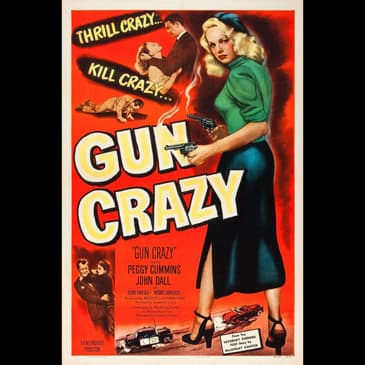
00:00:18 --> 00:00:20 war film noir. Gun Crazy.
00:00:21 --> 00:00:24 Released in 1950 and starring Peggy Cummings
00:00:24 --> 00:00:24 and John Dall
00:00:34 --> 00:00:36 the 1950 film noir Gun Crazy
00:00:36 --> 00:00:39 stands as a groundbreaking exploration of
00:00:39 --> 00:00:41 obsession, love and violence in post war
00:00:41 --> 00:00:44 America. This influential movie tells
00:00:44 --> 00:00:47 the story of Bart Tare a young man whose
00:00:47 --> 00:00:49 fascination with firearms begins in
00:00:49 --> 00:00:52 childhood. Not out of violent tendencies, but
00:00:52 --> 00:00:54 from a pure technical interest that lands him
00:00:54 --> 00:00:56 in reform school after stealing a gun.
00:00:57 --> 00:00:59 The film establishes early that Bart isn't
00:00:59 --> 00:01:02 violent by nature, a point he emphasizes to
00:01:02 --> 00:01:04 the judge during his hearing. The narrative
00:01:04 --> 00:01:06 takes a dramatic turn when the adult Bart
00:01:06 --> 00:01:09 encounters Laurie Starr, a carnival
00:01:09 --> 00:01:11 sharpshooter who can hit targets while
00:01:11 --> 00:01:13 blindfolded. Their immediate attraction
00:01:13 --> 00:01:15 ignites a passionate and ultimately
00:01:15 --> 00:01:18 destructive relationship. Lori's thirst for
00:01:18 --> 00:01:21 excitement draws the initially reluctant Bart
00:01:21 --> 00:01:23 into a life of crime, setting them on a path
00:01:23 --> 00:01:26 of no return. Their chemistry is electric
00:01:26 --> 00:01:28 from their first meeting across the carnival
00:01:28 --> 00:01:30 tent marking the beginning of their dangerous
00:01:30 --> 00:01:33 descent. The film's technical achievements
00:01:33 --> 00:01:36 were revolutionary for its time, particularly
00:01:36 --> 00:01:38 the famous bank robbery sequence captured in
00:01:38 --> 00:01:41 a single unedited take from the backseat of a
00:01:41 --> 00:01:44 car. This scene, shot guerrilla
00:01:44 --> 00:01:46 style on real streets with actual
00:01:46 --> 00:01:49 pedestrians, exemplifies director Joseph
00:01:49 --> 00:01:52 H. Lewis innovative approach to filmmaking.
00:01:53 --> 00:01:55 Lewis, nicknamed Wagon Wheel Joe for his
00:01:55 --> 00:01:58 distinctive visual style, made creative use
00:01:58 --> 00:02:00 of unusual camera angles and frames,
00:02:00 --> 00:02:02 including shooting through wagon spokes,
00:02:03 --> 00:02:05 fences and reflections to enhance the
00:02:05 --> 00:02:08 film's artistic impact. The casting
00:02:08 --> 00:02:10 proved crucial to the film's enduring appeal.
00:02:11 --> 00:02:14 Peggy Cummings, at just 25 and born in Wales,
00:02:14 --> 00:02:17 brought both sweetness and danger to the role
00:02:17 --> 00:02:19 of Laurie Star. Having already starred
00:02:19 --> 00:02:22 opposite Tyrone Power in the late George
00:02:22 --> 00:02:25 Apley and Forever Amber, Cummings
00:02:25 --> 00:02:26 delivered a performance that feels
00:02:26 --> 00:02:29 startlingly modern. John Dahl's portrayal
00:02:29 --> 00:02:32 of Bart provided a compelling contrast. His
00:02:32 --> 00:02:35 classical training and natural vulnerability
00:02:35 --> 00:02:37 created a character torn between moral
00:02:37 --> 00:02:40 conscience and overwhelming love. Dall was
00:02:40 --> 00:02:43 known for his role in Hitchcock's Rope, where
00:02:43 --> 00:02:45 he demonstrated his ability to portray
00:02:45 --> 00:02:48 complex, troubled characters. An interesting
00:02:48 --> 00:02:51 historical. The screenplay was secretly
00:02:51 --> 00:02:53 co written by Dalton Trumbo, one of the
00:02:53 --> 00:02:56 blacklisted Hollywood 10 due to McCarthy
00:02:56 --> 00:02:59 era censorship. Another writer, Millard
00:02:59 --> 00:03:00 Kaufman, was credited instead.
00:03:01 --> 00:03:03 Trumbo's contribution wasn't officially
00:03:03 --> 00:03:05 acknowledged until decades later, adding
00:03:05 --> 00:03:08 another layer of defiance to this story about
00:03:08 --> 00:03:10 outsiders. While Gun Crazy didn't achieve
00:03:10 --> 00:03:13 immediate commercial success upon its 1950
00:03:13 --> 00:03:16 release, with critics divided between
00:03:16 --> 00:03:19 dismissing it as pulp and recognizing its
00:03:19 --> 00:03:21 innovative qualities, it gained significant
00:03:21 --> 00:03:24 recognition during the 1960s. The
00:03:24 --> 00:03:26 film's influence can be clearly seen in later
00:03:26 --> 00:03:29 works, particularly 1967's
00:03:29 --> 00:03:32 Bonnie and Clyde, with directors Arthur
00:03:32 --> 00:03:34 Penn and Robert Benton directly citing it
00:03:34 --> 00:03:37 as an influence. The production's low budget
00:03:37 --> 00:03:39 actually contributed to its authentic feel.
00:03:40 --> 00:03:42 Many scenes were filmed without permits,
00:03:42 --> 00:03:45 using real locations and genuine public
00:03:45 --> 00:03:47 reactions. Director Lewis famously
00:03:47 --> 00:03:50 instructed his leads to perform as if they
00:03:50 --> 00:03:52 were the only two people left in the world,
00:03:52 --> 00:03:55 creating an intense intimacy that permeates
00:03:55 --> 00:03:57 the entire film. This approach
00:03:57 --> 00:04:00 resulted in a documentary like realism that
00:04:00 --> 00:04:03 was ahead of its time. Originally titled
00:04:03 --> 00:04:05 Deadly as the Female, the movie was later
00:04:05 --> 00:04:08 renamed Gun Crazy. Though it premiered under
00:04:08 --> 00:04:11 its original title in some cities, today,
00:04:11 --> 00:04:13 it's preserved in the US National Film
00:04:13 --> 00:04:16 Registry. Recognized for its cultural and
00:04:16 --> 00:04:18 artistic significance. The film's enduring
00:04:18 --> 00:04:21 power lies not just in its action sequences
00:04:21 --> 00:04:24 or crime narrative, but in its intimate
00:04:24 --> 00:04:26 portrayal of destructive love and addiction.
00:04:27 --> 00:04:30 Not to crime itself, but to the intensity
00:04:30 --> 00:04:33 of human connection. At its core,
00:04:33 --> 00:04:36 Gun Crazy transcends its noir
00:04:36 --> 00:04:38 origins to become a study of obsession
00:04:38 --> 00:04:41 and the prices we pay for passion. The
00:04:41 --> 00:04:44 film's technical innovations, combined with
00:04:44 --> 00:04:46 its psychological depth and raw energy,
00:04:46 --> 00:04:49 continue to influence filmmakers and
00:04:49 --> 00:04:51 captivate audiences, cementing its place
00:04:51 --> 00:04:54 in cinema history as more than just another
00:04:54 --> 00:04:57 crime thriller. Its exploration of the
00:04:57 --> 00:05:00 relationship between love and obsession and
00:05:00 --> 00:05:02 destruction remains relevant and compelling
00:05:02 --> 00:05:05 for modern viewers, making it a significant
00:05:05 --> 00:05:08 piece of American cinema that continues to
00:05:08 --> 00:05:10 resonate decades after its release. It feels
00:05:10 --> 00:05:12 like you're intruding on something private,
00:05:13 --> 00:05:16 dangerous, and all too human. Let's drop
00:05:16 --> 00:05:18 a few bits of trivia perfect for your next
00:05:18 --> 00:05:21 movie night. Flex. The film's original title
00:05:21 --> 00:05:23 was Deadly as the Female. It premiered under
00:05:23 --> 00:05:25 that name in some cities before being
00:05:25 --> 00:05:28 retitled Gun Crazy. The production was
00:05:28 --> 00:05:31 so low budget that some of the robbery scenes
00:05:31 --> 00:05:33 were shot without permits, using real streets
00:05:33 --> 00:05:36 and unsuspecting townspeople. Director
00:05:36 --> 00:05:39 Joseph H. Lewis told Cummings and Dall to act
00:05:39 --> 00:05:41 like they were the only two people left in
00:05:41 --> 00:05:43 the world. That intimacy defines the
00:05:43 --> 00:05:46 entire film. And that legendary one
00:05:46 --> 00:05:49 take bank robbery sequence. It was filmed
00:05:49 --> 00:05:51 guerrilla style from a real car,
00:05:52 --> 00:05:55 on real streets, using real reactions.
00:05:55 --> 00:05:58 No reshoots, no staged extras, just
00:05:58 --> 00:06:01 pure adrenaline. So does Gun
00:06:01 --> 00:06:04 Crazy still hold up for me? Absolutely. it's
00:06:04 --> 00:06:06 pulpy and stylish, but also deeply
00:06:06 --> 00:06:08 emotional and surprisingly modern.
00:06:09 --> 00:06:11 Underneath the gun smoke, it's really about
00:06:11 --> 00:06:14 addiction. Not to crime, but
00:06:14 --> 00:06:17 to love. Two people who can't escape
00:06:17 --> 00:06:20 each other or themselves. But
00:06:20 --> 00:06:23 what about you? Have you seen Gun Crazy?
00:06:23 --> 00:06:26 Does it still pack a punch in 2025?
00:06:26 --> 00:06:29 Or does it feel like a relic of another age?
00:06:29 --> 00:06:32 Give it a watch, then rate it out of 10 and
00:06:32 --> 00:06:33 drop your thoughts and rating in the
00:06:33 --> 00:06:35 comments. You'll find us on Spotify,
00:06:36 --> 00:06:38 YouTubeMusic and Facebook. Just search the
00:06:38 --> 00:06:41 Classic Film Club. And if you're enjoying
00:06:41 --> 00:06:43 these journeys through cinema's past, make
00:06:43 --> 00:06:46 sure to follow or subscribe so you never miss
00:06:46 --> 00:06:49 an episode. Next time, we'll tackle
00:06:49 --> 00:06:52 another noir gem. one that asks whether
00:06:52 --> 00:06:55 redemption ever really exists. Until
00:06:55 --> 00:06:58 then, I'm Brian. Your classic
00:06:58 --> 00:07:00 film Tragic. And this has been the Classic
00:07:00 --> 00:07:01 Film Club.