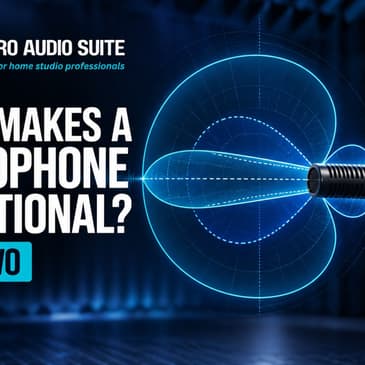
Y'all ready to be history? Welcome. Pro Audio Suite. These guys are professional. They're motivated. With Tech to the VO stars. George Whittam. Founder of Source Elements. Robert Marshall. International Audio Engineer. Darren Robbo Robertson. And Global Voice. Andrew Peters. Thanks to Tribu. Austrian Audio. Making Passion Heard. Source Elements. George the Tech Whittam. And Robbo and AP's International Demos. To find out more about us, check theproaudiosuite.com. Line up, ladies! Here we go. And welcome to another Pro Audio Suite. This week we're going to continue talking about the Neumann factory because I was watching a couple of tours of the Neumann factory. One was Warren Hewitt. He was like a pro. Which was interesting. But the most fascinating one was Rick Beato. And there was something that came up in the anechoic chamber where they were talking about cardioid, supercardioid, hypercardioid. Yeah. Now a lot of people claim to have hypercardioid on their microphone, but this could be completely wrong. And there's going to be some audio nerd out there that's going to go, what are you talking about? But their tech guy was talking about hypercardioid and said the only true hypercardioid is a shotgun mic. And also it has to be a certain length. Yeah. And if you look at the Sennheiser 41.6, And you look at the slots in the side, they measure at 15 centimeters, which is about six inches. Six inches from what to what? From the slots in the side of the microphone. From the tip of the microphone to where the slots end. Yeah, which is where the... Six inches. Yeah, which is basically where the capsule is, isn't it? Down at the bottom there. Right, nearly, yeah. They're saying that the only true hypercardioid is an interference tube, Mike? It's the length, it's the key, which is what I've found fascinating because I never knew this. A pressure gradient capsule and a conventional slotted interference tube. Oh, there you go. Lovely. I'll put my dust coat away. But what he was saying was, which I didn't know, but anything above 1K, the wavelength... is 30 centimeters or a foot. And the slots in the side of the 41.6 is six inches or 15 centimeters. So it's actually half a sound wave, which creates the hypercardioid. Interesting. It's pretty interesting. Have you ever seen like, especially the early designs of some of the interference tubes? No. It's imagine like a, each tube is like a cigarette, but you have all these cigarettes of different lengths. Oh yeah, yeah, yeah. Okay. So the sound goes in onto one tube at one point in its phase, but then the sound goes into the other tube at another point in its phase. Right. And because those two points end up at the diaphragm, you know, the pressure, they cancel out or they don't cancel out because it's capturing the sound basically at a different physical point in the distance from the, From the diaphragm, essentially. It's kind of funny that they're called shotgun mics. They actually originally resembled more of like a gatling gun. Yeah, it should be a gatling gun mic. Or a rotary gun. Because they had multiple barrels in a spiral or a circle. And each one of those was a different length, tuned to a harmonic, I guess? Yeah, it's hard to... Because that's why they are known for getting all comb-filtery. But I think the newer designs have a way of... Smoothing that out, not having so many tubes, which obviously can rip the waveform apart in terms of peaks and valleys. Yeah. But it's still the same basic idea, which is to get the sound to arrive to the same sound to arrive to the capsule at, it's not really, people say at a different time, and it's not really a different time. It's at a different point in its phase, essentially. Is that why if you're in a live room with like a 416, you get combing? Well, yeah, so as the signal goes up in higher frequency, they say that the pattern gets lobar, lober, or lobar, and so it gets these lobes. Lobes are like bulbs or growths that sort of stick out the side of the mic. They're weird sensitive. Yeah, they're not necessarily a good thing. And when you look at a polar pattern of the 416, for example— you'll notice that at different frequencies, the off-axis response is real not smooth, like very bumpy. There's little jaggedy lines representing what audio gets passed through to the capsule at off-axis. And so that's mainly a bad thing. But in a really dead booth, it can almost work to your advantage if your booth is dead enough, because it will make you sound like it's you and a mic and nothing, just the most dead sound you can Imagine this side of an anechoic chamber. If you stay on mic, like this is why it works in a booth. If you stay on axis, you're giving it 90% on axis signal. So there's none of that jaggedness. And then if you're in a dead booth, the other... signal is not bouncing off the walls and getting back into the mic. So those lobes, those jagged lobes are virtually not there in a booth. And that's why the mic has this hyper-focused sound because it's. But that's also why a 416 can sound really bad in a booth without great treatment. Because then it does sort of focus in and pick up those reflections and give you that interior mix of signal and it can sound really pretty bad so. It's bad bad reflections going through a so the reflection happens and has its own weird frequency focusing or enhancements and it whatever it peaks up at 300 hertz and then the microphone's got another lobe at 250 and now you're really like picking up this one you know because it's coming in off access where the mic has really bad coloration right and the wall colors it badly Yeah, you're trying to make the walls go away. That's what you're trying to do with the booth. Yeah, so I think when Rode came along with the NGG-5, they threw out the book and started over, and they're like, how can we design something that has that same positive effect of directionality without the negative effect of the low bar? And that's what they designed with the NGG-5. It does not have the weird low bar side pattern, side pickup. It has a very smooth... off-axis response so ngg5 theoretically should be the best of all worlds because it's more directional but it's more it's more friendly to somebody who's moving around a lot more because as they get off center. But more directional at what frequencies it's a shorter mic so it cannot be as it. Is a shorter viral directional yeah it is. Yeah, so as it goes lower in frequency, it's just got to be less directional, because physics-wise, it's. Like, how is it going to. Yeah, but does that really matter in a small, small booth where all you're really trying to do. If you're going after a voice, I mean, what do you care about anything below 100 hertz? Well, not unless you're AP. Maybe. Right, then like 1K or something is all that. Yeah. Well, I mean, in a small booth, you're just trying to get rid of the low-frequency standing waves. You know, you're just trying to kill off those modes. You know, room modes are all those things that resonate based on the size of your booth, literally dimensionally, right? And they're there all the time. It's just you're trying to kill them so that they don't get picked up at the mic. They're there in the room, but as long as the mic isn't hearing them, it doesn't matter, you know? And so that mic does a pretty good job of dealing with that. Yeah, you're trying to keep them from reflecting off. The room node exists because the room has a certain dimension. Mathematically, if you put an acoustic mirror there, the room node would be very present. And then as you put that acoustic foam there, you're suppressing it because even though mathematically a wall that's this far apart is going to have this resonance to it, if the sound never bounces off of it, there's nothing to resonate. The problem is that the thinner the acoustic foam, the shorter the mic, it can't make low frequencies as super directional. So it starts to become more omnidirectional low frequencies. And the acoustic foam, the thinner it is, it's just not going to absorb low frequencies. It does less and less at lower frequency. Yeah, I mean, most people buying a booth with two inches of foam is only getting treatment down to 1,000 hertz. That's about it. Maybe 500, a little bit at 500. After that, it's not doing anything. Yeah, it doesn't cut off all at once. It's a continuum. But yeah, man, down to 200, 100, that foam might as well not even be there. It's not doing anything at all. So that's why so many people end up buying booths and having this terrible sound. Have you ever been in an anechoic chamber? I still have yet to be in one. I'm still dying to get into one. I just haven't done it. You know the classic Auralex wedge foam, like that stuff, right? Sure. Okay. An old, I don't know about new, but an old, at least, anechoic chamber uses essentially kind of wedge foam, except- It's three feet deep. That thing goes down to forever, right? That wedge is like four feet deep. Yeah. It's really deep. So, are you prepared to give away the entire size of your booth to get down to 20 hertz? The closest thing most people- will ever have in their home is a walk-in closet with two feet of clothing on all the walls. Yeah. That's getting pretty close. And I'll give you something else. My control room is 16 feet. I wanted a 20-foot control room. Why? Because of the length of the wavelength? What's the wavelength of a 20-foot? If you want to do some serious, like, Drum and bass music. The wavelength of a 20 hertz is like 20 feet, I think. I'm not sure what it is. But yeah, I mean, the longer the room and the larger the control room, the better, the more accurate. The more low frequency it can give you accurately. Yeah. Yeah, let's see here. Exactly. A 20-hertz wave. You're going to love this. The physical wavelength of a 20-hertz sound wave is... Let's take some guesses here, guys. Okay. I have no idea. 20 hertz you're talking about? 20 hertz, like the bottom of the human hearing. What? Yeah, that's like theater organ or pipe organ level stuff. Yeah, it is. Nobody's doing that now. How long is that shit? It's probably 50 feet. 56.2 feet. Wow. Wow. Yeah. So your control room is not supporting low frequencies unless it's almost 60 feet long. Do you know the biggest control room I've been in? There was a studio built in Sydney called Rhinoceros, and their control room was absolutely huge. Yeah. So that would have worked quite well for a pipe organ, if they had one. I've always been fascinated by pipe organs. My dad helped restore a theater organ when he was in his 20s, way back in the day. Yeah. To this day, he's still fascinated. He still has like a little miniature pipe organ pipe set up in his living room. That's cool. Yeah. I mean, the subwoofer pipe in there is like four foot long, a four foot long wooden pipe, you know, that makes like maybe 80 Hertz, something like that. There's still a couple of cinemas in, uh, in Australia. There's one in Sydney and we're at the, uh, the premiere of the, uh, Australia at the Adelaide film festival. uh, last year, year before. And, um, there's a cinema there called the Capri. And there was a guy that, you know, comes out, out of the stage playing the pipe organ. And then he disappears back under the stage and the movie comes on. It's fantastic. Oh, he, they have the turn to, they have the lift. Yeah. The console. Yeah. It's very cool. Yeah. Did that one even have a turntable? Do you remember that? No, it didn't, but I think. Could it lift and then rotate the whole console to show the audience? No, it just comes out. Yeah, yeah. They had that at my dad's, the theater my dad worked on. You ever seen the movie The Blob, by the way? Here's some math for you. That was where they shot the movie. It's the half wavelength that matters, by the way. The half wavelength. Right. The half wavelength. So, like, you know, you're talking about a 25-foot control room. Right. Because if not, it's going to start destructively adding. So a tube of six inches what's the minimum frequency that a tube of six inches can actually control them based on all that math and while you're doing that i'm looking at comparing the 416 with this 8060 uh-huh um because the 8060 is what you know what they learned from the 416 yeah as far as i know right it's the newer generation and the 8060 um has almost exactly the same SPL, almost exactly the same sensitivity, almost exactly the same self-noise as an NTG-5. I mean, they're within 10% of each other. Wow. AI is so precise. It depends on the speed of sound and at what altitude. Oh, you've got to be kidding. Of course it does, and the barometric pressure and the humidity. It makes sense, yes. The speed of sound changes as you go up in altitude, so the mic's. Going to change. Okay, here's one for you then if we're going to get nerding out. So Neumann have their anechoic chamber, and they have a set distance to test microphones. So they've got the coaxial speaker pointing at the microphone straight in the middle of the capsule. What do you think the distance is between the speaker and the capsule? I mean, my default guess is one meter. Six feet. Six feet, I see. Ooh, no. 1.24 meters. 1,240 centimeters. 1.24. Okay, so it's more than a meter. And I'm sure they have a very good reason. They're like, that's the point where the sound coming out of the coaxial speaker is fully congealed, is the word. Well, I looked at that and thought, okay, it looks like it's four times the wavelength. Interesting. Okay, here you go. I got the numbers for you. Okay, your little 5-inch shotgun mics only really making directionality at 1,300 on up. Your 10-inch shotgun, which is not even an NTG-5, like a 10-inch. You got to remember there's the preamp, so the whole length of the mic is not the length of the interference tube. Okay? Okay. But a 10-inch shotgun, which I don't think the... Like the NTG-5 is therefore probably, with the preamp and everything, it's probably like 1.5 kilohertz or something on up is directional. 10 inches is going to give you a curve point at around 700 hertz. And a 20-inch shotgun, which is a true shotgun, is going to start its curve at around 300 to 400 hertz. Wow. So basically, all these mics in the critical voice range... The frequency range where the voice is the most prominent and where the room modes of a booth have the most effect is they're essentially omni. They're not fully omni. Would they be figure eight? No, because to be figure eight, you have to be a ribbon mic. You have to have two signals opposing. The only true figure eight is a ribbon. No, but when you see some cardioid patterns... Or you need two capsules. Actually, your large diaphragm condenser is not a true figure eight because those two capsules are still a few centimeters, like microns or whatever, away from each other. To be a true figure eight, both sides of the capsule have to be the same active sound receiving side. And technically, whatever the hell it's made out of should be infinitesimally thin. Thus, you have your ribbons. But I was just thinking, you know, if you look at some of the cardioid patterns, when they get a bit weird, and you have the bulb at the back, like with a shotgun, you can see the bulb at the front, and then you can see the bulb extending at the back of the. Yeah, do you know how they make the polar patterns on a mic? No. No. Oh. You have two capsules, right? Yeah. If you run one of them in Omni, and you run the other one. Actually, they're both omni. Yeah, they cut each other. Yeah, and then you flip one out of phase, then you're cutting that out of the omni, and that's why you get that wraparound. Because if you think about it, if you take a figure eight, okay, and an omni, and you add them together, you have a cardioid. And look at the shape, and you'll see it. The figure eight is very much front and back, and the omni's got the side lobes. So when you add the one lobe, you boost it up and you subtract the other lobe, you subtract it. But then those two, that little void in the figure eight is like half volume. It's not fully. And that's why you see the, you know, you have multi-pattern microphones that they don't have like three patterns. They just have a dial. Yeah, yeah, exactly. Because you're just basically mixing between a figure eight and a, I guess, an Omni to to dial in different patterns. That's fascinating. And it's such an old design, right? From the 30s. Yeah. Well, the first cardioid was made by, I'm going to say, I think it was Shure. Yeah, Shure, but that's a different cardioid. So, making a cardioid mic out of two very open diaphragms and adding their polar patterns together is different than what Shure did. Because Shure basically... came up with the idea of let's let some sound around the side of that diaphragm and let it get back into the back of it. And that's going to cancel out. It's like their idea was basically like, let's take the idea that a ribbon microphone is completely dead to the side, but let's not make it so it's a ribbon mic because we have all this apparatus behind it, the coil. They were doing this with a dynamic microphone. So they can't get the sound completely on the backside of that mic, but they could get it around Just in the corner of it. And that's why you get those vents. And it's the same thing. It's basically like an early design of an interference tube. Yeah, because that was back in the 30s. So if you want to take any mic, why is it that when you're on stage and the stupid people grab the mic and come and then it feeds back? Why? The back of the capsule is now being pushed to the front, I'm guessing. Not quite. You are preventing. the sound from getting to the back of the capsule, and you're effectively taking your SM57, making it an Omni. And now it hears your monitors. And then the response goes out of whack, too. Yeah, because the mic is tuned to compensate for these... weird things that happen when you're doing the interference. But yeah, so Shor invents the idea of interference to create. A polar pattern. The unidyne thing. That's the unidyne, right? Yes. That's the unidyne. They patented that. And when was that? That was the 1930s, right? We were here in Chicago. Yeah. That was in the 30s. Interesting. So Neumann then quickly, they followed suit with their condenser design and creating a directional condenser. They were like, we want to do it with a condenser instead of dynamic. Now, RCA was doing condensers a little bit before or at the same time as Neumann. But yes, Neumann's the first one to really make a marketable product. Fascist microphone. Sorry. Well, it was the CMV564. But it was the first one to really have a, like, you know, the RCA one was just like probably like stupid expensive and one-offs. It's more experimental. Yeah. And then I was looking at, you know, there's a whole range of different shotgun mics from, you know, Sennheiser. And the 80s, 70s, that's their long one. That's the very long one. That's 465 millimeters long, the barrel of the mic. That's probably like around 20. That's probably like two feet. Almost two feet, yeah. And then the NTG-5 is the shorty at 203. Now, the 8060 is even shorter than the NTG-5. The 8060 is. And that has a very, very similar quality to the NGG-5s. In terms of a smooth off-axis response. So what's funny is when you're looking at comparing mics to mics to mics and price point, the NTG-5 really is actually a lot like an 8060. So you're basically getting a very similar performing mic for $ 1, 000 less. Oh, wow. Roughly. Because the 8060s are, what are those, $ 1, 200 to $ 1, 500 US? Yeah. I think, at least. They're not cheap. So the NTG-5 is really going to sound more like an 8060. The 416 is theoretically not the best of any of these mics. Like, it's the least preferable for a voiceover booth. But, you know, it has a sound, and we're all pretty used to it. Yeah, true. So, it's kind of hard to move away from it. I think that's the thing about the 416, is that it's loved for its imperfection. And maybe also it's that idea that, like, you know, everyone... got so used to it that it became the sound even though on paper it is not mathematically flat or in any way like yeah well. It was funny because i heard i saw a youtube video yesterday talking about the 41 six and the guy getting talked about you know how it works and why it's good for voiceover and blah blah blah and it became industry standard thanks to one man The question is, who do you think that man was that this person referred to? Ernie Anderson. Nope. Tyler LaFontaine? Nope. I mean, these are the obvious ones, and Ernie is the guy that did it, but yeah. I don't know. He gave the credit to Joe Cipriano. Oh, really? Yeah. No. I mean, Joe was doing a lot of home stuff and using. A 416 a lot, but. Yeah, but it was already well into the industry standard by then. He didn't come up with it. It was. Yeah, I mean, he uses it. I think it's because Joe, you know, has always been very outward facing about what he's doing. Yeah, true. You know, very public, you know? Like, this is what I'm doing, this is how I do it, da-da-da-da. And I think everybody else was a little... They weren't quite as... You know, it didn't have as much of a public persona and presence like Joe did. Or does. Sorry, Joe. Yeah, true. He's still with us very much so. Well and truly. The 416 has an effective interference tube of about 5 inches, giving it a turn frequency around 2k. Okay. After which point the capsule itself is what dominates its polarity, not the interference tube. Well, do you like the way it sounds better than the CC8? Because I switched them out. Ah. So what do you want? That looks like a 416. Yeah. Yeah, with the world's worst pop screen. Yeah. Like the $ 10 one that's worth five cents. But yeah, I don't even really need a pop screen on it. I mean, actually, the pop screen from the CC8 is probably a better pop screen than really anything else. Yeah, it doesn't sound too bad at all. Yeah. There's just something about the smile, the disco smile that it has. It's got a bit of that top-end lift that sounds nice with my voice because I tend to have a dark voice. So here's what I want to know. A CC8, they make a CC8 that's hypercardioid and a CC8 that's supercardioid. Supercardioid, right, and cardioid. And then also you have other microphones that are what's called a wide cardioid, which a lot of classical engineers like because they're not as colored on the extremes. But all of these mics, if you didn't know what they were from five feet away, you wouldn't be able to tell one from the other. Yeah. There's more to it than just the length of these interference tubes. Somehow they're tweaking the directionality maybe by the size of the slots and how much of the sound they let in. I don't know. It's like this is all the voodoo. Well, I think the ultimate voodoo mic is this Earthworks that I have here. Because this Earthworks mic I'm talking into now is a very small omni capsule by design, right? Tiny diaphragm. It's like the size of the end of a pencil. Pencil eraser. It's the size of your thing. Speak for yourself. It's the size of the eraser of a pencil. It's about the size of a capsule in this Ethos mic. But yet they figured out how to give it directionality and give it like a cardioid or super cardioid pattern. But that's all about the body design, the slots. It's got little holes machined into the tube that the capsule's attached to. It's a whole thing, you know? And it does a good job. It's really funny with the NTG5. When we first started reviewing that, we actually really loved those microphones. And I recommended them to quite a few people who bought them. And they loved them. It's funny going back to it and using it again. Because there's something about the NTG5 that's really, it's like a 41.6 without the toothpick. Yeah, with balls. Yeah. Yeah, yeah. It's a great mic. I hope they've worked out all their manufacturing issues. We had numbers of users with odd issues. Yeah, they would die. I think I had one person that had two replacements, maybe. Wow. So I'm hoping whatever that bad component they got stuck with, they must have gotten stuck with a bad batch of diodes or something. Bad batch. Yeah. Either that or a bad... Somebody hates you working for them. Well, I mean, these things are notoriously robotically built, the Roguelikes are. You know, they're known for that, you know... the way they're manufactured being primarily automated and thereby they're a perfect, you know, each mic theoretically is a perfect match, you know? Yeah. Is it a, what do you call it? A RF mic? Is the NTG5 RF? Yeah, it's RF. It is RF mic. It is. So that emulates the 416's design. Yep. What's crazy is, so the Ethos, I'm just reading, I'm looking at a chart. I'm creating a chart of microphones so I can compare their things is a condenser of course it's a soup this is a super cardioid but it's based around a very tiny teeny weeny omni capsule that's what's inside the thing so it's all about the manufacturer of the mal that's i'm like. And and because it's a because it's earthworks it's an electric it's not a true condenser oh. Oh is that true interesting okay it's an electric capsule. I'm pretty sure all of Earthworks stuff is electric. Because once a capsule gets down to a certain size. So it's pre-charged. It can't. It'll eventually, I think that too, but it'll eventually die in theory. Well, I've already had one replaced for the record. So in microphone years, then that would be a dog as opposed to a human. Quite possibly, yeah. Yeah, seven years in one. Right. Before it dies. It's good to know. And they fade. I think electrettes, when they start to lose their voltage, they start to lose their high end, I believe. Yeah, that would be the same as... What happens to them. But if they're done right, they last a. A. Fine electrette might only last a month or two. But one of these days... A proper electrette is charged up and will last 20, 30 years or something. One of these days, we'll dig into what a MEMS microphone capsule is. But that's for another time. If you guys want to know all about MEMS microphones, M-E-M-S, let us know. Give us feedback if you want us to dive into what MEMS microphones are. You know what you've just done. You've ruined my week now. I'm going to be bloody online looking at MEMS microphones. By the way, you're already using a MEMS mic. You just don't know it. You're already using one every single day. No. Oh, you telephone. Yeah. Okay. So imagine this. You take a, um, a, highly optically reflective surface that is also infinitely light and thin which they can now make okay and then you bounce a laser off of it and then you receive that bounced laser many feet away so that when it moves, it moves a lot. And now you speak into this infinitely light reflective surface, and you have an optical microphone. Because if you can sense where that laser is moving, you have literally your waveform. I love that. Yeah. That reminds me of the, now what was it, the oldest piece of music that's being replicated. There was some weird thing where it was on paper. but it looked like it was actually a waveform. Does that ring a bell? It was in the 1800s. Some French guy came up with something called, I forgot, the sonogram. And he was able to capture sound, but he had no way of playing it back. And this all got forgotten about. And then in the early 2000s, someone dug it up and threw it into a computer. And we then heard... Because, you know, it's just a waveform at that point. It was just literally a photographic waveform. And people heard what they basically said was the oldest captured sound predating the record by something like 40 years or something. Yeah, probably even more. Yeah, because it was, and I think he speaks as well. It was in the early, it was at the beginning of optical processes with film. So whenever the optical film stuff, early 1800s, middle 1800s. Yeah. Yeah, 1830s or 1840s, something like that. Yeah. Wow. That was amazing. Yeah, it really is. Just for the record, the Ethos electric capsule is a modern design that should last decades before any loss of quality. So they're saying, yeah, electret. Yeah. Yeah, but it is electric. It should last quite a long time. It is electric, yeah. Whereas a condenser, theoretically, I mean, let's face it, the electronics in the mic are going to fail. Before the capsule probably is going to fail. Yeah. Right? Yeah, yeah. I mean, electric mites from the 70s, good electric mites from the 70s are now beginning to fail. Yeah. Right. Cheap ones fail much earlier, but good ones are beginning to fail now. But then, you know, based on that, I mean, my C414, that had to be recapped, and that's I'm 43 years old, but. I had that one. Yeah, and that's the capacitors. That's not electric. The 414 is a true condenser. Yeah, yeah, yeah. I'm saying things do fail, and that had to be replaced. And then, of course, the tube's gone, and the gefell. But the difference is when an electric mic fails, you're doing open-heart surgery. I mean, no, you could put a new electric capsule in it. It needs a new capsule. Yeah, cool. That's all. Is the capsule in the... Is a CAD E100S an electorate as well? I don't know for sure, but a lot of less expensive microphones, even if they're a large diaphragm, it does not mean that they are or are not true condensers. For example, I believe if you look at, we'll play a game here, Audio-Technica 4033, electorate or true condenser? 4033, that's got to be true condenser. I don't think so. Really? I don't think so. Well, I just looked it up. The Caddy 100S is an electric permanently biased condenser. And it's super cardioid. That's another super cardioid. A 4033 is electric. No kidding. Yeah. A lot of mics are electric. They're not true, true condensers. And it has nothing to do with large or small diaphragm. It's just in how it's charged and powered. Fascinating. Because the phantom power is there also for the preamp. But the charging of the capsule... which is like the capacitor part of it, which is what measures like as the capacitance changes, that's either pre-charged or it gets charged up every time. Yeah, a lot of, so interesting, like a 4040 and a 4050, those are true condensers, but the 4033, electret. It will die. Yes, that is interesting. On that note, I think it's time to get down to electret avenue. That's actually right down the street from me by the way what's his name Grant what's his name Eddie Grant who did that song Electric Avenue I have to assume they're talking about Venice because we actually have Electric Avenue right down the street it's right along Abbot Kinney and everybody on that street is high as. Fuck yeah yeah they're all plugged in that's for sure. That's right And it will fade out like an electric capsule. Yeah, it wasn't a cold end, that's for sure. Well, that was fun. Is it over? The Pro Audio Suite. With thanks to Tribo. And Austrian Audio. Recorded using Source Connect. Edited by Andrew Peters. And mixed by Robbo. Got your own audio issues? Justaskrobo.com. And tech support from George the Tech Whittem. Don't forget to subscribe to the show and join in the conversation on our Facebook group. To leave a comment, suggest a topic, or just say g'day, drop us a note at our website, theproaudiosuite.com.