
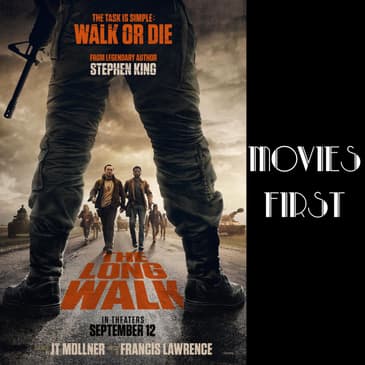
Listeners will be captivated by the chilling premise and the way it reflects our current obsession with competition and entertainment. Directed by Francis Lawrence, known for his work on the Hunger Games series, the film expertly builds tension as we witness the physical and mental deterioration of 50 teenage boys, each vying for a chance at a better life.
The hosts discuss standout performances, particularly Mark Hamill's chilling portrayal of the Major, a character that embodies the cold mechanics of this oppressive system. Cooper Hoffman shines as Ray Guerretti, navigating the emotional turmoil of familial absence, while Judy Greer's portrayal of his mother adds a poignant layer of parental fear and desperation.
As the narrative unfolds, the friendship between Ray and David Johnson's character, Peter McVeeze, provides a glimmer of hope amidst despair, showcasing the human spirit's resilience even in dire circumstances. The episode highlights the film's technical brilliance, from its unstable cinematography to the relentless sound design that immerses viewers in the contestants' harrowing journey.
Chris and Jessica also explore the film's unsettling elimination system, a metaphor for modern life’s pressures and the commodification of human suffering. With a rating of 8 out of 10, *The Long Walk* serves as a thought-provoking reflection on our societal trajectory, urging audiences to confront the uncomfortable truths of survival as a competition and suffering as entertainment.
https://www.bitesz.com/podcast/movies-first
Become a supporter of this podcast: https://www.spreaker.com/podcast/movies-first.
To access the Movies First reviews archive visit our website at www.bitesz.com/podcast/movies-first
To access the Movies First reviews archive visit our website at www.bitesz.com/podcast/movies-first
00:00:00 --> 00:00:02 Chris: Imagine a world where teenagers literally
00:00:02 --> 00:00:04 walk themselves to death for a shot at the
00:00:04 --> 00:00:07 American dream. Well, that
00:00:07 --> 00:00:10 dystopian nightmare has hit theaters with
00:00:10 --> 00:00:13 the Long Walk, and it feels disturbingly
00:00:13 --> 00:00:13 close to home.
00:00:14 --> 00:00:16 Jessica: The timing of this adaptation couldn't be
00:00:16 --> 00:00:19 more relevant, especially considering it's
00:00:19 --> 00:00:21 based on Stephen King's first ever novel.
00:00:22 --> 00:00:23 How do you think it reflects our current
00:00:23 --> 00:00:24 reality?
00:00:25 --> 00:00:27 Chris: Well, what's fascinating is how it takes this
00:00:27 --> 00:00:30 simple concept, walking at exactly 3 miles
00:00:30 --> 00:00:33 per hour or face execution, and turns it
00:00:33 --> 00:00:36 into this brutal commentary on economic
00:00:36 --> 00:00:38 inequality. You know, in the film's world,
00:00:38 --> 00:00:40 this twisted competition is the only way out
00:00:40 --> 00:00:41 of poverty.
00:00:41 --> 00:00:44 Jessica: That's exactly what makes it so chilling, the
00:00:44 --> 00:00:46 way it mirrors our own society's obsession
00:00:46 --> 00:00:48 with competition and entertainment.
00:00:49 --> 00:00:51 Chris: And Francis Lawrence, fresh from the Hunger
00:00:51 --> 00:00:53 Games series, brings this incredible tension
00:00:53 --> 00:00:56 to every scene. The way he shows these 50
00:00:56 --> 00:00:59 teenage boys slowly breaking down, both
00:00:59 --> 00:01:01 physically and mentally, is masterful.
00:01:02 --> 00:01:04 Jessica: Let's talk about Mark Hamill as the Major.
00:01:05 --> 00:01:07 Such a departure from his usual roles, right?
00:01:08 --> 00:01:11 Chris: Oh, man. He brings this cold, calculating
00:01:11 --> 00:01:13 presence that makes you understand how this
00:01:13 --> 00:01:15 whole system could actually work. But what
00:01:15 --> 00:01:18 really got me was Cooper Hoffman as Ray
00:01:18 --> 00:01:20 Guerretti. There's this raw
00:01:20 --> 00:01:22 authenticity in how he portrays this kid
00:01:22 --> 00:01:24 carrying the weight of his father's absence.
00:01:25 --> 00:01:27 Jessica: The relationship between Ray and his mother,
00:01:27 --> 00:01:29 played by Judy Greer, really hits hard.
00:01:30 --> 00:01:32 Those scenes where she's begging him not to
00:01:32 --> 00:01:34 participate. You can feel every parent's
00:01:34 --> 00:01:35 worst nightmare.
00:01:36 --> 00:01:38 Chris: And then there's David Johnson as Peter
00:01:38 --> 00:01:41 McVeeze. The way their friendship develops
00:01:41 --> 00:01:43 while they're literally walking to their
00:01:43 --> 00:01:45 death adds this whole other layer of
00:01:45 --> 00:01:48 emotional complexity. It's like watching
00:01:48 --> 00:01:51 hope grow in the most hopeless situation.
00:01:51 --> 00:01:53 Jessica: Well, what really struck me was how they
00:01:53 --> 00:01:56 handle the physical deterioration. The
00:01:56 --> 00:01:59 cinematography gets increasingly unstable as
00:01:59 --> 00:02:00 the contestants get more exhausted.
00:02:01 --> 00:02:04 Chris: That's exactly right. The
00:02:04 --> 00:02:07 technical aspects are incredible. The sound
00:02:07 --> 00:02:09 design with the constant footsteps, the
00:02:09 --> 00:02:11 labored breathing. It all creates this
00:02:11 --> 00:02:13 relentless rhythm that just builds and
00:02:13 --> 00:02:14 builds.
00:02:15 --> 00:02:16 Jessica: And they don't shy away from showing the
00:02:16 --> 00:02:18 brutal consequences when someone falls below
00:02:18 --> 00:02:20 that 3 mile per hour limit.
00:02:21 --> 00:02:23 Chris: You know what's really interesting? The way
00:02:23 --> 00:02:26 they handle the elimination system. Three
00:02:26 --> 00:02:29 warnings, then you're shot. No excuses, no
00:02:29 --> 00:02:31 breaks. Not even for basic human needs.
00:02:32 --> 00:02:34 It strips away every shred of dignity.
00:02:35 --> 00:02:37 Jessica: The psychological horror of that constant
00:02:37 --> 00:02:39 pressure. It's almost like a metaphor for
00:02:39 --> 00:02:40 modern life, isn't it?
00:02:42 --> 00:02:44 Chris: Absolutely right. And the wish they
00:02:44 --> 00:02:47 promised the winner. It's like this cruel
00:02:47 --> 00:02:50 carrot dangling in front of them. It reminds
00:02:50 --> 00:02:52 me of how systems often exploit people's
00:02:52 --> 00:02:55 desperation with false promises of mobility.
00:02:56 --> 00:02:58 Jessica: The way Lawrence paces. The revelations about
00:02:58 --> 00:03:00 each character's background really makes you
00:03:00 --> 00:03:03 invest in their stories, even though you know
00:03:03 --> 00:03:04 most won't survive.
00:03:05 --> 00:03:07 Chris: That's what elevates us beyond just another
00:03:07 --> 00:03:10 dystopian thriller. Every death carries
00:03:10 --> 00:03:12 weight because we've gotten to know these
00:03:12 --> 00:03:15 characters, understand their motivations,
00:03:15 --> 00:03:15 their dreams.
00:03:16 --> 00:03:18 Jessica: So what do you think the film is ultimately
00:03:18 --> 00:03:20 saying about our society's direction?
00:03:21 --> 00:03:24 Chris: Well, it's warning us about treating survival
00:03:24 --> 00:03:26 as a competition and suffering as
00:03:26 --> 00:03:29 entertainment. Like we're already doing this
00:03:29 --> 00:03:31 in subtle ways. Reality tv,
00:03:32 --> 00:03:35 social media contests, even, even some
00:03:35 --> 00:03:36 aspects of our economic system.
00:03:37 --> 00:03:39 Jessica: The parallels to present day America are
00:03:39 --> 00:03:41 pretty unsettling when you think about it.
00:03:42 --> 00:03:44 Chris: Exactly. While it might be set in a
00:03:44 --> 00:03:46 dystopian future, its themes of economic
00:03:47 --> 00:03:49 inequality, exploitation, and the
00:03:49 --> 00:03:51 commodification of human suffering feel very
00:03:51 --> 00:03:54 much rooted in our present reality. It's
00:03:54 --> 00:03:56 the kind of film that makes you question the
00:03:56 --> 00:03:58 path we're on as a society.
00:03:59 --> 00:04:01 Jessica: And that ending, without spoiling it, really
00:04:01 --> 00:04:03 drives those points home.
00:04:04 --> 00:04:05 Chris: M. You know, that's what makes this film so
00:04:05 --> 00:04:08 effective. It's not just showing us a
00:04:08 --> 00:04:10 possible future, it's holding up a mirror to
00:04:10 --> 00:04:13 where we are right now. The world they create
00:04:13 --> 00:04:15 feels like it's just a few wrong turns
00:04:16 --> 00:04:17 away from our own reality.
00:04:18 --> 00:04:20 Jessica: Well, it certainly gives us plenty to think
00:04:20 --> 00:04:20 about.
00:04:21 --> 00:04:23 Chris: And that's exactly what great science fiction
00:04:23 --> 00:04:25 should do, make us uncomfortable enough to
00:04:25 --> 00:04:28 examine our own world more closely. The Long
00:04:28 --> 00:04:30 Walk definitely succeeds on that front,
00:04:30 --> 00:04:33 making it a journey worth taking even if it's
00:04:33 --> 00:04:36 not an easy one. It scores an 8 out of 10.
00:04:36 --> 00:04:38 Voice Over Guy: You've been listening to movies first
00:04:38 --> 00:04:41 available at Apple Podcasts, Spotify,
00:04:41 --> 00:04:44 iHeartRadio or your favorite podcast
00:04:44 --> 00:04:46 player. You can also stream on
00:04:46 --> 00:04:48 demand@bytes.com this.
00:04:48 --> 00:04:50 Chris: Has been another quality podcast production
00:04:50 --> 00:04:52 from bytes.com.