
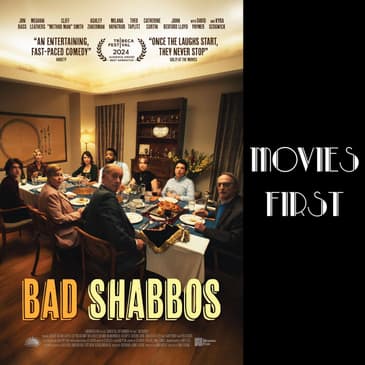
Listeners will appreciate the dynamic cast, including Kyra Sedgwick as the conflicted mother grappling with her daughter's conversion, and the unexpected yet delightful appearance of Method Man as the doorman caught in the unfolding chaos. Chris and Jessica unpack the film's exploration of interfaith relationships and family acceptance, highlighting how it resonates with nearly 50% of Jewish Americans navigating similar challenges in their own lives.
The hosts discuss the film's unique setting—a cramped 10th-floor apartment—where the pressure of familial expectations amplifies the comedic stakes. They draw attention to the character of Benjamin, David's sister's insufferable boyfriend, whose antagonism adds fuel to the already volatile family dynamics, creating a pressure cooker of hilarity.
As the plot thickens, the hosts reflect on the film's ability to tackle serious themes like mental health and religious identity through a comedic lens, illustrating how laughter can emerge from chaos. They note the clever production design that authentically captures the essence of Jewish culture while serving as a backdrop for farcical events.
Ultimately, *Bad Shabbos* resonates as a relatable tale of family gatherings gone awry, reminding us that regardless of our backgrounds, we all share the universal experience of wanting our important moments to go smoothly. With a commendable score of 7.5 out of 10, this film invites viewers to embrace the discomfort of family dynamics and find joy in the laughter that follows.
https://www.bitesz.com/podcast/movies-first
Become a supporter of this podcast: https://www.spreaker.com/podcast/movies-first.
To access the Movies First reviews archive visit our website at www.bitesz.com/podcast/movies-first
To access the Movies First reviews archive visit our website at www.bitesz.com/podcast/movies-first
This episode includes AI-generated content.
00:00:00 --> 00:00:02 Chris: Family dinners going catastrophically wrong.
00:00:02 --> 00:00:04 We've all been there. But imagine a, uh,
00:00:04 --> 00:00:07 Shabbat dinner where things go so sideways it
00:00:07 --> 00:00:09 turns into a Jewish version of Weekend at
00:00:09 --> 00:00:10 Bernie's.
00:00:11 --> 00:00:13 Jessica: The premise of this film, Bad Shabbos is
00:00:13 --> 00:00:16 absolutely genius. Taking the classic meet
00:00:16 --> 00:00:18 the parents scenario and adding layers of
00:00:18 --> 00:00:21 religious tradition, family tension, and what
00:00:21 --> 00:00:22 sounds like an actual disaster.
00:00:24 --> 00:00:25 Chris: You know what makes this particularly
00:00:25 --> 00:00:28 fascinating? The film tackles this
00:00:28 --> 00:00:30 intersection of traditional Jewish culture
00:00:30 --> 00:00:33 with modern interfaith relationships.
00:00:33 --> 00:00:36 Something that nearly 50% of Jewish Americans
00:00:36 --> 00:00:38 now navigate in their own families.
00:00:38 --> 00:00:41 Jessica: That statistic really puts the pressure on
00:00:41 --> 00:00:43 our main character David, played by John
00:00:43 --> 00:00:45 Bass, who's trying to introduce his Catholic
00:00:45 --> 00:00:47 girlfriend Meg to his traditional Jewish
00:00:47 --> 00:00:49 family during one of the most important
00:00:49 --> 00:00:51 weekly rituals.
00:00:51 --> 00:00:53 Chris: And let's talk about the brilliant casting.
00:00:53 --> 00:00:56 Here you've got Kyra Sedgwick playing this
00:00:56 --> 00:00:59 mother who's struggling to accept her future
00:00:59 --> 00:01:01 daughter in law, even though Meg is
00:01:01 --> 00:01:04 actively converting. It's like watching a
00:01:04 --> 00:01:06 pressure cooker being sealed tight.
00:01:07 --> 00:01:09 Jessica: Well, speaking of pressure, they've cleverly
00:01:09 --> 00:01:11 set this whole thing in a 10th floor
00:01:11 --> 00:01:13 apartment. There's literally nowhere to
00:01:13 --> 00:01:15 escape when things start going wrong.
00:01:15 --> 00:01:18 Chris: The genius of this setup is how they layer
00:01:18 --> 00:01:21 the complications. You've got Benjamin,
00:01:21 --> 00:01:23 this absolutely insufferable boyfriend of
00:01:23 --> 00:01:26 David's sister Abby, who's antagonizing their
00:01:26 --> 00:01:28 troubled younger brother Adam. It's like
00:01:28 --> 00:01:31 placing a lit match next to a powder keg.
00:01:31 --> 00:01:34 Jessica: Mhm. And then they bring in Method man as
00:01:34 --> 00:01:36 this doorman who gets wrapped up in whatever
00:01:36 --> 00:01:39 chaos ensues. That's such an unexpected
00:01:39 --> 00:01:41 casting choice that apparently really pays
00:01:41 --> 00:01:41 off.
00:01:42 --> 00:01:45 Chris: You know what's fascinating? The way they're
00:01:45 --> 00:01:47 using comedy to explore these really complex
00:01:47 --> 00:01:49 themes about family acceptance, mental health
00:01:49 --> 00:01:52 and religious identity. It's like they're
00:01:52 --> 00:01:54 serving serious issues with a side of
00:01:54 --> 00:01:55 slapstick.
00:01:55 --> 00:01:57 Jessica: The timing of everything seems so precisely
00:01:57 --> 00:02:00 orchestrated, especially how Meg's parents
00:02:00 --> 00:02:02 arrive from Milwaukee right after whatever
00:02:02 --> 00:02:03 catastrophe happens with Benjamin.
00:02:04 --> 00:02:07 Chris: Right, and here's where the Weekend at
00:02:07 --> 00:02:10 Bernie's comparison comes in. Whatever Adam
00:02:10 --> 00:02:12 does in response to Benjamin's antagonism
00:02:13 --> 00:02:15 leads to this massive cover up attempt.
00:02:16 --> 00:02:18 All while trying to maintain the sanctity of
00:02:18 --> 00:02:18 Shabbat.
00:02:19 --> 00:02:21 Jessica: That must create some uniquely Jewish comedy
00:02:21 --> 00:02:24 moments. Like how do you handle an emergency
00:02:24 --> 00:02:26 situation when you're not supposed to use
00:02:26 --> 00:02:27 electricity or phones?
00:02:29 --> 00:02:31 Chris: Exactly. And consider this. They've got
00:02:31 --> 00:02:34 David Pamer playing this father with peculiar
00:02:34 --> 00:02:36 grounding techniques, meticulously placing
00:02:36 --> 00:02:39 cutlery while chaos erupts around him.
00:02:40 --> 00:02:42 It's such a perfect metaphor for trying to
00:02:42 --> 00:02:44 maintain tradition in the face of modern
00:02:44 --> 00:02:44 mayhem.
00:02:44 --> 00:02:47 Jessica: Um, the production design apparently really
00:02:47 --> 00:02:49 sells the whole thing, too, creating this
00:02:49 --> 00:02:51 space that feels authentically Jewish while
00:02:51 --> 00:02:53 still working as a setting for farce.
00:02:54 --> 00:02:56 Chris: You know what's really clever about the
00:02:56 --> 00:02:58 structure? They open with this rabbi telling
00:02:58 --> 00:03:00 a story on the street below the apartment.
00:03:00 --> 00:03:02 It's like they're saying, you think you know
00:03:02 --> 00:03:04 where this is going. Just wait.
00:03:05 --> 00:03:07 Jessica: So what do you think makes this film resonate
00:03:07 --> 00:03:08 enough to be chosen as the opening night
00:03:08 --> 00:03:10 feature for the Jewish International Film
00:03:10 --> 00:03:11 Festival?
00:03:12 --> 00:03:14 Chris: Well, it's doing something really special.
00:03:14 --> 00:03:17 It's taking these specific cultural elements
00:03:17 --> 00:03:19 and making them universally relatable.
00:03:20 --> 00:03:22 Everyone understands the anxiety of wanting
00:03:22 --> 00:03:25 an important family gathering to go perfectly
00:03:25 --> 00:03:28 and the comedy that ensues when it
00:03:28 --> 00:03:29 spectacularly doesn't.
00:03:29 --> 00:03:32 Jessica: That's true. Whether it's Thanksgiving,
00:03:32 --> 00:03:35 Passover, or any big family dinner,
00:03:35 --> 00:03:37 we've all experienced that moment when things
00:03:37 --> 00:03:38 start to unravel.
00:03:39 --> 00:03:41 Chris: And in the end, that's what makes this film
00:03:41 --> 00:03:43 work so well. It's showing us that no matter
00:03:43 --> 00:03:45 our background or beliefs, we're all just
00:03:45 --> 00:03:47 trying our best to keep it together. When
00:03:47 --> 00:03:49 everything's falling apart, sometimes the
00:03:49 --> 00:03:52 best response is just to laugh. The way to
00:03:52 --> 00:03:54 get the most out of Bad Shabbos is to dive in
00:03:54 --> 00:03:57 headfirst and let the discomfort drive you to
00:03:57 --> 00:04:00 mirth and merriment. It scores a seven and
00:04:00 --> 00:04:01 a half out of ten.