
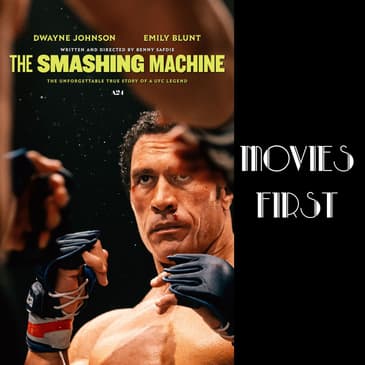
Listeners will appreciate the authentic depiction of the late 90s MMA scene, a time characterized by minimal oversight and evolving rules. Chris and Jessica highlight how the film captures the raw essence of the sport, with Ryan Bader's grounded performance as Coleman providing a stark contrast to Kerr's struggles. They discuss the thin line between athletic dedication and self-destruction, emphasizing how the very traits that elevate an athlete can also lead to their downfall.
Emily Blunt's heartbreaking portrayal of Don Staples adds depth to the narrative, particularly in her attempts to reach Kerr during his darkest moments. The hosts commend the film's cinematography, which immerses viewers in the fight scenes without glorifying the violence, instead focusing on the physical and emotional toll on the fighters.
Benny Safdie's direction is praised for its documentary-like feel, allowing real human struggles to unfold naturally. While some criticism arises regarding the pacing, Chris and Jessica argue that the slower moments serve to deepen the audience's understanding of Kerr's tragic descent.
Ultimately, *The Smashing Machine* emerges as a cautionary tale about the dark side of athletic ambition, exploring universal themes of ambition, relationships, and the sacrifices made for greatness. With a solid score of 7.5 out of 10, this film resonates beyond the realm of sports, inviting reflection on the true cost of success.
https://www.bitesz.com/podcast/movies-first
Become a supporter of this podcast: https://www.spreaker.com/podcast/movies-first.
To access the Movies First reviews archive visit our website at www.bitesz.com/podcast/movies-first
To access the Movies First reviews archive visit our website at www.bitesz.com/podcast/movies-first
This episode includes AI-generated content.
00:00:00 --> 00:00:02 Chris: Mixed martial arts seems like pure aggression
00:00:02 --> 00:00:05 and violence, but the smashing machine
00:00:05 --> 00:00:08 reveals a shocking truth. How the pursuit
00:00:08 --> 00:00:11 of athletic greatness can lead to complete
00:00:11 --> 00:00:12 self destruction.
00:00:13 --> 00:00:15 Jessica: You know what fascinates me about this film?
00:00:16 --> 00:00:18 Seeing Dwayne Johnson completely transform
00:00:18 --> 00:00:21 himself into Mark Kerr. It's like watching a
00:00:21 --> 00:00:22 different person entirely.
00:00:23 --> 00:00:25 Chris: The physical transformation is remarkable,
00:00:26 --> 00:00:28 but what really got me was how he captured
00:00:28 --> 00:00:31 Kerr's psychological descent.
00:00:31 --> 00:00:34 Here's this powerful fighter who starts as a
00:00:34 --> 00:00:37 gentle giant, then slowly unravels through
00:00:37 --> 00:00:40 painkiller addiction. It's probably Johnson's
00:00:40 --> 00:00:41 most nuanced performance to date.
00:00:42 --> 00:00:45 Jessica: That reminds me the film takes place between
00:00:45 --> 00:00:48 1997 and 2000, when MMA was
00:00:48 --> 00:00:51 still this raw, unpolished sport. The
00:00:51 --> 00:00:53 way they capture that era feels so authentic.
00:00:54 --> 00:00:56 Chris: Well, that's what makes it so compelling. The
00:00:56 --> 00:00:59 sport was basically the Wild west back then.
00:00:59 --> 00:01:02 No standardized rules, minimal oversight. And
00:01:02 --> 00:01:04 you've got these two pioneers, Kerr and
00:01:04 --> 00:01:06 Coleman, literally writing the playbook as
00:01:06 --> 00:01:06 they go.
00:01:07 --> 00:01:10 Jessica: Speaking of Coleman, Ryan Bader brings such a
00:01:10 --> 00:01:13 grounded quality to that role. The way he
00:01:13 --> 00:01:15 portrays Coleman as the stable family man
00:01:15 --> 00:01:17 really highlights Kerr's struggles.
00:01:17 --> 00:01:20 Chris: You know what's fascinating? The film shows
00:01:20 --> 00:01:22 how thin the line is between dedication and
00:01:22 --> 00:01:25 destruction. Like the same drive that
00:01:25 --> 00:01:27 makes Kerr exceptional in the ring ultimately
00:01:27 --> 00:01:29 leads him down this dark path with
00:01:29 --> 00:01:31 painkillers. Hmm. Mhm.
00:01:32 --> 00:01:35 Jessica: And Emily Blunt's portrayal of Don Staples
00:01:35 --> 00:01:37 really brings that home. Those scenes where
00:01:37 --> 00:01:39 she's trying to reach him while he's in the
00:01:39 --> 00:01:41 depths of addiction, they're absolutely
00:01:41 --> 00:01:42 heartbreaking.
00:01:43 --> 00:01:45 Chris: The cinematography during those fight scenes
00:01:45 --> 00:01:47 is intense. Marceo Bishop gets
00:01:47 --> 00:01:50 so close to the action, you can practically
00:01:50 --> 00:01:52 feel every impact. It's not
00:01:52 --> 00:01:55 glorifying the violence, it's showing the
00:01:55 --> 00:01:57 raw physical toll of the sport.
00:01:58 --> 00:01:59 Jessica: Well, that's what sets this apart from
00:01:59 --> 00:02:02 typical sports movies, right? It's more
00:02:02 --> 00:02:04 interested in the human cost than the glory
00:02:04 --> 00:02:05 of victory.
00:02:06 --> 00:02:09 Chris: Exactly. And Benny Safdie's direction
00:02:09 --> 00:02:12 maintains this almost documentary like feel
00:02:12 --> 00:02:15 while still crafting these incredibly
00:02:15 --> 00:02:17 intimate character moments. The film
00:02:17 --> 00:02:20 never manufactures drama. It just lets these
00:02:20 --> 00:02:23 very real human struggles unfold naturally.
00:02:24 --> 00:02:27 Jessica: You know what really struck me? The way the
00:02:27 --> 00:02:30 film handles addiction. It feels honest and
00:02:30 --> 00:02:33 unsensationalized, showing how it can affect
00:02:33 --> 00:02:34 even the most disciplined athletes.
00:02:35 --> 00:02:38 Chris: And M, that's what makes this story so
00:02:38 --> 00:02:40 universal. Like, yes, it's about
00:02:40 --> 00:02:42 mma, but it's really about ambition,
00:02:42 --> 00:02:45 relationships, and the price we're willing to
00:02:45 --> 00:02:48 pay for greatness. The
00:02:48 --> 00:02:50 sport is just the lens through which we
00:02:50 --> 00:02:51 examine these bigger themes.
00:02:52 --> 00:02:54 Jessica: So what do you think about the criticism that
00:02:54 --> 00:02:56 the pacing sometimes drags?
00:02:57 --> 00:02:59 Chris: Well, there are moments where scenes linger
00:02:59 --> 00:03:01 longer than necessary. But I think that
00:03:01 --> 00:03:04 slower pace serves the larger story.
00:03:04 --> 00:03:06 It gives us time to understand how someone
00:03:06 --> 00:03:09 like Kerr could go from being at the top of
00:03:09 --> 00:03:11 his game to losing everything that matters to
00:03:11 --> 00:03:12 him.
00:03:12 --> 00:03:14 Jessica: The production design really nails that late
00:03:14 --> 00:03:17 90s period too. Everything from the gym
00:03:17 --> 00:03:19 equipment to the tournament venues feels
00:03:19 --> 00:03:20 authentic to the era.
00:03:21 --> 00:03:24 Chris: Um, um. And let's not forget Nala Senefro's
00:03:24 --> 00:03:26 soundtrack. The way it builds tension during
00:03:26 --> 00:03:28 those fight scenes without overwhelming them.
00:03:29 --> 00:03:32 It's really masterful. You know, it's
00:03:32 --> 00:03:34 interesting how the film subverts our
00:03:34 --> 00:03:36 expectations of what a sports movie should
00:03:36 --> 00:03:36 be.
00:03:37 --> 00:03:39 Jessica: That's such a good point about expectations.
00:03:40 --> 00:03:42 Instead of the typical triumphant ending, we
00:03:42 --> 00:03:44 get something much more complex and honest.
00:03:45 --> 00:03:47 Chris: Looking at the bigger picture, the Smashing
00:03:47 --> 00:03:50 Machine is really a cautionary tale about
00:03:50 --> 00:03:53 the dark side of athletic ambition. It shows
00:03:53 --> 00:03:55 how the very qualities that make someone
00:03:55 --> 00:03:57 exceptional, drive, determination,
00:03:57 --> 00:04:00 single mindedness can also lead to their
00:04:00 --> 00:04:01 downfall.
00:04:02 --> 00:04:03 Jessica: Well, it certainly leaves you thinking about
00:04:03 --> 00:04:05 the true cost of pursuing greatness, doesn't
00:04:05 --> 00:04:06 it?
00:04:07 --> 00:04:09 Chris: Absolutely right. And that's what makes this
00:04:09 --> 00:04:11 film so significant. It's not just
00:04:11 --> 00:04:14 documenting a specific moment in MMA history.
00:04:14 --> 00:04:17 It's examining universal truths about
00:04:17 --> 00:04:19 human nature and the prices we're willing to
00:04:19 --> 00:04:22 pay for success. Despite its few flaws,
00:04:23 --> 00:04:25 it's a powerful piece of storytelling that
00:04:25 --> 00:04:28 will resonate whether you care about fighting
00:04:28 --> 00:04:30 or not. We're giving the Smashing Machine a
00:04:30 --> 00:04:32 score of 7.5 out of 10.