
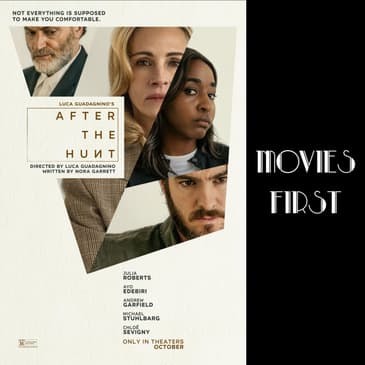
Julia Robert takes on a challenging role as Alma Imhoff, a cold and calculating professor vying for tenure in a male-dominated department, all while concealing a chronic illness from her colleagues. The complex relationship between Alma and her student Mikey, portrayed by A.O. Etabiri, adds layers of mentorship and attraction that complicate their interactions. Mikey, a privileged yet alienated philosophy student, grapples with her identity and her parents' significant influence at Yale, raising questions about the true nature of belonging.
Andrew Garfield delivers a powerful performance as Hank Gibson, the accused professor whose fierce denial of Mikey's allegations adds to the film's tension. Chris and Jessica highlight the film's exploration of truth and perception, particularly through Alma’s conflicted loyalties as she navigates the murky waters of the situation. The hosts also discuss the heavy secrets each character carries, from Alma's troubled past to Mikey's struggles with her identity as an adopted child, and how these elements contribute to the film's narrative complexity.
While Luca Guadagnino's direction is praised, the hosts note that the film sometimes feels overloaded with themes such as sexual assault, tenure politics, and hidden illnesses. Despite its ambitious scope, Chris and Jessica argue that these imperfections may spark important conversations about power dynamics in academia. With a score of 7.5 out of 10, *After the Hunt* stands as a thought-provoking piece that resonates with contemporary issues, reminding us that sometimes the most challenging stories leave a lasting impact.
https://www.bitesz.com/podcast/movies-first
Become a supporter of this podcast: https://www.spreaker.com/podcast/movies-first.
To access the Movies First reviews archive visit our website at www.bitesz.com/podcast/movies-first
To access the Movies First reviews archive visit our website at www.bitesz.com/podcast/movies-first
This episode includes AI-generated content.
00:00:00 --> 00:00:02 Chris: Power dynamics in elite universities have
00:00:02 --> 00:00:04 always been complicated. But what happens
00:00:04 --> 00:00:06 when a prestigious philosophy department at
00:00:06 --> 00:00:09 ah, Yale becomes ground zero for accusations
00:00:09 --> 00:00:11 of sexual misconduct? The new film
00:00:11 --> 00:00:14 after the Hunt explores exactly that powder
00:00:14 --> 00:00:15 keg situation.
00:00:16 --> 00:00:18 Jessica: That's fascinating because Yale already
00:00:18 --> 00:00:19 carries this weight of prestige and
00:00:19 --> 00:00:22 influence. When you add accusations of
00:00:22 --> 00:00:24 misconduct into that environment, it becomes
00:00:24 --> 00:00:25 explosive.
00:00:26 --> 00:00:28 Chris: You know what really elevates this material?
00:00:29 --> 00:00:32 Julia Roberts playing completely against type
00:00:32 --> 00:00:34 as Alma Imhoff. This cold,
00:00:34 --> 00:00:37 calculating professor fighting for tenure in
00:00:37 --> 00:00:40 a department where, get this, 80%
00:00:40 --> 00:00:43 of the professoriate are men. And she's
00:00:43 --> 00:00:45 hiding a chronic illness from everyone except
00:00:45 --> 00:00:47 her husband. Hmm. Hm.
00:00:48 --> 00:00:50 Jessica: The dynamic between Alma and her student
00:00:50 --> 00:00:52 Maggie, played by A.O. etabiri, seems
00:00:52 --> 00:00:55 incredibly layered. There's this mixture of
00:00:55 --> 00:00:57 mentorship and attraction that complicates
00:00:57 --> 00:00:57 everything.
00:00:58 --> 00:01:00 Chris: Well, here's what makes Maggie's character so
00:01:00 --> 00:01:03 compelling. She's this brilliant gay
00:01:03 --> 00:01:05 philosophy student from incredible privilege.
00:01:05 --> 00:01:08 Her parents are major donors to Yale, but she
00:01:08 --> 00:01:11 still feels like an outsider. Money can't buy
00:01:11 --> 00:01:12 belonging, right?
00:01:12 --> 00:01:14 Jessica: So how does that play into her accusation
00:01:14 --> 00:01:17 against Professor Hank Gibson? It seems like
00:01:17 --> 00:01:19 we're dealing with multiple layers of power
00:01:19 --> 00:01:19 dynamics here.
00:01:20 --> 00:01:23 Chris: Oh man. Andrew Garfield brings this
00:01:23 --> 00:01:26 full on, all guns blazing Persona
00:01:26 --> 00:01:29 to Hank Gibson. He's competing with Alma
00:01:29 --> 00:01:31 for possibly the only tenure position
00:01:31 --> 00:01:33 available when suddenly, boom.
00:01:34 --> 00:01:36 Maggie accuses him of rape. And his vehement
00:01:36 --> 00:01:38 denial just adds another layer of
00:01:38 --> 00:01:39 uncertainty.
00:01:40 --> 00:01:42 Jessica: The way the film handles truth and perception
00:01:42 --> 00:01:44 seems particularly relevant to our current
00:01:44 --> 00:01:47 moment. Especially since even Alma, who's
00:01:47 --> 00:01:49 close to both parties, isn't sure who to
00:01:49 --> 00:01:49 believe.
00:01:50 --> 00:01:53 Chris: You know what's wild? Everyone's carrying
00:01:53 --> 00:01:55 these heavy secrets. Alma has this
00:01:55 --> 00:01:58 dark childhood thing. Maggie's grappling with
00:01:58 --> 00:02:00 her identity as an adopted child.
00:02:01 --> 00:02:04 And even Frederick, Alma's husband, played by
00:02:04 --> 00:02:07 Michael Stuhlbarg, brings this fascinating
00:02:07 --> 00:02:09 background of being raised by Freudian
00:02:09 --> 00:02:10 psychoanalysts.
00:02:11 --> 00:02:13 Jessica: Well, that explains his almost puppy like
00:02:13 --> 00:02:15 devotion to his wife, despite her coldness
00:02:15 --> 00:02:16 and calculation.
00:02:17 --> 00:02:19 Chris: It's like one of those classic academic
00:02:19 --> 00:02:22 novels where the intellectual setting becomes
00:02:22 --> 00:02:23 this perfect pressure cooker for exploring
00:02:23 --> 00:02:26 raw human emotions. But Luca
00:02:26 --> 00:02:29 Guadagnino, fresh off Call Me by youy
00:02:29 --> 00:02:31 Name, might be trying to juggle too many
00:02:31 --> 00:02:32 elements here.
00:02:33 --> 00:02:35 Jessica: That's interesting. The criticism that it
00:02:35 --> 00:02:38 feels too drawn out, like maybe they're
00:02:38 --> 00:02:40 trying to pack too much into one narrative.
00:02:41 --> 00:02:43 Chris: Exactly. We've got sexual assault
00:02:43 --> 00:02:46 accusations, ten year politics, hidden
00:02:46 --> 00:02:49 illness, complex identities, plus
00:02:49 --> 00:02:51 all these interpersonal dynamics. It's
00:02:51 --> 00:02:53 ambitious for a first time screenwriter like
00:02:53 --> 00:02:56 Nora Garrett, but maybe too ambitious.
00:02:56 --> 00:02:58 Jessica: Though sometimes these imperfect but
00:02:58 --> 00:03:01 ambitious films give us more to discuss than
00:03:01 --> 00:03:02 polished ones. That play it safe.
00:03:03 --> 00:03:06 Chris: You m know what's really clever? The way Yale
00:03:06 --> 00:03:09 itself becomes almost another character. This
00:03:09 --> 00:03:11 prestigious institution where maintaining
00:03:11 --> 00:03:14 appearances is everything, but underneath
00:03:14 --> 00:03:16 there's all this darkness and tension. It's
00:03:16 --> 00:03:18 like a perfect metaphor for the.
00:03:18 --> 00:03:20 Jessica: Whole story, and it creates this fascinating
00:03:20 --> 00:03:23 exploration of vulnerability. You have
00:03:23 --> 00:03:25 Maggie, who's wealthy but feels like an
00:03:25 --> 00:03:27 outsider, and Alma, who's physically
00:03:27 --> 00:03:29 vulnerable but hiding it to maintain power.
00:03:30 --> 00:03:32 Chris: The film even gives this interesting nod to
00:03:32 --> 00:03:34 Woody Allen with the font style in the
00:03:34 --> 00:03:37 credits, which, uh, feels pretty loaded
00:03:37 --> 00:03:39 given the themes of power and morality
00:03:39 --> 00:03:40 they're exploring.
00:03:40 --> 00:03:43 Jessica: Looking at the overall impact, even with its
00:03:43 --> 00:03:45 flaws, it seems like the kind of film that
00:03:45 --> 00:03:47 generates important conversations about power
00:03:47 --> 00:03:49 dynamics in academia.
00:03:50 --> 00:03:52 Chris: Well, that 7 1/2 out of 10 rating suggests
00:03:53 --> 00:03:55 there's definitely something substantial
00:03:55 --> 00:03:57 here, even if it doesn't quite reach its full
00:03:57 --> 00:04:00 potential. Sometimes the messiest
00:04:00 --> 00:04:02 stories are the ones that stick with you the
00:04:02 --> 00:04:03 longest.
00:04:03 --> 00:04:05 Voice Over Guy: You've been listening to movies first
00:04:05 --> 00:04:08 available at Apple Podcasts, Spotify,
00:04:08 --> 00:04:11 iHeartRadio or your favorite podcast
00:04:11 --> 00:04:13 player. You can also stream on
00:04:13 --> 00:04:15 demand@bytes.com this.
00:04:15 --> 00:04:17 Chris: Has been another quality podcast production
00:04:17 --> 00:04:19 from bytes.com.