
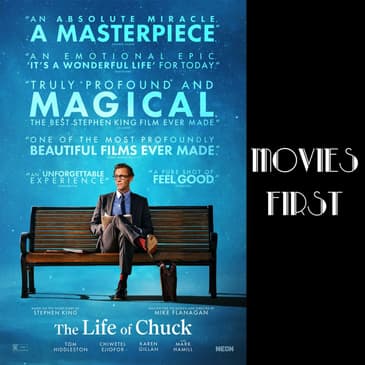
Jessica marvels at the film's ability to intertwine moments of joy amidst chaos, particularly during a stunning dance sequence featuring Tom Hiddleston. This scene, where a buttoned-up accountant transforms into a magnificent dancer, serves as a reminder of how spontaneous happiness can resonate even in the darkest times. The duo discusses the emotional weight of Chuck's backstory, including the loss of his parents at a young age and the bond with his grandmother that introduced him to dance, weaving a rich tapestry of human experience throughout the narrative.
Listeners will appreciate the film's exploration of the smallest acts of kindness and their potential to hold the universe together, as well as the seamless transitions between time periods that director Mike Flanagan masterfully orchestrates. The casting of three different actors as Chuck adds depth to his character, embodying the essence of ordinary decency and the extraordinary capacity to find joy in life's fleeting moments.
With a commendable rating of 8.5 out of 10, *The Life of Chuck* encourages viewers to recognize the transcendent beauty in their everyday lives and underscores the powerful message that life's true measure lies not in grand accomplishments, but in the small moments of connection and joy we share with one another. Tune in as Chris and Jessica celebrate this enriching cinematic experience that reminds us to dance through life, both literally and metaphorically.
https://www.bitesz.com/podcast/movies-first
Become a supporter of this podcast: https://www.spreaker.com/podcast/movies-first
Sponsor Details:
Secure your online privacy with NordVPN. To get our special offer and save a heap of money visit www.bitesz.com/nordvpn. You'll be glad you did.
To access the Movies First reviews archive visit our website at www.bitesz.com/podcast/movies-first
00:00:00 --> 00:00:02 Chris: Imagine a movie where the apocalypse isn't
00:00:02 --> 00:00:05 about destruction, but about celebrating one
00:00:05 --> 00:00:08 ordinary man's extraordinary impact on
00:00:08 --> 00:00:10 the world. That's exactly what we're
00:00:10 --> 00:00:13 exploring today with this remarkable new film
00:00:13 --> 00:00:15 that turns traditional storytelling
00:00:15 --> 00:00:17 completely inside out.
00:00:17 --> 00:00:19 Jessica: You know what fascinates me most about this
00:00:19 --> 00:00:22 approach? How it manages to make the end of
00:00:22 --> 00:00:24 the world feel intensely personal through
00:00:24 --> 00:00:26 those mysterious billboards appearing
00:00:26 --> 00:00:28 everywhere. Charles Krantz,
00:00:28 --> 00:00:31 39 great years. Thanks, Chuck.
00:00:32 --> 00:00:33 Chris: Well, that's the brilliant thing about
00:00:33 --> 00:00:36 starting at the end. We see these massive
00:00:36 --> 00:00:39 catastrophic events, but they're all somehow
00:00:39 --> 00:00:41 connected to this one seemingly ordinary
00:00:41 --> 00:00:44 accountant that nobody can identify.
00:00:44 --> 00:00:46 Jessica: And the way they handle those connections
00:00:46 --> 00:00:49 through Chiwetel Ejiofor's character, this
00:00:49 --> 00:00:51 teacher trying to help parents cope while
00:00:51 --> 00:00:53 everything crumbles. It adds such a human
00:00:53 --> 00:00:55 element to the chaos.
00:00:56 --> 00:00:58 Chris: Speaking of human elements, can we talk about
00:00:58 --> 00:01:00 that incredible dance sequence with Tom
00:01:00 --> 00:01:03 Hiddleston? Like, here's this
00:01:03 --> 00:01:06 buttoned up accountant who just, boom,
00:01:06 --> 00:01:09 transforms into this absolutely magnificent
00:01:09 --> 00:01:10 dancer in the middle of the street.
00:01:11 --> 00:01:14 Jessica: Oh, my goodness, yes. And you
00:01:14 --> 00:01:15 know what makes that scene even more
00:01:15 --> 00:01:18 powerful? How it connects with this young
00:01:18 --> 00:01:20 woman who's just been through a breakup. It's
00:01:20 --> 00:01:22 this perfect moment of how joy can be
00:01:22 --> 00:01:23 contagious.
00:01:24 --> 00:01:26 Chris: That's exactly what makes this film so
00:01:26 --> 00:01:28 unique. It suggests that maybe the most
00:01:28 --> 00:01:30 profound impacts we have aren't the big
00:01:30 --> 00:01:33 dramatic moments, but these spontaneous
00:01:33 --> 00:01:35 instances of shared happiness.
00:01:36 --> 00:01:38 Jessica: Well, how do you think that ties into the
00:01:38 --> 00:01:40 reverse chronological structure? Because
00:01:40 --> 00:01:42 we're essentially working backward from the
00:01:42 --> 00:01:44 literal end of the world to these intimate
00:01:44 --> 00:01:45 moments.
00:01:46 --> 00:01:48 Chris: You know, it's like peeling an onion in
00:01:48 --> 00:01:51 reverse. Each layer reveals something new
00:01:51 --> 00:01:54 about Chuck, from that apocalyptic opening
00:01:54 --> 00:01:57 to the street dance scene and then back to
00:01:57 --> 00:01:59 his childhood, where we learn about losing
00:01:59 --> 00:02:01 his parents at, uh, just seven years old.
00:02:01 --> 00:02:03 Jessica: And that relationship with his grandmother
00:02:03 --> 00:02:06 who introduced him to dance. It's such a
00:02:06 --> 00:02:07 beautiful thread throughout the story.
00:02:08 --> 00:02:10 Chris: Absolutely fascinating how they weave in that
00:02:10 --> 00:02:13 supernatural element too, with the mysterious
00:02:13 --> 00:02:15 locked attic in their 1885 house.
00:02:16 --> 00:02:19 It's classic Stephen King, but director Mike
00:02:19 --> 00:02:21 Flanagan knows exactly how to balance those
00:02:21 --> 00:02:22 elements with the human story.
00:02:23 --> 00:02:25 Jessica: The way they handle those transitions between
00:02:25 --> 00:02:28 time periods is so seamless, too. It's
00:02:28 --> 00:02:30 like watching time itself dance backward.
00:02:31 --> 00:02:32 Chris: Um, um. And can we talk about how they
00:02:32 --> 00:02:34 managed to cast three different actors as
00:02:34 --> 00:02:36 Charles who all capture this essential
00:02:36 --> 00:02:38 quality about him? It's this combination of
00:02:38 --> 00:02:41 ordinary decency and an extraordinary ability
00:02:41 --> 00:02:43 to find joy in small moments.
00:02:43 --> 00:02:45 Jessica: That's what makes the ending so powerful.
00:02:46 --> 00:02:48 When we finally understand why the world
00:02:48 --> 00:02:50 seems to be ending along with Chuck's life.
00:02:50 --> 00:02:53 It transforms everything we've seen before.
00:02:54 --> 00:02:56 Chris: You know what really strikes me? How the film
00:02:56 --> 00:02:59 suggests that the smallest acts of human
00:02:59 --> 00:03:01 connection might actually be holding the
00:03:01 --> 00:03:03 universe together in ways we can't even
00:03:03 --> 00:03:03 comprehend.
00:03:04 --> 00:03:07 Jessica: Well, that certainly gives new meaning to
00:03:07 --> 00:03:09 those dance sequences. They're not just
00:03:09 --> 00:03:10 beautiful moments. They're like little
00:03:10 --> 00:03:12 threads in the fabric of reality.
00:03:13 --> 00:03:15 Chris: And ultimately, that's what makes this film
00:03:15 --> 00:03:18 so enriching to watch. It reminds us that
00:03:18 --> 00:03:20 our own lives, however ordinary they might
00:03:20 --> 00:03:22 seem, contain these moments of
00:03:23 --> 00:03:26 transcendent beauty and connection. We
00:03:26 --> 00:03:27 just have to be willing to recognize them
00:03:27 --> 00:03:28 when they appear.
00:03:29 --> 00:03:31 Jessica: So in the end, it's really about how one
00:03:31 --> 00:03:33 person's 39 years of small kindnesses and
00:03:33 --> 00:03:35 moments of joy can literally change the
00:03:35 --> 00:03:36 world. World.
00:03:37 --> 00:03:39 Chris: Exactly. And isn't that a powerful message
00:03:39 --> 00:03:42 for all of us that maybe the measure of, uh,
00:03:42 --> 00:03:44 a life isn't in grand achievements, but in
00:03:44 --> 00:03:46 all those tiny moments where we choose to
00:03:46 --> 00:03:48 dance, literally or metaphorically,
00:03:49 --> 00:03:51 and share that joy with others? We're giving
00:03:51 --> 00:03:53 the life of Chuck. A score of eight and a
00:03:53 --> 00:03:54 half out of ten.