
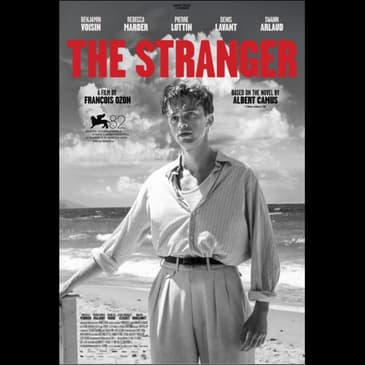
Set in 1938 French-controlled Algiers, the narrative begins with Meursault receiving news of his mother's death, yet his reaction is chillingly apathetic. Chris and Jessica discuss how this emotional detachment sets the tone for the film, as Meursault navigates life with a casual indifference that challenges societal norms around grief and connection. The hosts highlight his relationship with Marie, portrayed by Rebecca Marder, whose vibrant personality contrasts sharply with Meursault's emotional distance, leading to moments of profound tension and intrigue.
The episode further examines the film's pivotal beach scene, where Meursault's actions culminate in a dramatic confrontation, showcasing Ozon's masterful cinematography that captures the oppressive heat and relentless sunlight, amplifying the intensity of the moment. Chris and Jessica commend the performances of the cast, particularly Marder's portrayal of Marie, who serves as the emotional core of the film, and Denis Levant as Salamano, whose subplot adds depth to the overarching narrative.
With stunning black and white visuals, the film evokes a timeless quality that enhances its existential themes. Chris and Jessica agree that *The Stranger* is not a conventional fast-paced film but rather a slow, introspective journey that invites viewers to reflect on life and existence.
With a score of 8 out of 10, this episode encourages listeners to appreciate *The Stranger* as a compelling meditation on the human experience, celebrating its ability to challenge perceptions and provoke thought. Join Chris and Jessica as they unpack the layers of this mesmerizing film that dares to defy conventions and invites us to see the world anew.
https://www.bitesz.com/podcast/movies-first
Become a supporter of this podcast: https://www.spreaker.com/podcast/movies-first.
To access the Movies First reviews archive visit our website at www.bitesz.com/podcast/movies-first
This episode includes AI-generated content.
00:00:00 --> 00:00:01 Chris: Okay, so here's something to think about.
00:00:02 --> 00:00:04 What if the most compelling character in a
00:00:04 --> 00:00:06 movie wasn't a hero, wasn't a
00:00:06 --> 00:00:08 villain, but someone who just
00:00:09 --> 00:00:12 doesn't care? That's exactly what we're
00:00:12 --> 00:00:14 looking at with Francois Ozan's adaptation of
00:00:14 --> 00:00:15 the Stranger.
00:00:16 --> 00:00:18 Jessica: Oh, that's such a great way to frame it.
00:00:18 --> 00:00:21 Meursault, the protagonist, is so unlike any
00:00:21 --> 00:00:23 character we're used to seeing. He's not
00:00:23 --> 00:00:25 driven by ambition, love, or even anger.
00:00:26 --> 00:00:29 He's just there. And
00:00:29 --> 00:00:30 yet you can't look away.
00:00:31 --> 00:00:34 Chris: Exactly. The story starts in French
00:00:34 --> 00:00:37 controlled Algiers in 1938,
00:00:37 --> 00:00:40 and we meet Meursault, played by Benjamin
00:00:40 --> 00:00:42 Voisin. He's a clerk
00:00:42 --> 00:00:45 living a quiet, unremarkable life.
00:00:46 --> 00:00:48 Then he gets a telegram saying his mother has
00:00:48 --> 00:00:51 died. And here's the kicker, he doesn't
00:00:51 --> 00:00:53 cry, doesn't grieve, doesn't even seem
00:00:53 --> 00:00:54 affected.
00:00:55 --> 00:00:58 Jessica: That's what's so fascinating. It's not just
00:00:58 --> 00:01:00 that he doesn't cry, it's that he doesn't
00:01:00 --> 00:01:02 conform to any of the societal expectations
00:01:02 --> 00:01:05 we have around grief. He goes to the
00:01:05 --> 00:01:08 funeral, but he's completely detached. And.
00:01:08 --> 00:01:10 Hm, the next day he's back at the baths,
00:01:10 --> 00:01:12 living his life like nothing happened.
00:01:13 --> 00:01:15 Chris: And that's where he reconnects with Marie,
00:01:15 --> 00:01:18 played by Rebecca Marder. Their relationship
00:01:18 --> 00:01:20 is so interesting because it's casual,
00:01:20 --> 00:01:23 almost transactional. She's full of life
00:01:23 --> 00:01:26 and yet she's drawn to this man who's so
00:01:26 --> 00:01:29 emotionally distant, she even proposes
00:01:29 --> 00:01:32 marriage. And his response is basically,
00:01:32 --> 00:01:33 sure, why not?
00:01:34 --> 00:01:36 Jessica: That scene where she asks if he loves her and
00:01:36 --> 00:01:39 he just says it doesn't matter.
00:01:40 --> 00:01:42 It's so striking. It's not that he's
00:01:42 --> 00:01:45 cruel, it's that he genuinely doesn't see the
00:01:45 --> 00:01:47 point in pretending to feel something he
00:01:47 --> 00:01:49 doesn't. It's such a bold choice for a
00:01:49 --> 00:01:50 character.
00:01:51 --> 00:01:54 Chris: And then you add in the neighbor, Raymond
00:01:54 --> 00:01:56 Sintes, played by Pierre Lawton.
00:01:57 --> 00:02:00 He's this volatile, shady guy who's got
00:02:00 --> 00:02:02 this vendetta against his mistress. He drags
00:02:02 --> 00:02:05 Meursault into his drama and Meursault just
00:02:06 --> 00:02:07 goes along with it. It's like he doesn't have
00:02:07 --> 00:02:09 a moral compass in the traditional sense.
00:02:10 --> 00:02:12 Jessica: That's what makes him so compelling, though.
00:02:13 --> 00:02:16 He. He's not a hero, he's not a villain.
00:02:16 --> 00:02:18 He's just this blank slate that people
00:02:18 --> 00:02:20 project their own expectations onto.
00:02:21 --> 00:02:23 And then, of course, there's the pivotal
00:02:23 --> 00:02:25 moment on the beach with the mistress.
00:02:25 --> 00:02:27 Brother, that scene is so intense.
00:02:28 --> 00:02:31 Chris: Oh, absolutely. The
00:02:31 --> 00:02:34 way Ozan films it, with the relentless
00:02:34 --> 00:02:37 sunlight and the oppressive heat. It's almost
00:02:37 --> 00:02:40 unbearable. You can feel the tension
00:02:40 --> 00:02:42 building. And when Merceau crosses that line,
00:02:42 --> 00:02:45 it's like time stops. It's such a powerful
00:02:45 --> 00:02:46 moment.
00:02:46 --> 00:02:49 Jessica: And yet even after that, he remains so
00:02:49 --> 00:02:52 detached. He doesn't try to justify his
00:02:52 --> 00:02:54 actions, doesn't fight his fate. It's
00:02:54 --> 00:02:56 like he's resigned to the absurdity of it
00:02:56 --> 00:02:59 all. Meanwhile, Marie is falling
00:02:59 --> 00:03:01 apart, trying to make sense of what's
00:03:01 --> 00:03:01 happening.
00:03:02 --> 00:03:05 Chris: Rebecca Marder is phenomenal in that role.
00:03:05 --> 00:03:07 She brings so much emotion and vitality to
00:03:07 --> 00:03:10 Marie and you can feel her frustration and
00:03:10 --> 00:03:12 heartbreak as, uh, she tries to connect with
00:03:12 --> 00:03:15 Meursault. She's the emotional anchor of the
00:03:15 --> 00:03:16 film in many ways.
00:03:16 --> 00:03:19 Jessica: And then there's Dennis Levant as Salamano,
00:03:19 --> 00:03:21 the elderly neighbor who mistreats his dog
00:03:21 --> 00:03:23 but is devastated when it runs away.
00:03:24 --> 00:03:26 It's such a small subplot, but it adds so
00:03:26 --> 00:03:29 much depth to the story. Levant captures that
00:03:29 --> 00:03:32 desperation so perfectly, and
00:03:32 --> 00:03:34 Chris: that's what makes this film so rich. It's not
00:03:34 --> 00:03:37 just about Meursault. It's about all these
00:03:37 --> 00:03:39 little human moments that add texture and
00:03:39 --> 00:03:40 complexity to the story.
00:03:41 --> 00:03:43 And then there's the cinematography.
00:03:44 --> 00:03:46 Manu Dekosi does an incredible job with the
00:03:46 --> 00:03:47 visuals.
00:03:47 --> 00:03:49 Jessica: Oh, the black and white palette is stunning.
00:03:50 --> 00:03:52 It gives the film this timeless, almost
00:03:52 --> 00:03:55 dreamlike quality. It feels like a memory
00:03:55 --> 00:03:57 or a meditation on life and existence.
00:03:58 --> 00:03:59 And the use of light and shadow is just
00:03:59 --> 00:04:00 masterful.
00:04:01 --> 00:04:04 Chris: It really is. And it's so fitting for a story
00:04:04 --> 00:04:06 like this, which is all about existentialism
00:04:06 --> 00:04:09 and the absurdity of life. Camus's
00:04:09 --> 00:04:11 novel is a masterpiece and Ozan does such a
00:04:11 --> 00:04:14 great job of capturing its essence. This
00:04:14 --> 00:04:17 isn't just a retelling, it's a meditation on
00:04:17 --> 00:04:18 the themes of the book.
00:04:19 --> 00:04:22 Jessica: So the big Is it worth seeing?
00:04:23 --> 00:04:25 Chris: Oh, without a doubt. But I think it's
00:04:25 --> 00:04:26 important to go in with the right
00:04:26 --> 00:04:29 expectations. This isn't a fast paced,
00:04:29 --> 00:04:32 action packed film. It's slow,
00:04:32 --> 00:04:34 deliberate and introspective.
00:04:35 --> 00:04:37 It's the kind of film that asks you to sit
00:04:37 --> 00:04:38 with it and think.
00:04:38 --> 00:04:40 Jessica: And the performances alone are worth it.
00:04:41 --> 00:04:43 Benjamin Voisin, Rebecca Marder, Pierre
00:04:43 --> 00:04:45 Lotan. Huh, Denis Levant.
00:04:46 --> 00:04:49 They're all phenomenal. Each one brings
00:04:49 --> 00:04:50 something unique and essential to the film.
00:04:51 --> 00:04:54 Chris: And then there's the cinematography. It's a
00:04:54 --> 00:04:56 masterclass in visual storytelling. Every
00:04:56 --> 00:04:58 frame feels intentional and meaningful.
00:04:59 --> 00:05:00 Jessica: So, final verdict?
00:05:01 --> 00:05:04 Chris: I'd say an 8 out of 10 is spot on.
00:05:04 --> 00:05:07 It's not perfect, but it's a deeply engaging,
00:05:07 --> 00:05:10 thought provoking film that stays with you
00:05:10 --> 00:05:11 long after the credits roll.
00:05:12 --> 00:05:15 Jessica: I completely agree. It's a film that
00:05:15 --> 00:05:17 challenges you, that makes you think about
00:05:17 --> 00:05:19 life, death, and what it means to be human.
00:05:20 --> 00:05:22 And in today's cinematic landscape, that's
00:05:22 --> 00:05:24 something to be celebrated.
00:05:24 --> 00:05:27 Chris: Absolutely. So there you have
00:05:27 --> 00:05:30 it. The Stranger. A
00:05:30 --> 00:05:32 mesmerizing portrait of a man who defies
00:05:32 --> 00:05:35 convention, brought to life by a director and
00:05:35 --> 00:05:37 cast at the top of their game.
00:05:38 --> 00:05:40 Jessica: And a reminder that sometimes the most
00:05:40 --> 00:05:42 compelling stories are the ones that
00:05:42 --> 00:05:45 challenge us to see the world and ourselves
00:05:45 --> 00:05:46 in a different light.