
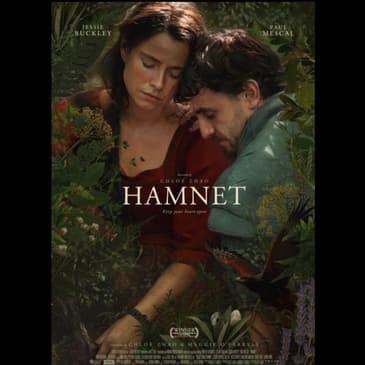
Listeners will be captivated by the portrayal of Agnes, Shakespeare's wife, depicted as a free-spirited healer deeply connected to nature. Chris and Jessica highlight the complexities of her relationship with Shakespeare, emphasizing the tension that arises from his career ambitions and the emotional toll it takes on their family. The hosts reflect on the heartbreaking moment of Hamnet's death, illustrating how it becomes a turning point that reshapes their lives and ultimately influences Shakespeare's work.
Chloe Zhao's masterful direction is praised for its intimate and patient storytelling, reminiscent of her acclaimed film *Nomadland*. The cinematography by Wukas Zhao is described as stunning, with striking visuals that immerse viewers in the 1580s English landscape, making nature a character in its own right.
Chris and Jessica also commend the performances, particularly Jessie Buckley as Agnes and Paul Mescal as Shakespeare, both of whom bring depth and authenticity to their roles. The supporting cast, including David Wilmot and Jacoby Jupe, further enriches the narrative, highlighting the intricate family dynamics at play.
With a score of 8.5 out of 10, this episode invites listeners to reflect on the intersection of love, loss, and creativity, showcasing *Hamnet* as a powerful exploration of how personal experiences shape the work of even the greatest artists. Join Chris and Jessica as they unravel the emotional layers of this cinematic masterpiece that lingers long after the credits roll.
https://www.bitesz.com/podcast/movies-first
Become a supporter of this podcast: https://www.spreaker.com/podcast/movies-first.
To access the Movies First reviews archive visit our website at www.bitesz.com/podcast/movies-first
To access the Movies First reviews archive visit our website at www.bitesz.com/podcast/movies-first
This episode includes AI-generated content.
00:00:00 --> 00:00:02 Chris: Okay, so get this. Shakespeare's son
00:00:02 --> 00:00:05 Hamnet, who died at just 11 years old,
00:00:05 --> 00:00:07 might have been the inspiration for one of
00:00:07 --> 00:00:09 the greatest plays ever written, Hamlet.
00:00:10 --> 00:00:11 That's the kind of connection that makes you
00:00:11 --> 00:00:13 rethink everything you know about his work.
00:00:14 --> 00:00:17 Jessica: Oh, wow. That's such a powerful starting
00:00:17 --> 00:00:20 point. I mean, uh, we always think of
00:00:20 --> 00:00:22 Shakespeare as this untouchable literary
00:00:22 --> 00:00:24 genius, but this really humanizes him.
00:00:25 --> 00:00:27 What's the story behind this connection?
00:00:28 --> 00:00:30 Chris: It all comes from Maggie o' Farrell's novel
00:00:30 --> 00:00:33 Hamnet, which Chloe Zhao has now adapted into
00:00:33 --> 00:00:36 a film. The novel dives into Shakespeare's
00:00:36 --> 00:00:37 family life, which is something we rarely
00:00:37 --> 00:00:40 hear about. It's set in the 1580s,
00:00:40 --> 00:00:43 and it focuses on his relationship with his
00:00:43 --> 00:00:44 wife Agnes, and their children.
00:00:45 --> 00:00:47 Hamnet's death from the plague is this
00:00:47 --> 00:00:50 pivotal moment that reshapes everything for
00:00:50 --> 00:00:50 them.
00:00:51 --> 00:00:53 Jessica: That's such a unique angle. We're so used to
00:00:53 --> 00:00:56 studying Shakespeare's plays, but we don't
00:00:56 --> 00:00:58 often think about the man behind them. What's
00:00:58 --> 00:00:59 Agnes like in the story?
00:01:00 --> 00:01:03 Chris: She's fascinating. Agnes, who
00:01:03 --> 00:01:06 Shakespeare calls Agnes, is this free
00:01:06 --> 00:01:08 spirited, unconventional woman. She's a
00:01:08 --> 00:01:11 healer and a forager, someone deeply
00:01:11 --> 00:01:14 connected to nature. There's this incredible
00:01:14 --> 00:01:16 image of her caring for a bird of prey in the
00:01:16 --> 00:01:19 woods near her home. She's unlike anyone
00:01:19 --> 00:01:21 Shakespeare has ever met. And their
00:01:21 --> 00:01:23 relationship is intense and passionate.
00:01:24 --> 00:01:26 Jessica: That sounds like such a rich dynamic to
00:01:26 --> 00:01:29 explore. But I imagine their
00:01:29 --> 00:01:31 relationship wasn't without its challenges,
00:01:31 --> 00:01:33 especially with Shakespeare's career pulling
00:01:33 --> 00:01:34 him away from home.
00:01:35 --> 00:01:38 Chris: Exactly. That's where the tension really
00:01:38 --> 00:01:41 starts to build. Agnes encourages him to
00:01:41 --> 00:01:43 pursue his dreams, but his absence is deeply
00:01:43 --> 00:01:46 felt by the family, especially Hamnet.
00:01:46 --> 00:01:48 You can feel the strain it puts on their
00:01:48 --> 00:01:51 relationships, and it's heartbreaking to see
00:01:51 --> 00:01:52 how that distance affects them all.
00:01:53 --> 00:01:55 Jessica: And then Hamnet's death happens. Right?
00:01:56 --> 00:01:58 That must be such a devastating moment in the
00:01:58 --> 00:01:58 story.
00:02:00 --> 00:02:03 Chris: It really is. The film doesn't shy away from
00:02:03 --> 00:02:06 the raw grief and pain that follows. What's
00:02:06 --> 00:02:07 incredible, though, is how it ties this
00:02:07 --> 00:02:10 personal tragedy to the creation of Hamlet.
00:02:11 --> 00:02:13 It's like Shakespeare channels his grief into
00:02:13 --> 00:02:15 his art, creating something timeless and
00:02:15 --> 00:02:17 universal out of his own loss.
00:02:18 --> 00:02:20 Jessica: That connection between personal pain and
00:02:20 --> 00:02:22 creative expression is so powerful.
00:02:23 --> 00:02:25 How does Chloe Zhao bring that to life on
00:02:25 --> 00:02:25 screen?
00:02:26 --> 00:02:28 Chris: Zhao's direction is just masterful.
00:02:29 --> 00:02:31 She's known for her patient, intimate
00:02:31 --> 00:02:33 storytelling. Just look at Nomadland.
00:02:34 --> 00:02:36 With Hamnet, she takes that same approach,
00:02:37 --> 00:02:39 letting the story unfold slowly and
00:02:39 --> 00:02:41 naturally. It's all about the small, quiet
00:02:41 --> 00:02:44 moments that build toward a deeply emotional
00:02:44 --> 00:02:45 and meaningful conclusion.
00:02:46 --> 00:02:48 Jessica: And Visually, how does the film capture the
00:02:48 --> 00:02:51 world of, uh, 1580s England? I
00:02:51 --> 00:02:53 imagine the setting plays a big role in the
00:02:53 --> 00:02:53 story.
00:02:54 --> 00:02:57 Chris: Oh, absolutely. The cinematography by
00:02:57 --> 00:02:59 Wukas Zhao is stunning.
00:03:00 --> 00:03:02 There's this opening scene where Agnes is
00:03:02 --> 00:03:04 curled up in the forest and in a fetal
00:03:04 --> 00:03:07 position and the camera captures her from
00:03:07 --> 00:03:09 above. It's such a striking image
00:03:10 --> 00:03:12 and it sets the tone for the entire film.
00:03:13 --> 00:03:15 The natural world feels like a character in
00:03:15 --> 00:03:17 its own right, reflecting Agnes's connection
00:03:17 --> 00:03:17 to it.
00:03:18 --> 00:03:21 Jessica: That sounds so immersive. And what about the
00:03:21 --> 00:03:23 performances? How do the actors bring these
00:03:23 --> 00:03:24 characters to life?
00:03:25 --> 00:03:28 Chris: Jessie Buckley as Agnes is absolutely
00:03:28 --> 00:03:30 mesmerizing. She completely embodies this
00:03:30 --> 00:03:33 untamed, free spirited woman who's both
00:03:33 --> 00:03:35 strong and vulnerable. And Paul
00:03:35 --> 00:03:38 Mescala's Shakespeare is just as compelling.
00:03:38 --> 00:03:40 He captures the intensity of a man driven by
00:03:40 --> 00:03:43 his need to create, but also the guilt and
00:03:43 --> 00:03:45 conflict he feels about what his ambition
00:03:45 --> 00:03:47 costs him and his family.
00:03:47 --> 00:03:50 Jessica: And what about the supporting cast? Do they
00:03:50 --> 00:03:51 add to the depth of the story?
00:03:53 --> 00:03:56 Chris: Definitely. David Wilmot as Shakespeare's
00:03:56 --> 00:03:58 father is just brutal. He's harsh and
00:03:58 --> 00:04:01 domineering and it's such a stark contrast to
00:04:01 --> 00:04:04 the tenderness we see in Hamnet. Jacoby Jupe,
00:04:04 --> 00:04:07 who plays Hamnet, is phenomenal. He brings so
00:04:07 --> 00:04:09 much heart to the role and you can feel how
00:04:09 --> 00:04:11 deeply he loves his father even as he
00:04:11 --> 00:04:12 struggles with his absence.
00:04:13 --> 00:04:15 Jessica: It sounds like the film really captures the
00:04:15 --> 00:04:18 complexity of these family dynamics. What's
00:04:18 --> 00:04:19 the overall takeaway from the story?
00:04:20 --> 00:04:22 Chris: It's a reminder that even the greatest
00:04:22 --> 00:04:25 artists are shaped by their personal lives
00:04:25 --> 00:04:28 and experiences. Hamnet isn't just
00:04:28 --> 00:04:30 a historical drama. It's an exploration of
00:04:30 --> 00:04:33 love, loss and creativity.
00:04:33 --> 00:04:36 It's eloquent, insightful and
00:04:36 --> 00:04:39 deeply moving. Honestly, I think
00:04:39 --> 00:04:41 it's one of the best films of the year.
00:04:42 --> 00:04:44 Jessica: I couldn't agree more. It's the kind of film
00:04:44 --> 00:04:46 that stays with you long after the credits
00:04:46 --> 00:04:48 roll. It's rated um, M and I'd give it an
00:04:48 --> 00:04:51 eight and a half out of ten. What about you?
00:04:53 --> 00:04:55 Chris: Same here. It's a masterpiece in its own
00:04:55 --> 00:04:58 right and it does justice to Ofarrell's novel
00:04:58 --> 00:05:00 while standing firmly on its own as a
00:05:00 --> 00:05:03 cinematic achievement. Honestly, I can't
00:05:03 --> 00:05:04 stop thinking about it.
00:05:04 --> 00:05:06 Voice Over Guy: You've been listening to movies first
00:05:06 --> 00:05:09 available at Apple Podcasts, Spotify,
00:05:09 --> 00:05:12 iHeartRadio or your favourite podcast
00:05:12 --> 00:05:14 player. You can also stream on
00:05:14 --> 00:05:16 demand@bytes.com this
00:05:16 --> 00:05:18 Chris: has been another quality podcast production
00:05:18 --> 00:05:20 from bytes.um com.