
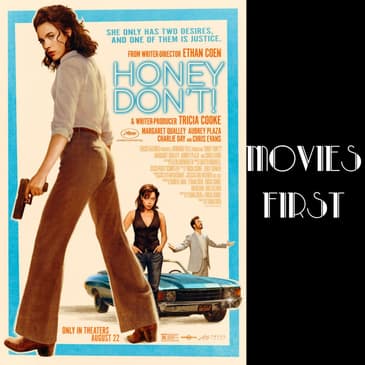
Chris and Jessica also dissect Chris Evans' surprising role as the corrupt Reverend Drew Devlin, noting how he expertly conveys menace in every gesture, subverting audience expectations. The film's nuanced approach to violence is praised for its impactful delivery, reminiscent of classic noir's strategic use of brutality. The chemistry between Qualley and Aubrey Plaza, who plays MG Falcone, is electric, creating a tension-filled dynamic that keeps viewers guessing.
The episode touches on the film's thoughtful critique of religious corruption without alienating faith itself, focusing instead on power dynamics—a theme central to noir storytelling. Listeners will appreciate how Honey's sexuality is seamlessly integrated into her character, avoiding clichéd tropes and instead offering a refreshing perspective in a genre often lacking in representation.
Visual aesthetics are also a focal point, with Chris and Jessica praising the film's ability to blend classic noir shadows with modern color palettes, creating a unique visual language that enhances the storytelling. They explore the mystery elements woven throughout the narrative, likening the experience to a gripping novel that keeps audiences engaged with each twist and turn.
With a solid rating of 7.5 out of 10, *Honey Dont* stands as a bold and innovative entry in the noir genre, showcasing the potential for evolution while remaining true to its roots. Join Chris and Jessica as they celebrate this film's fresh take on a beloved genre, paving the way for future storytelling possibilities.
https://www.bitesz.com/podcast/movies-first
Become a supporter of this podcast: https://www.spreaker.com/podcast/movies-first.
To access the Movies First reviews archive visit our website at www.bitesz.com/podcast/movies-first
00:00:00 --> 00:00:02 Chris: Film noir has always been about exploring
00:00:02 --> 00:00:04 society's dark underbelly. But what happens
00:00:04 --> 00:00:06 when you take those shadowy streets and
00:00:06 --> 00:00:08 filter them through a, uh, modern lesbian
00:00:08 --> 00:00:11 lens? That's the fascinating
00:00:11 --> 00:00:13 experiment we're seeing in Honeydont.
00:00:13 --> 00:00:15 Jessica: Let me tell you what makes this so
00:00:15 --> 00:00:17 groundbreaking. It's not just about
00:00:17 --> 00:00:19 representation. It's how they've managed to
00:00:19 --> 00:00:21 take those classic noir elements and
00:00:21 --> 00:00:23 completely reinvent them without losing what
00:00:23 --> 00:00:24 makes the genre special.
00:00:25 --> 00:00:26 Chris: You know what really stands out here?
00:00:27 --> 00:00:29 Margaret Qualley's portrayal of Honey o'.
00:00:29 --> 00:00:31 Donohue. The way she carries herself through
00:00:31 --> 00:00:34 Bakersfield's sun bleached streets. You can
00:00:34 --> 00:00:36 feel every ounce of her character's
00:00:36 --> 00:00:37 complicated history.
00:00:37 --> 00:00:39 Jessica: That's exactly what I was thinking,
00:00:40 --> 00:00:42 especially in those scenes where she's
00:00:42 --> 00:00:44 protecting her sister, Heidi. There's this
00:00:44 --> 00:00:46 weight to her performance that speaks to
00:00:46 --> 00:00:48 generations of family trauma.
00:00:49 --> 00:00:51 Chris: Speaking of complicated histories, let's talk
00:00:51 --> 00:00:54 about Chris Evans as Reverend Drew Devlin.
00:00:54 --> 00:00:57 Here's America's former captain playing this
00:00:57 --> 00:01:00 absolutely corrupted preacher. Talk about
00:01:00 --> 00:01:01 playing against type.
00:01:01 --> 00:01:03 Jessica: Well, what really struck me about his
00:01:03 --> 00:01:05 performance is how he manages to make every
00:01:05 --> 00:01:08 blessed gesture feel like a threat. It's
00:01:08 --> 00:01:10 so far from what we expect from Evans.
00:01:11 --> 00:01:13 Chris: The film's approach to violence is
00:01:13 --> 00:01:15 particularly interesting. It's not
00:01:15 --> 00:01:17 gratuitous, but when it happens, like with
00:01:17 --> 00:01:19 Corinne's beating and disappearance, it hits
00:01:19 --> 00:01:22 hard. It reminds me of how classic noir films
00:01:22 --> 00:01:25 would handle violence sparingly but
00:01:25 --> 00:01:25 effectively.
00:01:26 --> 00:01:29 Jessica: The way they balance those darker elements
00:01:29 --> 00:01:31 with moments of levity, like that charming
00:01:31 --> 00:01:33 turquoise Chevrolet, really keeps you off
00:01:33 --> 00:01:34 balance.
00:01:35 --> 00:01:37 Chris: And then there's Aubrey Plaza as MG
00:01:37 --> 00:01:40 Falcone. Her chemistry with Quali is
00:01:40 --> 00:01:42 electric. Every scene they share has this
00:01:42 --> 00:01:45 crackling tension where you're never quite
00:01:45 --> 00:01:46 sure if they're about to kiss or kill each
00:01:46 --> 00:01:47 other.
00:01:47 --> 00:01:49 Jessica: So what do you make of how they handled the
00:01:49 --> 00:01:51 religious elements? That's always such
00:01:51 --> 00:01:53 tricky territory in films.
00:01:54 --> 00:01:56 Chris: Well, they manage to critique specific
00:01:56 --> 00:01:58 corruption without making it feel like a
00:01:58 --> 00:02:01 broader attack on faith itself. It's more
00:02:01 --> 00:02:04 about power and how people abuse it, which is
00:02:04 --> 00:02:05 really at the heart of any good noir story.
00:02:06 --> 00:02:08 Jessica: That's precisely what makes this film feel so
00:02:08 --> 00:02:11 contemporary while still honoring its noir
00:02:11 --> 00:02:14 roots. It's taking on modern issues through
00:02:14 --> 00:02:15 this classic lens.
00:02:16 --> 00:02:19 Chris: You know what really makes this work? The way
00:02:19 --> 00:02:21 they handle Honey's sexuality. It's just part
00:02:21 --> 00:02:24 of who she is, not some big plot point.
00:02:24 --> 00:02:26 Even her interactions with Charlie Day's
00:02:26 --> 00:02:29 character, Marty Matakowicz, feel natural and
00:02:29 --> 00:02:30 unforced.
00:02:31 --> 00:02:32 Jessica: Let me point out how refreshing that is,
00:02:33 --> 00:02:35 especially in a genre that historically
00:02:35 --> 00:02:36 hasn't been great with representation.
00:02:37 --> 00:02:39 Chris: The M technical aspects really deserve
00:02:39 --> 00:02:42 special mention too. The way they shoot
00:02:42 --> 00:02:44 Bakersfield makes it feel both familiar and
00:02:45 --> 00:02:47 somehow threatening, especially in those
00:02:47 --> 00:02:49 scenes around the church. It's like they've
00:02:49 --> 00:02:51 created this whole new visual language for
00:02:51 --> 00:02:51 noir.
00:02:52 --> 00:02:54 Jessica: That visual style really does stand out.
00:02:55 --> 00:02:57 The way they balance those classic noir
00:02:57 --> 00:02:59 shadows with modern color choices is just
00:02:59 --> 00:03:00 masterful.
00:03:01 --> 00:03:02 Chris: And let's talk about how they handle the
00:03:02 --> 00:03:05 mystery elements, particularly around what's
00:03:05 --> 00:03:07 happening at the church. Like reading a
00:03:07 --> 00:03:09 really good novel where each chapter reveals
00:03:09 --> 00:03:12 just enough to keep you hooked while holding
00:03:12 --> 00:03:13 back crucial information.
00:03:13 --> 00:03:15 Jessica: Well, that's what makes it such a page turner
00:03:15 --> 00:03:18 of a film. You're never quite sure what's
00:03:18 --> 00:03:19 coming next, but everything makes perfect
00:03:19 --> 00:03:21 sense in retrospect.
00:03:21 --> 00:03:24 Chris: Looking at the bigger picture, I think what
00:03:24 --> 00:03:26 we're seeing here is how genre films can
00:03:26 --> 00:03:28 evolve while staying true to their roots.
00:03:28 --> 00:03:31 It's taking everything we love about noir,
00:03:31 --> 00:03:33 the corruption, the danger, the complex
00:03:33 --> 00:03:35 characters, and making it relevant for
00:03:35 --> 00:03:37 today's audiences.
00:03:37 --> 00:03:39 Jessica: That's exactly why this film feels so
00:03:39 --> 00:03:42 special. It's both a love letter to classic
00:03:42 --> 00:03:44 noir and a completely fresh take on the
00:03:44 --> 00:03:44 genre.
00:03:45 --> 00:03:47 Chris: You m know what's going to be interesting?
00:03:47 --> 00:03:50 Seeing how this influences future
00:03:50 --> 00:03:53 noir films. Because I think Honey
00:03:53 --> 00:03:55 don't has shown us that there's still plenty
00:03:55 --> 00:03:57 of room for innovation in what some might
00:03:57 --> 00:03:59 consider a very traditional genre.
00:04:00 --> 00:04:02 Jessica: Well, if nothing else, it's definitely opened
00:04:02 --> 00:04:05 up new possibilities for storytelling in noir
00:04:06 --> 00:04:07 and that's something worth celebrating.
00:04:08 --> 00:04:10 Chris: To sum up, Honey don't is the
00:04:10 --> 00:04:13 equivalent of a page turner where you are
00:04:13 --> 00:04:16 never sure what is coming next. It is
00:04:16 --> 00:04:18 sensual crime infested, bold and
00:04:18 --> 00:04:21 belligerent, with some delightful cinematic
00:04:21 --> 00:04:24 touches. Honey drives an open top
00:04:24 --> 00:04:27 vintage turquoise Chevrolet while a cheeky
00:04:27 --> 00:04:30 little scooter adds to the charm. But what
00:04:30 --> 00:04:33 really makes this left of center movie is the
00:04:33 --> 00:04:35 performance of Margaret Qualley as the femme
00:04:35 --> 00:04:38 fatale. Honey don't
00:04:38 --> 00:04:40 scores a seven and a half out of ten.
00:04:41 --> 00:04:43 You've been listening to movies first
00:04:43 --> 00:04:44 available.
00:04:44 --> 00:04:46 Jessica: At Apple Podcasts, Spotify,
00:04:46 --> 00:04:49 iHeartRadio or your favourite podcast
00:04:49 --> 00:04:49 player.
00:04:49 --> 00:04:51 Chris: You can also stream on
00:04:51 --> 00:04:53 demand@bytes.com this has been another
00:04:53 --> 00:04:56 quality podcast production from
00:04:56 --> 00:04:57 bytes.com.