
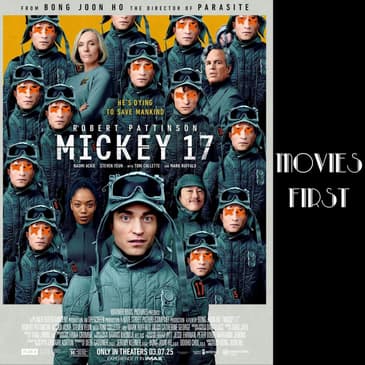
Chris & Jessica explore the film's commentary on corporate exploitation and the nature of being replaceable, especially as Mikey 17 encounters his own clone, Mikey 18. The dynamics of their relationship delve into the complexities of selfhood and what it means to be "real" in a world of endless replication. With a supporting cast that includes Mark Ruffalo and Toni Collette, the film attempts to juggle themes of power and manipulation, yet struggles to fully develop its ideas.
While director Bong Joon Ho’s vision is ambitious, Alex critiques the film for its overstuffed narrative that sacrifices character depth for an array of plot complications, including a love triangle and bizarre threats like giant caterpillars. The episode discusses how Pattinson and Colette deliver commendable performances, yet the film ultimately feels like a missed opportunity to explore its fascinating premise more profoundly.
Listeners will find themselves pondering the implications of cloning and the essence of identity, even as the film's execution leaves much to be desired. With a runtime of 2 hours and 17 minutes, *Mikey 17* presents a compelling concept but falters in its storytelling.
**Highlights:**
- **Chilling Premise:** The psychological impact of cloning and memory raises profound existential questions.
- **Strong Performances:** Pattinson and Colette shine in their roles, bringing depth to their characters.
- **Missed Opportunities:** The film's ambitious themes struggle under the weight of too many plot elements.
Score: 5.10
For more film reviews and discussions, subscribe to *Movies First* on your favorite podcast platform!
https://www.bitesz.com/podcast/movies-first
Become a supporter of this podcast: https://www.spreaker.com/podcast/movies-first--2648009/support.
To access the Movies First reviews archive visit our website at www.bitesz.com/podcast/movies-first
What if being immortal was actually the worst job benefit ever. In this new sci fi film, Mickey seventeen, we're seeing a future where disposable workers can be endlessly cloned, but carrying the memories of each death might be worse than dying for good. That's such a chilling premise. It's like the ultimate extension of how corporations already treat workers as replaceable parts. And here's where it gets really interesting. We're following Robert Pattinson as Mickey Barnes, who's basically signed up to be corporate cannon fodder on this frozen planet called Nilfheim. By the time we meet him, he's already died and been reprinted sixteen times. The psychological trauma of remembering your own death that many times. I can't even imagine what that would do to someone's mind. Well, that's exactly what makes the premise so fascinating, especially when they accidentally create Mickey eighteen while Mickey seventeen is still alive. Suddenly you've got two identical people with the same memories but developing different perspectives. So it's exploring questions of identity and consciousness, Like if you have two identical copies of the same person, which one is real? Right? And they've got this whole power structure in place, with Mark Ruffalo playing this former congressman running the colony and Tony Collette as his manipulative wife. It's meant to be this commentary on exploitation and colonization. Hmmm, that sounds like a lot of different themes to juggle. How does director Bong June Hoe handle all these elements? That's where things start to fall apart. Coming off Parasite, you'd expect something really special, but at two hours and seventeen minutes, it feels like they're trying to cram in too many ideas without fully developing any of them. You know what, This reminds me of how sometimes sci fi gets so caught up in world building that it forgets to give us characters we actually care. About exactly, And instead of really exploing oring the psychological impact of being repeatedly cloned, they keep adding more complications. There's a love story with Naomi Aki's character Nasha, than another romantic interest. Plus these giant caterpillar creatures called creepers. Giant caterpillars on an ice planet. That seems like an interesting choice for the main threat. Well, they were probably trying to differentiate themselves from other sci fi films like Dune, but it just comes across as silly. The real missed opportunity here is not diving deeper into the existential questions the premise raises. Like what happens to someone's soul if you believe in that when they're cloned? Does each new version have equal claim to being the real Mickey? Those are exactly the kind of questions that could have made this film truly compelling. Instead, we get what feels like a surface level critique of corporate power structures, wrapped in a love triangle and garnished with those giant caterpillars. That's such a shame, especially with actors like Pattinson, Collette, and Ruffalo in the cast. How do they handle the material they're given. Pattinson actually does some solid work here, managing to make each version of Mickey distinct while still fundamentally the same person, and Collette brings a lot of nuance to her role as this manipulative colonial leader. So the performances are strong, but the story itself doesn't quite come together precisely. It's like they had all these interesting ingredients, but couldn't figure out the right recipe. The political satire feels heavy handed, the sci fi elements aren't particularly convincing, and the emotional core gets lost in all the plot complications. That's often the challenge with ambitious sci fi, isn't it finding the right balance between big ideas and engaging storytelling, And. That's really the lesson here. Having great actors, an interesting premise, and a talented director isn't enough if you don't have a clear vision for the story you're trying to to tell. Sometimes less really is more, especially when you're dealing with concepts as complex as identity and mortality. Well, at least it's giving us plenty to think about, even if the execution wasn't quite what we hoped for. True enough, And maybe that's the real irony here. A movie about disposable workers ends up feeling somewhat disposable itself, though I can't help but wonder what it could have been if they'd focused more on the human story at its core. You've been listening to movies. First available at Apple Podcasts, Spotify, iHeart Radio, or your favorite podcast player. You can also stream on demand at bytes dot com. This has been another quantity podcast production from bytes dot com.