
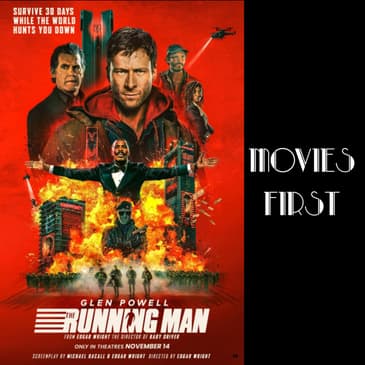
Listeners will be captivated as Chris and Jessica analyze Glen Powell's portrayal of Richards, which diverges from Arnold Schwarzenegger's iconic performance, bringing a sense of vulnerability and realism that resonates deeply. They highlight the film's exploration of media manipulation, particularly through Josh Brolin's character, Killian, who embodies the terrifying power of entertainment executives.
The episode also delves into the supporting cast's contributions, with standout performances from William H. Macy and Michael Cera, who add layers to the narrative's resistance theme. The hosts appreciate Edgar Wright's direction, noting how he skillfully balances action with darker satirical elements, ensuring that each sequence serves a purpose in character development and plot advancement.
As they reflect on the film's commentary about society's trajectory, Chris and Jessica emphasize the unsettling plausibility of the depicted technology and the cultural implications of an entertainment landscape driven by corporate greed. With a score of 7.5 out of 10, this episode invites listeners to consider the fine line between entertainment and exploitation, and the enduring hope for authentic human connection amidst a manufactured reality.
https://www.bitesz.com/podcast/movies-first
Become a supporter of this podcast: https://www.spreaker.com/podcast/movies-first.
To access the Movies First reviews archive visit our website at www.bitesz.com/podcast/movies-first
To access the Movies First reviews archive visit our website at www.bitesz.com/podcast/movies-first
This episode includes AI-generated content.
00:00:00 --> 00:00:02 Chris: Reality TV has always pushed boundaries for
00:00:02 --> 00:00:04 ratings, but imagine a world where
00:00:04 --> 00:00:06 contestants literally fight to the death
00:00:06 --> 00:00:09 while millions watch. That's the terrifying
00:00:09 --> 00:00:12 premise of the new Running man remake. And
00:00:12 --> 00:00:14 what's scarier is how close to reality it
00:00:14 --> 00:00:15 feels.
00:00:15 --> 00:00:18 Jessica: The timing of this film is so interesting,
00:00:18 --> 00:00:20 especially as we're seeing reality shows
00:00:20 --> 00:00:23 become increasingly exploitative. How m do
00:00:23 --> 00:00:25 you think they managed to Update Stephen
00:00:25 --> 00:00:27 King's 1982 story for today's audience?
00:00:29 --> 00:00:31 Chris: Well, they've brilliantly tapped into our
00:00:31 --> 00:00:33 current anxieties about healthcare and
00:00:33 --> 00:00:36 corporate control. The premise hits harder
00:00:36 --> 00:00:39 now. A desperate father enters a deadly game
00:00:39 --> 00:00:41 show because he can't afford medical care for
00:00:41 --> 00:00:44 his sick child. It's like Black Mirror
00:00:44 --> 00:00:46 meets the Hunger Games, but with this
00:00:46 --> 00:00:48 uncomfortable layer of plausibility.
00:00:49 --> 00:00:51 Jessica: The way they've incorporated modern media
00:00:51 --> 00:00:53 manipulation is particularly chilling.
00:00:54 --> 00:00:56 Josh Brolin's character, Killian represents
00:00:56 --> 00:00:58 everything scary about entertainment
00:00:58 --> 00:00:59 executives with too much power.
00:01:00 --> 00:01:02 Chris: You know what's fascinating? The whole
00:01:02 --> 00:01:04 concept of doctoring Richards video
00:01:04 --> 00:01:07 commentary to paint him as a villain. It's
00:01:07 --> 00:01:09 not even that far fetched anymore. We're
00:01:09 --> 00:01:11 already seeing deep fakes and selective
00:01:11 --> 00:01:14 editing in reality tv. This just takes it
00:01:14 --> 00:01:16 to its logical, horrifying conclusion.
00:01:17 --> 00:01:17 Jessica: Hmm.
00:01:17 --> 00:01:19 Um, speaking of which, let's talk about
00:01:19 --> 00:01:22 Glen Powell's performance as Richards.
00:01:22 --> 00:01:24 It's quite different from Schwarzenegger's
00:01:24 --> 00:01:26 take in the 1987 version.
00:01:27 --> 00:01:29 Chris: That's exactly what makes this version work.
00:01:29 --> 00:01:31 Powell brings this vulnerability that
00:01:31 --> 00:01:33 Schwarzenegger never could. He's not an
00:01:33 --> 00:01:36 invincible action hero. He's a regular
00:01:36 --> 00:01:39 guy pushed to extremes. Though I
00:01:39 --> 00:01:41 noticed those awkward facial expressions in
00:01:41 --> 00:01:44 early scenes, they actually help sell his
00:01:44 --> 00:01:45 character's discomfort with the whole
00:01:45 --> 00:01:46 situation.
00:01:47 --> 00:01:49 Jessica: The supporting cast really elevates the whole
00:01:49 --> 00:01:52 film too. William H. Macy and Michael
00:01:52 --> 00:01:54 Cera bring such different energies to their
00:01:54 --> 00:01:54 roles.
00:01:55 --> 00:01:58 Chris: Oh, man. Sarah Zelton Parakis
00:01:58 --> 00:02:01 is exactly what this movie needed.
00:02:01 --> 00:02:04 This sort of awkward rebel whose father was
00:02:04 --> 00:02:06 destroyed by the same system. It adds this
00:02:06 --> 00:02:09 whole generational aspect to the Resistance
00:02:09 --> 00:02:11 narrative. And Macy's character, Moly
00:02:11 --> 00:02:14 Jernigan, brings this world weary wisdom
00:02:14 --> 00:02:16 that makes the underground resistance feel
00:02:16 --> 00:02:17 more credible.
00:02:17 --> 00:02:19 Jessica: The technical aspects, uh, really serve the
00:02:19 --> 00:02:22 story well too. Edgar Wright's direction
00:02:22 --> 00:02:24 brings his signature style while still
00:02:24 --> 00:02:26 feeling different from his previous work.
00:02:27 --> 00:02:30 Chris: Well, that's what impressed me most, how
00:02:30 --> 00:02:32 Wright balances the action sequences with
00:02:32 --> 00:02:35 darker satirical elements. Each
00:02:35 --> 00:02:38 chase or fight scene reveals something about
00:02:38 --> 00:02:40 the characters or advances the plot.
00:02:41 --> 00:02:43 It's not just mindless spectacle.
00:02:44 --> 00:02:45 Jessica: The way they handle the public's changing
00:02:45 --> 00:02:48 perception of Richards is particularly well
00:02:48 --> 00:02:50 done. It really reflects how social media can
00:02:50 --> 00:02:52 turn someone into a hero or villain
00:02:52 --> 00:02:53 overnight.
00:02:54 --> 00:02:56 Chris: You know what's clever about that? The
00:02:56 --> 00:02:58 system's attempts to destroy Richards
00:02:58 --> 00:03:01 actually create this unexpected folk hero.
00:03:02 --> 00:03:05 Even with all their media manipulation, they
00:03:05 --> 00:03:06 can't control how people connect with his
00:03:06 --> 00:03:09 authentic struggle. It's like a commentary
00:03:09 --> 00:03:11 on how truth can still break through in our
00:03:11 --> 00:03:13 age of manufactured content.
00:03:14 --> 00:03:15 Jessica: The film's length has been a point of
00:03:15 --> 00:03:18 discussion at, uh, 2 hours and 13 minutes.
00:03:18 --> 00:03:21 Some say it runs long. What's your take?
00:03:21 --> 00:03:24 Chris: Here's the thing about the length. It gives
00:03:24 --> 00:03:26 them time to really build this world and show
00:03:26 --> 00:03:29 how the game show has become this cornerstone
00:03:29 --> 00:03:31 of society. Though, yeah, there
00:03:31 --> 00:03:33 are moments in the middle that could have
00:03:33 --> 00:03:35 been tighter. The pacing serves the story's
00:03:35 --> 00:03:37 larger themes about systemic corruption and
00:03:37 --> 00:03:38 resistance.
00:03:39 --> 00:03:41 Jessica: The way they've updated the technology for
00:03:41 --> 00:03:44 2025 feels unnervingly possible too.
00:03:44 --> 00:03:46 Chris: That's because they kept it just advanced
00:03:46 --> 00:03:49 enough to be scary, but not so far fetched
00:03:49 --> 00:03:51 that it breaks your suspension of disbelief.
00:03:52 --> 00:03:54 The surveillance systems, the tracking
00:03:54 --> 00:03:56 methods, the footage manipulation, it all
00:03:56 --> 00:03:58 feels like it could exist five minutes from
00:03:58 --> 00:03:58 now.
00:03:59 --> 00:04:01 Jessica: So, looking at the bigger picture, what do
00:04:01 --> 00:04:03 you think this film says about where we're
00:04:03 --> 00:04:04 heading as a society?
00:04:05 --> 00:04:07 Chris: Well, it's essentially warning us about the
00:04:07 --> 00:04:09 logical endpoint of our entertainment culture
00:04:09 --> 00:04:12 colliding with corporate power. When you
00:04:12 --> 00:04:14 combine unlimited corporate control,
00:04:15 --> 00:04:17 desperate people, and an audience hungry for
00:04:17 --> 00:04:20 increasingly extreme content, this is where
00:04:20 --> 00:04:22 you end up. The scariest part isn't the
00:04:22 --> 00:04:25 action or the violence. It's how believable
00:04:25 --> 00:04:26 the whole premise feels.
00:04:27 --> 00:04:29 Jessica: That's m what makes it more than just another
00:04:29 --> 00:04:30 remake, doesn't it?
00:04:31 --> 00:04:34 Chris: Exactly. It takes King's original concept
00:04:34 --> 00:04:36 and makes it relevant for today while still
00:04:36 --> 00:04:38 honoring what made the story compelling in
00:04:38 --> 00:04:41 the first place. It's both a warning about
00:04:41 --> 00:04:44 where we're heading and a reminder that
00:04:44 --> 00:04:46 resistance against corrupt systems isn't
00:04:46 --> 00:04:49 futile. Even in this dark future,
00:04:49 --> 00:04:51 there's still hope for human connection and
00:04:51 --> 00:04:54 truth to break through. We give
00:04:54 --> 00:04:56 the Running Man a score of 7.5 out of 10.
00:04:57 --> 00:04:59 Voice Over Guy: You've been listening to movies first
00:04:59 --> 00:05:02 available at Apple Podcasts, Spotify,
00:05:02 --> 00:05:05 iHeartRadio or your favorite podcast player.
00:05:05 --> 00:05:08 You can also stream on demand@bytes.com
00:05:08 --> 00:05:09 this.
00:05:09 --> 00:05:11 Chris: Has been another quality podcast production
00:05:11 --> 00:05:12 from bytes.com.