
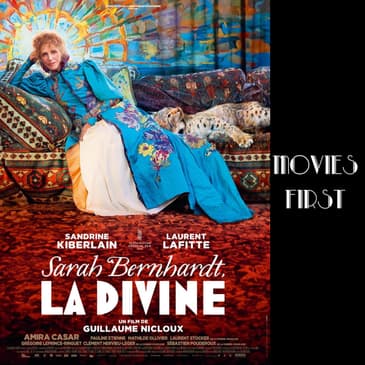
The film paints a vivid portrait of Bernhardt, whose lavish lifestyle included a Paris residence that resembled a private zoo. Chris discusses how, despite her immense wealth from a successful career, her financial stability was often threatened by extravagant spending and her son Maurice's gambling addiction. The narrative bravely addresses darker themes, including Bernhardt's struggles with self-harm, while also exploring her passionate yet tumultuous relationship with fellow actor Lucien Guitry.
Listeners will hear about the dramatic climax of their affair as Guitry's desire for a younger actress creates a rift in his family, with Bernhardt surprisingly stepping in as a peacemaker. The film also highlights Bernhardt's political activism, particularly her support for Alfred Dreyfus, which adds complexity to her relationship with Maurice. Sandrine Kyberlin's powerful portrayal of Bernhardt captures her larger-than-life persona, while Laurent Laffitte and Laurent Stalker provide strong supporting performances that enrich the narrative.
Directed by Guillaume Nigel and written by Natalie Lothro, *The Divine Sarah Bernhardt* successfully celebrates its subject's excesses while maintaining historical authenticity. With a rating of 7 out of 10, this film offers a captivating glimpse into the life of a woman who defied conventions and embraced both the pleasures and controversies of her time. Join Chris as he unpacks this engaging portrait of one of theatre's most unforgettable figures.
https://www.bitesz.com/podcast/movies-first
Become a supporter of this podcast: https://www.spreaker.com/podcast/movies-first
To access the Movies First reviews archive visit our website at www.bitesz.com/podcast/movies-first
00:00:00 --> 00:00:02 Chris: The remarkable story of Sarah Bernhard, the
00:00:02 --> 00:00:05 legendary French stage actress, unfolds
00:00:05 --> 00:00:08 in this dramatized biographical film that
00:00:08 --> 00:00:11 masterfully blends historical fact with
00:00:11 --> 00:00:13 creative storytelling. The narrative opens
00:00:13 --> 00:00:16 with a pivotal moment in Bernhardt's life,
00:00:16 --> 00:00:19 the amputation of her right leg at age 70, a
00:00:19 --> 00:00:21 ah, consequence of an earlier stage accident
00:00:21 --> 00:00:24 when a mattress wasn't properly positioned
00:00:24 --> 00:00:27 during a performance. Even in this
00:00:27 --> 00:00:30 challenging moment, Bernhardt's indomitable
00:00:30 --> 00:00:32 spirit shines through as she continues to
00:00:32 --> 00:00:34 direct those around her. With her
00:00:34 --> 00:00:37 characteristic mix of humor and demanding
00:00:37 --> 00:00:39 perfectionism, the film paints a vivid
00:00:39 --> 00:00:42 portrait of an extraordinarily complex woman
00:00:42 --> 00:00:44 whose life was marked by excess and
00:00:44 --> 00:00:47 adventure. Her Paris residence resembled a
00:00:47 --> 00:00:50 private zoo with wild animals freely
00:00:50 --> 00:00:52 roaming through luxurious rooms. Despite
00:00:53 --> 00:00:54 generating immense wealth through her
00:00:54 --> 00:00:57 successful career, Bernhardt's financial
00:00:57 --> 00:01:00 situation was often precarious due to
00:01:00 --> 00:01:02 her lavish spending habits and the constant
00:01:02 --> 00:01:05 drain of supporting her son Maurice's
00:01:05 --> 00:01:08 gambling addiction. The narrative doesn't shy
00:01:08 --> 00:01:10 away from darker elements, including
00:01:10 --> 00:01:13 Bernhardt's recurring episodes of self harm
00:01:13 --> 00:01:15 manifested through frequent wrist slashing
00:01:15 --> 00:01:18 incidents. At the heart of the story lies
00:01:18 --> 00:01:20 Bernhardt's passionate and turbulent
00:01:20 --> 00:01:22 relationship with fellow French actor Le
00:01:22 --> 00:01:25 Lucien Guitry. Their affair,
00:01:25 --> 00:01:27 characterized by mutual libertine lifestyles,
00:01:28 --> 00:01:30 reaches a dramatic climax when Guitry
00:01:30 --> 00:01:32 attempts to leave Bernhard for a younger
00:01:32 --> 00:01:35 actress. This same romantic entanglement
00:01:35 --> 00:01:37 creates a rift between Guitry and his son
00:01:37 --> 00:01:40 Sasha, leading to a family drama where
00:01:40 --> 00:01:42 Bernhardt, despite her own emotional
00:01:42 --> 00:01:44 involvement, surprisingly emerges as the
00:01:44 --> 00:01:47 peacemaker who helps reconcile father and
00:01:47 --> 00:01:49 son. The film delves into
00:01:49 --> 00:01:51 Bernhardt's political consciousness,
00:01:52 --> 00:01:54 particularly her outspoken support of Alfred
00:01:54 --> 00:01:57 Dreyfus, the French army officer at the
00:01:57 --> 00:01:59 center of a notorious political scandal. This
00:01:59 --> 00:02:02 stance creates significant tension with her
00:02:02 --> 00:02:04 son Maurice, adding another layer of
00:02:04 --> 00:02:06 complexity to their already strained
00:02:06 --> 00:02:09 relationship. Throughout the narrative, the
00:02:09 --> 00:02:11 story is enriched with references to
00:02:11 --> 00:02:14 contemporary luminaries from Victor Hugo
00:02:14 --> 00:02:16 to Oscar Wilde and Sigmund Freud,
00:02:16 --> 00:02:19 illustrating Bernhardt's extensive influence
00:02:19 --> 00:02:22 and connections in 19th century cultural
00:02:22 --> 00:02:25 circles. Sandrine Kyberlin delivers a
00:02:25 --> 00:02:27 powerful performance as Bernhardt, embodying
00:02:27 --> 00:02:29 the actress's larger than life personality
00:02:30 --> 00:02:32 and unshakable self centeredness with
00:02:32 --> 00:02:35 bold, brazen energy. Laurent
00:02:35 --> 00:02:37 Laffitte provides a measured counterpoint as
00:02:37 --> 00:02:40 Lucien Guitry, while Laurent Stalker
00:02:40 --> 00:02:42 brings nuance to the role of Pitou,
00:02:43 --> 00:02:45 Bernhardt's long suffering attendant who
00:02:45 --> 00:02:47 stoically endures her frequent outbursts
00:02:47 --> 00:02:50 while acknowledging both her cruelties and
00:02:50 --> 00:02:53 her genius. Director Guillaume Niclou and
00:02:53 --> 00:02:55 screenwriter Natalie Lothro have created a
00:02:55 --> 00:02:57 period drama that celebrates its subjects
00:02:57 --> 00:03:00 excesses while maintaining historical
00:03:00 --> 00:03:02 authenticity through meticulous attention to
00:03:02 --> 00:03:05 detail in sets and costumes. The film
00:03:05 --> 00:03:07 presents Bernhardt in all her complexity,
00:03:08 --> 00:03:11 demanding self centered and often
00:03:11 --> 00:03:13 cruel, yet undeniably magnetic
00:03:13 --> 00:03:16 and talented enough to become one of the
00:03:16 --> 00:03:19 first truly global celebrities of her
00:03:19 --> 00:03:21 era. The divine Sarah Bernhardt
00:03:21 --> 00:03:23 succeeds in portraying its subject as a woman
00:03:23 --> 00:03:26 who lived life on her own terms, embracing
00:03:26 --> 00:03:28 both pleasure and controversy with equal
00:03:28 --> 00:03:31 enthusiasm. While she could be dismissive and
00:03:31 --> 00:03:33 harsh with those around her, she also
00:03:33 --> 00:03:35 demonstrated an ability to bring people
00:03:35 --> 00:03:37 together, as shown in her reconciliation of
00:03:37 --> 00:03:40 the guitries. The film captures both the
00:03:40 --> 00:03:42 glittering success and personal struggles of
00:03:42 --> 00:03:44 a woman who refused to be constrained by the
00:03:44 --> 00:03:47 conventions of her time, creating an engaging
00:03:47 --> 00:03:49 portrait of one of theatre's most memorable
00:03:49 --> 00:03:52 figures. The narrative structure,
00:03:52 --> 00:03:55 unfolding through flashbacks, effectively
00:03:55 --> 00:03:56 weaves together the various threads of
00:03:56 --> 00:03:59 Bernhardt's life, from her professional
00:03:59 --> 00:04:01 triumphs to her personal tribulations,
00:04:01 --> 00:04:04 creating a rich tapestry that brings this
00:04:04 --> 00:04:06 historical figure vividly to life for modern
00:04:06 --> 00:04:08 audiences. We give it a 7 out of 10
00:04:08 --> 00:04:09 score.