
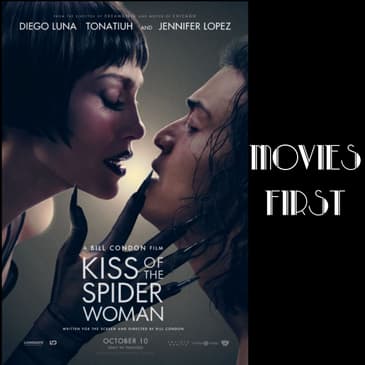
Listeners will appreciate the nuanced performances, particularly how Diego Luna transforms Valentin from a hardened figure into someone capable of vulnerability. The conversation reveals the film's attempt to balance personal and political narratives, with the intimate prison drama resonating more profoundly than the musical elements introduced by Jennifer Lopez’s dual roles. Chris and Jessica discuss how the film's musical sequences often feel disconnected from the overarching political drama, creating a sense of dissonance.
Despite its flaws, the hosts highlight the film's commitment to portraying the brutality of the regime, adding layers of tension to every interaction between Molina and Valentin. They reflect on the film's core themes of identity politics and human connection, emphasizing the importance of storytelling as a means to process trauma in dire circumstances.
With a score of 6 out of 10, this episode encourages listeners to engage with both this new adaptation and the original 1985 film, reminding us that the most significant stories are those we continue to tell, even imperfectly. Join Chris and Jessica as they unpack this thought-provoking narrative that challenges our understanding of love and resilience in the face of oppression.
https://www.bitesz.com/podcast/movies-first
Become a supporter of this podcast: https://www.spreaker.com/podcast/movies-first.
To access the Movies First reviews archive visit our website at www.bitesz.com/podcast/movies-first
To access the Movies First reviews archive visit our website at www.bitesz.com/podcast/movies-first
This episode includes AI-generated content.
00:00:00 --> 00:00:02 Chris: The Dirty war In Argentina saw 30 people
00:00:02 --> 00:00:04 killed or imprisoned by their own government.
00:00:04 --> 00:00:06 And somehow this dark chapter of history
00:00:07 --> 00:00:09 became the backdrop for one of Hollywood's
00:00:09 --> 00:00:12 most unexpected musicals. Let me tell you
00:00:12 --> 00:00:14 about the new Kiss of the Spider Woman
00:00:14 --> 00:00:14 adaptation.
00:00:15 --> 00:00:17 Jessica: That's such a bold choice to turn such
00:00:17 --> 00:00:19 serious source material into a musical.
00:00:20 --> 00:00:22 How does it handle that delicate balance?
00:00:23 --> 00:00:26 Chris: Well, it's fascinating because the film
00:00:26 --> 00:00:28 operates on multiple levels.
00:00:28 --> 00:00:31 You've got this intimate prison drama between
00:00:31 --> 00:00:34 two cellmates. Molina,
00:00:34 --> 00:00:37 this gay window dresser played by Tonariu,
00:00:37 --> 00:00:39 and Valentin, a, uh, political
00:00:39 --> 00:00:42 revolutionary played by Diego Luna.
00:00:43 --> 00:00:45 Their dynamic is immediately charged with
00:00:45 --> 00:00:46 tension.
00:00:46 --> 00:00:48 Jessica: Hmm. Um, tell me more about how they
00:00:48 --> 00:00:50 developed that relationship within such a
00:00:50 --> 00:00:51 politically charged setting.
00:00:52 --> 00:00:55 Chris: So here's where it gets interesting. Malina
00:00:55 --> 00:00:57 is actually planted there by the warden to
00:00:57 --> 00:01:00 spy on Valentin, but he uses these
00:01:00 --> 00:01:03 elaborate stories about his favorite films
00:01:03 --> 00:01:06 to build a connection. The genius is in
00:01:06 --> 00:01:09 how Tanatia portrays this character who's
00:01:09 --> 00:01:11 essentially performing multiple spy,
00:01:11 --> 00:01:14 storyteller and eventually genuine
00:01:14 --> 00:01:15 friend.
00:01:15 --> 00:01:17 Jessica: That must create some incredibly complex
00:01:17 --> 00:01:19 emotional moments between them.
00:01:20 --> 00:01:23 Chris: Oh, it does. And what's really compelling is
00:01:23 --> 00:01:25 how Diego Luna transforms
00:01:25 --> 00:01:28 Valentin from this hardened revolutionary
00:01:28 --> 00:01:31 into someone who actually allows himself to
00:01:31 --> 00:01:34 be vulnerable. But. And here's where
00:01:34 --> 00:01:36 things get complicated. The film tries to
00:01:36 --> 00:01:38 weave in this whole musical element with
00:01:38 --> 00:01:41 Jennifer Lopez playing dual roles as both a
00:01:41 --> 00:01:44 magazine publisher and the mysterious Spider
00:01:44 --> 00:01:44 Woman.
00:01:45 --> 00:01:47 Jessica: You know, that's quite different from the
00:01:47 --> 00:01:50 1985 version that won William Hurt his Oscar.
00:01:50 --> 00:01:52 How does this new interpretation hold up?
00:01:53 --> 00:01:55 Chris: Well, that's where we run into some issues.
00:01:56 --> 00:01:58 Despite having Bill Condon, who wrote
00:01:58 --> 00:02:00 Chicago, at the helm, the musical elements
00:02:00 --> 00:02:03 feel disconnected from the political drama.
00:02:03 --> 00:02:05 It's like watching two different movies
00:02:05 --> 00:02:06 fighting for attention.
00:02:06 --> 00:02:08 Jessica: So the intimate prison story works better
00:02:08 --> 00:02:09 than the musical numbers?
00:02:10 --> 00:02:13 Chris: Exactly. When we're focused on Melina and
00:02:13 --> 00:02:15 Valentin in their cell, the film really comes
00:02:15 --> 00:02:18 alive. There's this beautiful metaphor about
00:02:18 --> 00:02:21 how stories can help us process reality, even
00:02:21 --> 00:02:23 in the darkest circumstances. But then we
00:02:23 --> 00:02:26 shift to these elaborate musical sequences
00:02:26 --> 00:02:28 that just don't carry the same weight.
00:02:28 --> 00:02:30 Jessica: That's fascinating how even with some
00:02:30 --> 00:02:32 missteps, the core story still resonates.
00:02:33 --> 00:02:35 Chris: You know what's really interesting? The way
00:02:35 --> 00:02:38 they handle the political context. They don't
00:02:38 --> 00:02:40 shy away from showing the brutality of the
00:02:40 --> 00:02:42 regime, which gives every interaction between
00:02:42 --> 00:02:44 Malina and Valentin this underlying tension,
00:02:45 --> 00:02:47 every conversation could literally be a
00:02:47 --> 00:02:48 matter of life and death.
00:02:49 --> 00:02:51 Jessica: That must add so many layers to their growing
00:02:51 --> 00:02:51 friendship.
00:02:52 --> 00:02:55 Chris: It really does. And Tonatio's performance
00:02:55 --> 00:02:58 captures all those complexities. He
00:02:58 --> 00:03:00 brings this incredible vulnerability to
00:03:00 --> 00:03:02 Malina while still maintaining this sense of
00:03:02 --> 00:03:05 flamboyance that's almost like armor.
00:03:06 --> 00:03:08 When that armor starts to crack, it's really
00:03:08 --> 00:03:09 powerful stuff.
00:03:10 --> 00:03:12 Jessica: How does the film balance the personal story
00:03:12 --> 00:03:13 with the larger political narrative?
00:03:15 --> 00:03:17 Chris: That's actually one of its stronger aspects.
00:03:17 --> 00:03:20 The personal betrayals mirror the political
00:03:20 --> 00:03:22 ones, and even though the musical elements
00:03:22 --> 00:03:25 don't quite work, you can see what they were
00:03:25 --> 00:03:27 trying to do. Use art as a way to process
00:03:28 --> 00:03:30 trauma and find connection in impossible
00:03:30 --> 00:03:31 circumstances.
00:03:32 --> 00:03:34 Jessica: It sounds like despite its flaws, it's still
00:03:34 --> 00:03:35 contributing something meaningful to the
00:03:35 --> 00:03:36 conversation.
00:03:37 --> 00:03:40 Chris: That's exactly right. While it might only
00:03:40 --> 00:03:42 score a 6 out of 10, and I'd still recommend
00:03:42 --> 00:03:45 people watch the 1985 version first,
00:03:45 --> 00:03:47 there's something valuable about seeing how
00:03:47 --> 00:03:50 these themes of identity politics and human
00:03:50 --> 00:03:53 connection resonate in a contemporary
00:03:53 --> 00:03:56 context. Sometimes the attempt to tell these
00:03:56 --> 00:03:59 stories in new ways is just as interesting
00:03:59 --> 00:04:00 as getting everything perfect.
00:04:01 --> 00:04:03 Jessica: And perhaps that's what keeps these important
00:04:03 --> 00:04:05 stories alive. Finding new ways to tell them
00:04:05 --> 00:04:07 for each generation.
00:04:07 --> 00:04:09 Chris: You know, that's really what it comes down
00:04:09 --> 00:04:12 to. Even when certain elements don't quite
00:04:12 --> 00:04:14 work, the core story about human connection
00:04:14 --> 00:04:17 in the face of political oppression remains
00:04:17 --> 00:04:19 incredibly powerful. It's a reminder that
00:04:19 --> 00:04:21 sometimes the most important stories are the
00:04:21 --> 00:04:24 ones we keep trying to tell, even if we don't
00:04:24 --> 00:04:25 always get it exactly right.
00:04:26 --> 00:04:28 Finally, I'd like to suggest revisiting the
00:04:28 --> 00:04:31 1985 film or visiting it for the
00:04:31 --> 00:04:33 first time. If you haven't before, it would
00:04:33 --> 00:04:36 be worthwhile. This version scores a 6 out
00:04:36 --> 00:04:37 of 10.
00:04:37 --> 00:04:39 Voice Over Guy: You've been listening to movies first
00:04:39 --> 00:04:42 available at Apple Podcasts, Spotify,
00:04:42 --> 00:04:45 iHeartRadio or your favourite podcast
00:04:45 --> 00:04:47 player. You can also stream on
00:04:47 --> 00:04:50 demand at bitesz.com. This has been another
00:04:50 --> 00:04:52 quality podcast production from
00:04:52 --> 00:04:53 bitesz.com