
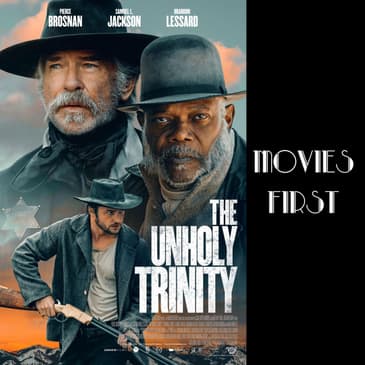
As the narrative unfolds in the town of Trinity, the hosts discuss the layers of deception and missed connections, particularly highlighting Samuel L. Jackson's charismatic performance as St. Christopher, whose clever timing adds depth to the story. In contrast, Pierce Brosnan's portrayal of Sheriff Gabriel Dove brings a stoic gravitas, creating a dynamic interplay between restraint and flamboyance. Brandon Lessard's Henry Broadway embodies a more contemporary moral complexity, effectively representing the evolving nature of the Western genre.
Chris and Jessica delve into the film's exploration of violence and moral ambiguity, noting how it navigates the gray areas often overlooked in traditional Westerns. Despite its modern take, the film delivers a satisfying conclusion where good triumphs over evil, tying together complex themes of justice, redemption, and mistaken identity in a way that feels earned.
The hosts appreciate the film's authentic production design, capturing the gritty reality of frontier life, which contrasts sharply with the polished aesthetics of classic Westerns. As they discuss the film's relevance in today's society, they ponder whether *The Unholy Trinity* could spark a revival of the genre, inviting fresh perspectives that honor its roots while pushing boundaries. With a rating of 6 out of 10, Chris and Jessica conclude that this film, while not without its flaws, is a refreshing attempt to reinvigorate a once-dominant genre.
https://www.bitesz.com/podcast/movies-first
Become a supporter of this podcast: https://www.spreaker.com/podcast/movies-first
To access the Movies First reviews archive visit our website at www.bitesz.com/podcast/movies-first
00:00:00 --> 00:00:02 Chris: Westerns used to dominate Hollywood with over
00:00:02 --> 00:00:04 140 films per year in the 1950s.
00:00:05 --> 00:00:08 But in 2024, we'll see just three major
00:00:08 --> 00:00:11 Western releases, making the Unholy
00:00:11 --> 00:00:13 Trinity a rare breed indeed.
00:00:14 --> 00:00:15 Jessica: That's such a dramatic shift in the industry.
00:00:16 --> 00:00:18 What really catches my attention about this
00:00:18 --> 00:00:20 one is how it's bringing fresh international
00:00:21 --> 00:00:23 perspective to such a quintessentially
00:00:23 --> 00:00:24 American genre.
00:00:25 --> 00:00:27 Chris: Well, you know what's fascinating about that?
00:00:27 --> 00:00:29 The Australian filmmakers behind this
00:00:29 --> 00:00:32 project, Lee Zachariah and Richard Grey,
00:00:32 --> 00:00:34 are actually tapping into some shared
00:00:34 --> 00:00:37 cultural DNA. Both countries have these
00:00:37 --> 00:00:39 powerful frontier mythologies.
00:00:39 --> 00:00:42 Jessica: Hmm, That's a really interesting parallel I
00:00:42 --> 00:00:44 hadn't considered. How do you think that
00:00:44 --> 00:00:46 shapes their approach to this Montana set
00:00:46 --> 00:00:46 story?
00:00:48 --> 00:00:50 Chris: So the way they handle the opening scene
00:00:50 --> 00:00:53 really shows their grasp of Western tension.
00:00:54 --> 00:00:56 Imagine this. It's 1873
00:00:57 --> 00:00:59 and a man named Isaacman Broadway is
00:00:59 --> 00:01:02 literally moments from execution when he
00:01:02 --> 00:01:05 spots his estranged son Henry in the crowd.
00:01:05 --> 00:01:08 Instead of saying goodbye, he uses his
00:01:08 --> 00:01:10 final breath to demand revenge.
00:01:11 --> 00:01:14 Jessica: Oh, man, that's such a loaded moment. Forcing
00:01:14 --> 00:01:16 this seemingly law abiding son to choose
00:01:16 --> 00:01:18 between honoring his father's last wish and
00:01:18 --> 00:01:20 maintaining his moral compass.
00:01:21 --> 00:01:23 Chris: Right, and here's where it gets really
00:01:23 --> 00:01:25 interesting. When Henry arrives in this
00:01:25 --> 00:01:27 remote town of Trinity, which his father
00:01:27 --> 00:01:30 helped build by the way, he ends up targeting
00:01:30 --> 00:01:32 completely the wrong person because the
00:01:32 --> 00:01:35 sheriff his father wanted dead is already six
00:01:35 --> 00:01:35 feet under.
00:01:36 --> 00:01:38 Jessica: The plot seems to have these layers of
00:01:38 --> 00:01:40 deception that you don't typically see in
00:01:40 --> 00:01:43 traditional Westerns. Like how Samuel l.
00:01:43 --> 00:01:46 Jackson's character, St. Christopher, keeps
00:01:46 --> 00:01:48 showing up at these perfectly timed moments.
00:01:49 --> 00:01:52 Chris: Speaking of Jackson, his performance here is
00:01:52 --> 00:01:54 exactly what this film needed. He's got this
00:01:54 --> 00:01:57 incredible swagger and this knowing
00:01:57 --> 00:02:00 grin that suggests he's always three steps
00:02:00 --> 00:02:02 ahead of everyone else. You can tell he's
00:02:02 --> 00:02:05 just having an absolute blast with the role.
00:02:05 --> 00:02:07 Jessica: Well, that's gotta create an interesting
00:02:07 --> 00:02:09 dynamic with Pierce Brosnan's more stoic
00:02:09 --> 00:02:11 sheriff, Gabriel Dove, right?
00:02:12 --> 00:02:15 Chris: Oh, for sure. Brosnan brings this wonderful
00:02:15 --> 00:02:17 world weary gravitas to the role he's
00:02:17 --> 00:02:20 playing. This upstanding lawman trying to
00:02:20 --> 00:02:22 clean up a town that's basically allergic to
00:02:22 --> 00:02:25 law and order. The contrast between his
00:02:25 --> 00:02:27 restraint and Jackson's more flamboyant
00:02:27 --> 00:02:29 presence really drives the tension.
00:02:29 --> 00:02:31 Jessica: And somewhere in the middle of all this,
00:02:31 --> 00:02:33 you've got Brandon Lessard playing Henry
00:02:33 --> 00:02:35 Broadway with this compelling, naive quality.
00:02:36 --> 00:02:38 Chris: You know what's really clever about the way
00:02:38 --> 00:02:40 they've structured this? They've taken
00:02:40 --> 00:02:43 these three very different performance styles
00:02:43 --> 00:02:45 and used them to represent different aspects
00:02:45 --> 00:02:48 of the Western genre itself. Brosnan's
00:02:48 --> 00:02:50 classical approach, Jackson's modern energy,
00:02:51 --> 00:02:53 and Lessard's more contemporary moral
00:02:53 --> 00:02:54 complexity.
00:02:55 --> 00:02:57 Jessica: That's such a smart observation about how
00:02:57 --> 00:02:59 they're balancing traditional Western
00:02:59 --> 00:03:00 elements with more modern storytelling
00:03:00 --> 00:03:01 approaches.
00:03:02 --> 00:03:04 Chris: And, uh, let's talk about how they handle the
00:03:04 --> 00:03:06 violence and moral questions.
00:03:06 --> 00:03:08 Because unlike classic Westerns, where
00:03:08 --> 00:03:11 everything was black and white, this film
00:03:11 --> 00:03:13 really leans into the gray areas, especially
00:03:13 --> 00:03:15 with Henry's character being forced to
00:03:15 --> 00:03:18 navigate this world of violence despite his
00:03:18 --> 00:03:19 ethical nature.
00:03:20 --> 00:03:22 Jessica: Though, in the end, they still give us that
00:03:22 --> 00:03:24 satisfying traditional Western conclusion
00:03:24 --> 00:03:26 where good triumphs over evil, don't they?
00:03:28 --> 00:03:30 Chris: Exactly. And you know what makes that work?
00:03:30 --> 00:03:32 The way they've built up all these complex
00:03:32 --> 00:03:35 threads about stolen gold, mistaken identity
00:03:36 --> 00:03:38 and revenge, but still manage to bring it all
00:03:38 --> 00:03:41 together in this explosive finale that feels
00:03:41 --> 00:03:43 earned rather than forced.
00:03:44 --> 00:03:46 Jessica: The production design really helps sell all
00:03:46 --> 00:03:48 of this too. They've clearly done their
00:03:48 --> 00:03:51 homework on capturing that 1873 Montana
00:03:51 --> 00:03:51 setting.
00:03:52 --> 00:03:54 Chris: Um, um, speaking of authenticity,
00:03:55 --> 00:03:57 here's something interesting about modern
00:03:57 --> 00:03:59 Westerns. They actually tend to be
00:04:00 --> 00:04:02 more historically accurate than the classics.
00:04:03 --> 00:04:05 The dirt, the grime, the practical
00:04:05 --> 00:04:08 challenges of frontier life. It's all there
00:04:08 --> 00:04:11 in a way that those polished 1950s
00:04:11 --> 00:04:13 Westerns never showed.
00:04:13 --> 00:04:15 Jessica: That attention to detail really helps ground
00:04:15 --> 00:04:17 all the dramatic elements of the story.
00:04:18 --> 00:04:20 Chris: So here's what I think makes this film
00:04:20 --> 00:04:22 particularly relevant right now. It's
00:04:22 --> 00:04:25 exploring themes of justice, redemption,
00:04:25 --> 00:04:28 and moral compromise at a time when.
00:04:28 --> 00:04:30 When we're having similar conversations in
00:04:30 --> 00:04:33 our society. It's just doing it through the
00:04:33 --> 00:04:35 lens of this genre. We don't see much
00:04:35 --> 00:04:35 anymore.
00:04:36 --> 00:04:38 Jessica: Well, viewers can judge for themselves when
00:04:38 --> 00:04:41 it hits digital platforms on July 16,
00:04:41 --> 00:04:43 2025. Though I have to say,
00:04:44 --> 00:04:46 even if it's not perfect, it's refreshing to
00:04:46 --> 00:04:48 see someone trying to breathe new life into
00:04:48 --> 00:04:48 this genre.
00:04:49 --> 00:04:50 Chris: You know what's really going to be
00:04:50 --> 00:04:53 interesting to watch? Whether this film's
00:04:53 --> 00:04:55 approach mixing traditional Western elements
00:04:55 --> 00:04:58 with more complex modern storytelling
00:04:58 --> 00:05:00 might actually help revive the genre for a
00:05:00 --> 00:05:03 new generation. Because right now, we're
00:05:03 --> 00:05:05 seeing more international filmmakers
00:05:05 --> 00:05:07 interested in putting their spin on these
00:05:07 --> 00:05:09 uniquely American stories.
00:05:10 --> 00:05:11 Jessica: That could definitely lead to some
00:05:11 --> 00:05:13 fascinating new interpretations of the
00:05:13 --> 00:05:14 Western genre.
00:05:15 --> 00:05:17 Chris: And m, maybe that's exactly what the Western
00:05:17 --> 00:05:19 needs right now. Fresh perspectives that can
00:05:19 --> 00:05:21 honor the traditional while pushing it in new
00:05:21 --> 00:05:24 directions. After all, the best
00:05:24 --> 00:05:26 Westerns have always been about more than
00:05:26 --> 00:05:28 just cowboys and gunfights. They're about how
00:05:28 --> 00:05:31 we deal with change, justice, and what it
00:05:31 --> 00:05:34 means to be civilized. We give the Unholy
00:05:34 --> 00:05:36 Trinity a rating of 6 out of 10.