
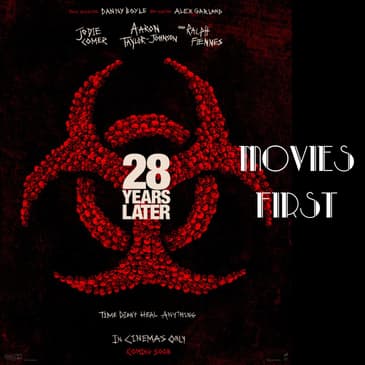
The episode highlights the film's innovative take on the zombie genre, showcasing a diverse array of Infected, from slow, crawling creatures to agile, terrifying foes. Alex discusses the standout antagonist, Sampson, played by Chai Lewis Parry, and the film's bold narrative choices, including a shocking scene of a zombie giving birth that expands the established mythology.
Ralph Fiennes' performance as Dr. Kelson adds depth to the story, as he helps Spike on a perilous journey across the mainland, emphasizing the film's blend of family drama and horror. The host appreciates the high production values that convincingly depict a post-apocalyptic Britain, while also praising Alfie Williams' emotional depth and maturity in his role.
As they dissect the film's themes of survival and coming of age, Alex notes the controversial ending that sets the stage for potential sequels, sparking debate about its tonal consistency. Despite mixed reactions to the finale, the film earns a commendable rating of 7.5 out of 10, proving that meaningful storytelling still thrives within the zombie genre. Join Alex as he unpacks *28 Years Later*, a film that not only delivers thrills but also resonates with genuine emotional weight.
https://www.bitesz.com/podcast/movies-first
Become a supporter of this podcast: https://www.spreaker.com/podcast/movies-first
To access the Movies First reviews archive visit our website at www.bitesz.com/podcast/movies-first
00:00:00 --> 00:00:02 Alex First: The long awaited continuation of the zombie
00:00:02 --> 00:00:04 franchise brings together original
00:00:04 --> 00:00:07 collaborators Alex Garland and Danny
00:00:07 --> 00:00:10 Boyle for 28 years later, marking their
00:00:10 --> 00:00:13 reunion 23 years after the release
00:00:13 --> 00:00:14 of 28 Days Later.
00:00:15 --> 00:00:18 Garland, known for ex machina, and Boyle,
00:00:18 --> 00:00:21 celebrated for slum dog millionaire, return
00:00:21 --> 00:00:24 to a United Kingdom that has been devastated
00:00:24 --> 00:00:27 by the Rage virus, which originally escaped
00:00:27 --> 00:00:30 from a biological weapons laboratory nearly
00:00:30 --> 00:00:32 three decades ago. The
00:00:32 --> 00:00:35 story unfolds on a small island community
00:00:35 --> 00:00:38 connected to the quarantined mainland by a
00:00:38 --> 00:00:40 causeway that's only accessible during low
00:00:40 --> 00:00:43 tide. This isolated sanctuary
00:00:43 --> 00:00:46 operates like a society from the turn of the
00:00:46 --> 00:00:49 20th century, lacking modern amenities and
00:00:49 --> 00:00:52 medical resources. The narrative centers
00:00:52 --> 00:00:54 on 12 year old spike Port, portrayed by
00:00:54 --> 00:00:57 newcomer Alfie Williams, who lives with his
00:00:57 --> 00:01:00 father Jamie and his
00:01:00 --> 00:01:02 gravely ill mother Isa,
00:01:03 --> 00:01:05 who frequently succumbs to delusions due to
00:01:05 --> 00:01:08 her condition. The film's emotional
00:01:08 --> 00:01:10 core develops through Jamie's efforts to
00:01:10 --> 00:01:13 prepare his son for survival in this harsh
00:01:13 --> 00:01:16 new world. This preparation
00:01:16 --> 00:01:18 culminates in a significant rite of passage
00:01:18 --> 00:01:21 where father and son venture to the mainland
00:01:22 --> 00:01:24 armed with bows and arrows for Spike's first
00:01:24 --> 00:01:26 encounter with the Infected.
00:01:27 --> 00:01:29 However, what should have been a triumphant
00:01:29 --> 00:01:31 return to celebrate Spike's achievement
00:01:32 --> 00:01:34 becomes a turning point when he witnesses an
00:01:34 --> 00:01:36 event that profoundly affects him.
00:01:37 --> 00:01:39 The zombie elements in the film showcase
00:01:39 --> 00:01:42 remarkable variety and innovation. The
00:01:42 --> 00:01:44 Infected appear in different forms. Some are
00:01:44 --> 00:01:47 fat and slow, crawling along the ground,
00:01:47 --> 00:01:49 while others demonstrate frightening agility
00:01:49 --> 00:01:52 and speed. A standout
00:01:52 --> 00:01:55 antagonist is Sampson, played by Chai
00:01:55 --> 00:01:58 Lewis Parry, described as a mountain of a
00:01:58 --> 00:02:00 former man. The film pushes genre
00:02:00 --> 00:02:03 boundaries by including unprecedented
00:02:03 --> 00:02:06 scenes such as a zombie giving birth, adding
00:02:06 --> 00:02:08 new dimensions to the established mythology.
00:02:08 --> 00:02:11 Ralph Fiennes delivers a compelling
00:02:11 --> 00:02:13 performance as Dr. Kelson, a UH
00:02:14 --> 00:02:16 survivor who has managed to establish a life
00:02:16 --> 00:02:18 on the mainland despite the constant threat
00:02:18 --> 00:02:21 of the Infected. His character has
00:02:21 --> 00:02:24 constructed an impressive bone temple to
00:02:24 --> 00:02:27 honor those who have fallen, adding a layer
00:02:27 --> 00:02:29 of philosophical contemplation to the
00:02:29 --> 00:02:32 apocalyptic setting. When
00:02:32 --> 00:02:35 Spike decides to seek Dr. Kelson's help
00:02:35 --> 00:02:38 for his ailing mother, the narrative
00:02:38 --> 00:02:40 transforms into a dangerous journey across
00:02:41 --> 00:02:43 zombie infested territory. The
00:02:43 --> 00:02:46 production values throughout the film are
00:02:46 --> 00:02:48 consistently high, creating a convincing
00:02:48 --> 00:02:51 post apocalyptic Britain. Alfie
00:02:51 --> 00:02:54 Williams performance as Spike is particularly
00:02:54 --> 00:02:57 noteworthy, displaying an emotional depth and
00:02:57 --> 00:03:00 maturity beyond his years. Aaron
00:03:00 --> 00:03:02 Taylor Johnson brings an appropriate edge to
00:03:02 --> 00:03:05 Jamie's character, while Jodie Comer infuses
00:03:05 --> 00:03:07 Isla with warmth and humanity when she joins
00:03:07 --> 00:03:10 Spike on their perilous journey to find Dr.
00:03:10 --> 00:03:12 Kelson. The film successfully
00:03:12 --> 00:03:15 balances intimate family drama with horror
00:03:15 --> 00:03:17 elements, making it more than just another
00:03:17 --> 00:03:20 zombie movie. At its heart,
00:03:20 --> 00:03:23 it's a coming of age story about a family
00:03:23 --> 00:03:26 facing extraordinary adversity. The
00:03:26 --> 00:03:27 relationship dynamics and character
00:03:27 --> 00:03:30 development remain central even as the
00:03:30 --> 00:03:33 threat of the infected looms constantly in
00:03:33 --> 00:03:35 the background. While the majority of the
00:03:35 --> 00:03:38 film maintains a strong and consistent tone,
00:03:38 --> 00:03:40 the ending has proven controversial.
00:03:41 --> 00:03:43 The finale takes a significant shift in
00:03:43 --> 00:03:46 direction, clearly setting up potential
00:03:46 --> 00:03:48 sequels or even a trilogy.
00:03:49 --> 00:03:51 Some viewers might find this conclusion
00:03:51 --> 00:03:54 overly dramatic and tonally inconsistent with
00:03:54 --> 00:03:57 the rest of the film. However, this
00:03:57 --> 00:03:59 departure doesn't significantly diminish the
00:03:59 --> 00:04:02 overall quality of the movie, which succeeds
00:04:02 --> 00:04:05 in bringing fresh perspective to the zombie
00:04:05 --> 00:04:08 genre. With an MA rating and earning
00:04:08 --> 00:04:10 a seven and a half out of 10, 28 years
00:04:10 --> 00:04:13 later demonstrates that there's still room
00:04:13 --> 00:04:15 for meaningful storytelling in the zombie
00:04:15 --> 00:04:18 genre. The film's strength lies in
00:04:18 --> 00:04:21 its ability to combine horror elements with
00:04:21 --> 00:04:24 genuine emotional depth, creating a
00:04:24 --> 00:04:26 narrative that resonates beyond its genre
00:04:26 --> 00:04:29 conventions. Despite the divisive
00:04:29 --> 00:04:32 ending, the Journey proves both engaging and
00:04:32 --> 00:04:34 and emotionally satisfying, suggesting that
00:04:34 --> 00:04:37 the 28 days later universe still has
00:04:37 --> 00:04:38 compelling stories to tell.