
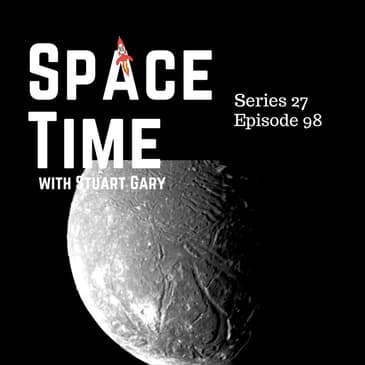
00:00:00 - This is spacetime series 27 episode 98 for broadcast on the 14 August 2024
00:00:43 - Growing speculation that Uranuss moon Ariel could harbour a hidden subsurface ocean
00:12:46 - Scientists use supercomputers to study how quickly black holes form from neutron star merger
00:16:30 - A new study claims thinking too hard can be unpleasant
00:19:22 - Apple releases new security updates for iPhones, iPads and Macs
00:19:59 - Google unveils new Pixel phones in Australia on Wednesday morning
00:22:02 - Spacetime is available every Monday, Wednesday and Friday through various podcasting services
For more SpaceTime, visit our website at www.spacetimewithstuartgary.com
www.bitesz.com
Become a supporter of this podcast: https://www.spreaker.com/podcast/spacetime-with-stuart-gary--2458531/support
[00:00:00] [SPEAKER_00]: This is SpaceTime Series 27 Episode 98 for broadcast on the 14th of August 2024.
[00:00:06] [SPEAKER_00]: Coming up on SpaceTime, a hidden ocean on Uranus' moon Ariel,
[00:00:11] [SPEAKER_00]: the Webb Space Telescope sees the birth of stars in a new light,
[00:00:16] [SPEAKER_00]: and what happens to the remains of a neutron star merger?
[00:00:20] [SPEAKER_00]: All that and more coming up on SpaceTime.
[00:00:23] [SPEAKER_03]: Welcome to SpaceTime with Stuart Gary.
[00:00:43] [SPEAKER_00]: There's growing speculation that Uranus' moon Ariel could harbour a hidden subsurface ocean under its frozen crust.
[00:00:51] [SPEAKER_00]: Ariel's surface is coated with a significant amount of carbon dioxide ice,
[00:00:55] [SPEAKER_00]: especially on its trailing hemisphere, which always faces away from the moon's direction of orbital motion.
[00:01:01] [SPEAKER_00]: This fact presents somewhat of a surprise, because even at the frigid reaches of the Uranian system,
[00:01:07] [SPEAKER_00]: some 20 times further away from the sun than the Earth, carbon dioxide readily turns into a gas and is lost into space.
[00:01:15] [SPEAKER_00]: Scientists have long theorised that something is supplying fresh carbon dioxide to Ariel's surface.
[00:01:22] [SPEAKER_00]: One hypothesis suggests that interactions between the moon's surface and charged particles in Uranus' magnetosphere
[00:01:29] [SPEAKER_00]: are creating carbon dioxide through a process called radiolysis,
[00:01:33] [SPEAKER_00]: in which molecules are broken down by ionising radiation.
[00:01:37] [SPEAKER_00]: But a new study reported in the astrophysical journal Letters suggests a different idea,
[00:01:42] [SPEAKER_00]: namely that carbon dioxide and other molecules are emerging from inside Ariel,
[00:01:47] [SPEAKER_00]: possibly even from a subsurface liquid ocean.
[00:01:51] [SPEAKER_00]: The authors used NASA's James Webb Space Telescope to collect chemical spectra on the moon
[00:01:55] [SPEAKER_00]: and then compared those results with spectra from simulated chemical mixtures in the lab.
[00:02:00] [SPEAKER_00]: They discovered that Ariel actually has some of the most carbon dioxide-rich deposits in the solar system,
[00:02:06] [SPEAKER_00]: adding up to an estimated 10mm or more in thickness on the moon's trailing hemisphere.
[00:02:12] [SPEAKER_00]: Among those deposits was another puzzling find, the first clear signals of carbon monoxide.
[00:02:19] [SPEAKER_00]: The study's lead author, Richard Cartwright from the Johns Hopkins Applied Physics Laboratory in L'Oreal, Maryland,
[00:02:25] [SPEAKER_00]: says that carbon monoxide simply shouldn't be there.
[00:02:28] [SPEAKER_00]: He points out that temperatures need to get as low as 30 Kelvin,
[00:02:32] [SPEAKER_00]: that's minus 243 degrees Celsius, before carbon monoxide is stable.
[00:02:37] [SPEAKER_00]: And Ariel's surface temperature averages around 18 degrees Celsius warmer than that.
[00:02:42] [SPEAKER_00]: It means the carbon monoxide there would have to be actively replenished.
[00:02:46] [SPEAKER_00]: Now, radiolysis could still be responsible for some of that replenishment.
[00:02:51] [SPEAKER_00]: But the lab's experiments have shown that radiation bombardment of water ice
[00:02:55] [SPEAKER_00]: mixed with carbon-rich material could produce both carbon dioxide and carbon monoxide.
[00:03:01] [SPEAKER_00]: Thus, radiolysis can provide a restocking source
[00:03:04] [SPEAKER_00]: and account for the rich abundance of both molecules on Ariel's trailing hemisphere.
[00:03:09] [SPEAKER_00]: But many questions remain about the Uranian magnetosphere
[00:03:12] [SPEAKER_00]: and the extent of its interactions with the planet's moons.
[00:03:16] [SPEAKER_00]: Even during the Voyager 2's flyby of Uranus nearly 40 years ago,
[00:03:20] [SPEAKER_00]: scientists suspected that such interactions would be limited
[00:03:22] [SPEAKER_00]: because Uranus's magnetic field axis and the orbital plane of its moons
[00:03:26] [SPEAKER_00]: are offset from each other by about 58 degrees.
[00:03:30] [SPEAKER_00]: So instead, the bulk of the carbon oxides may be coming from chemical processes that
[00:03:35] [SPEAKER_00]: happened and possibly are still happening in the ocean waters beneath Ariel's icy surface,
[00:03:41] [SPEAKER_00]: escaping either through cracks in the moon's frozen crust or possibly even through eruptive plumes.
[00:03:47] [SPEAKER_00]: What's more, the new spectral observations by Webb are hinting that Ariel's surface
[00:03:51] [SPEAKER_00]: may also harbour carbonate minerals, salts that could only have come through
[00:03:56] [SPEAKER_00]: the interaction of liquid water with rocks.
[00:03:59] [SPEAKER_00]: Cartwright says that if his interpretation of the carbonate feature is correct,
[00:04:03] [SPEAKER_00]: that means it had to form in the moon's interior.
[00:04:06] [SPEAKER_00]: And that's something astronomers absolutely need to confirm.
[00:04:10] [SPEAKER_00]: Astronomers have already suspected that Ariel may be geologically active because
[00:04:13] [SPEAKER_00]: its surface is covered in gash-like canyons, crisscrossing grooves,
[00:04:17] [SPEAKER_00]: and smooth spots thought to be formed from cryovolcanic overflows.
[00:04:21] [SPEAKER_00]: A study last year by Johns Hopkins Applied Physics laboratory scientist Ian Cohen even
[00:04:27] [SPEAKER_00]: suggested that Ariel and or its sister moon Miranda could be emitting material into Uranus's
[00:04:32] [SPEAKER_00]: magnetosphere, including possibly through plumes.
[00:04:36] [SPEAKER_00]: Cohen says all these new insights are underscoring how compelling the Uranian system is.
[00:04:41] [SPEAKER_00]: Whether it's to unlock the keys of how the solar system formed,
[00:04:45] [SPEAKER_00]: to better understand the planet's complex magnetosphere,
[00:04:48] [SPEAKER_00]: or to determine whether these moons are potential ocean worlds,
[00:04:51] [SPEAKER_00]: many scientists are now calling for a future mission to explore Uranus.
[00:04:56] [SPEAKER_00]: Last year, the planetary science community prioritised the first dedicated mission to
[00:05:00] [SPEAKER_00]: Uranus, raising hopes that a scientific voyage through the turquoise ice giant
[00:05:04] [SPEAKER_00]: could be on the horizon.
[00:05:06] [SPEAKER_00]: Cartwright sees this as an opportunity to collect valuable data about the solar system's
[00:05:11] [SPEAKER_00]: ice giants Uranus and Neptune and their potentially ocean-bearing moons.
[00:05:15] [SPEAKER_00]: But it would also be a chance to finally receive concrete answers that are only
[00:05:20] [SPEAKER_00]: possible by actually being in the system.
[00:05:23] [SPEAKER_00]: For example, most of Ariel's observed grooves, suspected of being openings to its interior,
[00:05:28] [SPEAKER_00]: are on the trailing side of the moon.
[00:05:30] [SPEAKER_00]: The trouble is, astronomers really haven't seen all that much of this tiny moon's surface.
[00:05:36] [SPEAKER_00]: Voyager 2 only captured about 35% of Ariel's surface during its brief flyby.
[00:05:41] [SPEAKER_00]: Scientists simply aren't going to find out much more until a dedicated science mission
[00:05:46] [SPEAKER_00]: can be undertaken.
[00:05:48] [SPEAKER_00]: This is Space Time.
[00:05:51] [SPEAKER_00]: Still to come, the James Webb Space Telescope sees the birth of stars in a new light,
[00:05:56] [SPEAKER_00]: and what happens to the remains of neutron stars when they merge?
[00:06:00] [SPEAKER_00]: All that and more still to come on Space Time.
[00:06:19] [SPEAKER_00]: NASA's James Webb Space Telescope has captured the historic first direct images of a key
[00:06:24] [SPEAKER_00]: phase of how newborn stars are actually formed.
[00:06:28] [SPEAKER_00]: The new observations, reported in the Astrophysical Journal, have long been sought after by astronomers
[00:06:34] [SPEAKER_00]: as they show an important process in stellar evolution.
[00:06:38] [SPEAKER_00]: The images, captured by Webb's near-infrared camera, show details of a young nearby star-forming
[00:06:43] [SPEAKER_00]: region in the Serpent's Nebula, an especially dense cluster of newly forming stars only
[00:06:48] [SPEAKER_00]: around 100,000 years old, which is located some 1,300 light-years away.
[00:06:53] [SPEAKER_00]: Some of these stars will eventually grow to be as massive as our Sun.
[00:06:58] [SPEAKER_00]: Astronomers found an intriguing group of protostellar outflows formed when jets of gas spewing out
[00:07:04] [SPEAKER_00]: from nearby stars collide with nearby gas and dust at high speeds.
[00:07:09] [SPEAKER_00]: Typically, these outflows have varied orientations within one region.
[00:07:13] [SPEAKER_00]: However, here they're all slanted in the same direction, to the same degree,
[00:07:17] [SPEAKER_00]: sort of like sleet falling during a snowstorm.
[00:07:20] [SPEAKER_00]: The discovery of these aligned objects provides new information into the fundamentals of how
[00:07:25] [SPEAKER_00]: stars are born.
[00:07:27] [SPEAKER_00]: Astronomers have long assumed that as clouds collapse to form stars,
[00:07:31] [SPEAKER_00]: these stars will tend to spin in the same direction.
[00:07:35] [SPEAKER_00]: The trouble is this has never actually been directly seen before.
[00:07:38] [SPEAKER_00]: That's where the new images come in.
[00:07:40] [SPEAKER_00]: They're showing a series of aligned, elongated structures, an historical record, if you will,
[00:07:46] [SPEAKER_00]: of the fundamental way in which the stars are born.
[00:07:49] [SPEAKER_00]: Now, as an interstellar gas cloud collapses in on itself to form a star, it spins up.
[00:07:54] [SPEAKER_00]: In other words, it tends to spin more rapidly.
[00:07:57] [SPEAKER_00]: That's called the conservation of angular momentum.
[00:08:00] [SPEAKER_00]: It's the same way an ice skater spins more rapidly when they bring their arms in close
[00:08:05] [SPEAKER_00]: to their body.
[00:08:06] [SPEAKER_00]: Now, the only way for that gas to continue moving inwards is for some of that angular
[00:08:10] [SPEAKER_00]: momentum to be removed.
[00:08:13] [SPEAKER_00]: A disk of material forms around the young star to transport material down,
[00:08:17] [SPEAKER_00]: like a whirlpool around a drain.
[00:08:20] [SPEAKER_00]: The swirling magnetic fields in the inner disk launch some of that material away in
[00:08:24] [SPEAKER_00]: twin jets.
[00:08:25] [SPEAKER_00]: They shoot outwards in opposite directions, perpendicular to the disk of material.
[00:08:30] [SPEAKER_00]: Now, in the new Webb images, these jets are signified by bright, clumpy red streaks of
[00:08:34] [SPEAKER_00]: shock waves from the jets hitting the surrounding gas and dust.
[00:08:38] [SPEAKER_00]: A study's lead author, Joel Green from the Space Telescope Science Institute in Baltimore,
[00:08:43] [SPEAKER_00]: Maryland, says Webb has allowed astronomers to catch these extremely young stars and
[00:08:47] [SPEAKER_00]: their outflows, some of which previously appeared as just blobs or were completely
[00:08:51] [SPEAKER_00]: invisible in optical wavelength images because of the thick dust surrounding them.
[00:08:56] [SPEAKER_00]: Astronomers say there are few forces that potentially can shift the direction of these
[00:09:00] [SPEAKER_00]: outflows during this period in a young star's life.
[00:09:03] [SPEAKER_00]: But one way is when binary stars spin around each other and wobble in orientation, twisting
[00:09:09] [SPEAKER_00]: the direction of the outflows over time.
[00:09:11] [SPEAKER_00]: The study's authors will now use Webb's near-infrared spectrograph to further investigate
[00:09:16] [SPEAKER_00]: the chemical makeup of this cloud.
[00:09:18] [SPEAKER_00]: Astronomers are interested in determining how volatile chemicals survive star and planet
[00:09:23] [SPEAKER_00]: formation.
[00:09:24] [SPEAKER_00]: Volatiles are compounds that supplement or transition from a solid directly into a gas
[00:09:29] [SPEAKER_00]: at relatively low temperatures, and that includes both water and carbon monoxide.
[00:09:35] [SPEAKER_00]: They'll then compare their findings to amounts found in protoplanetary disks of other similar
[00:09:39] [SPEAKER_00]: type stars.
[00:09:40] [SPEAKER_00]: The majority of our water here on Earth originated when the Sun was an infant protostar billions
[00:09:46] [SPEAKER_00]: of years ago.
[00:09:47] [SPEAKER_00]: Looking at the abundance of these critical compounds in protostars just before their
[00:09:52] [SPEAKER_00]: protoplanetary disks are formed could help scientists better understand how unique the
[00:09:56] [SPEAKER_00]: circumstances were when our own solar system was formed.
[00:10:01] [SPEAKER_00]: This report from NASA TV.
[00:10:03] [SPEAKER_01]: Situated only 1,300 light-years from Earth, the Serpent's main region covers a span of
[00:10:09] [SPEAKER_01]: 16 trillion miles by 11 trillion miles.
[00:10:13] [SPEAKER_01]: Its proximity to Earth makes it an ideal region for studying individual young stellar
[00:10:18] [SPEAKER_01]: objects.
[00:10:19] [SPEAKER_01]: Serpent's is a famous stellar nursery.
[00:10:22] [SPEAKER_01]: It has been imaged before, but this is the first time we've had an instrument that
[00:10:26] [SPEAKER_01]: can give us this level of detail.
[00:10:29] [SPEAKER_01]: A groundbreaking discovery has been made by NASA's James Webb Space Telescope in
[00:10:33] [SPEAKER_01]: the Serpent's Nebula.
[00:10:35] [SPEAKER_01]: Astronomers observed aligned protostellar outflows within this region for the first
[00:10:40] [SPEAKER_01]: time, providing unparalleled insights into star formation theories.
[00:10:45] [SPEAKER_01]: These protostellar outflows occur when jets of gas expelled by newborn stars interact
[00:10:50] [SPEAKER_01]: with the surrounding gas and dust.
[00:10:53] [SPEAKER_01]: What sets this discovery apart is that the outflows are aligned in the same direction.
[00:10:58] [SPEAKER_01]: The remarkable alignment of these outflows illustrates previously unseen details of how
[00:11:04] [SPEAKER_01]: stars are born.
[00:11:05] [SPEAKER_01]: As we continue to explore this new image, we find multiple captivating features that
[00:11:11] [SPEAKER_01]: also warrant a closer look.
[00:11:13] [SPEAKER_01]: We orient ourselves by looking for the Bat Shadow, a large shadow of a planet-forming
[00:11:18] [SPEAKER_01]: disk recently imaged by Hubble.
[00:11:21] [SPEAKER_01]: To the right of the Bat Shadow lies an eye-shaped feature, which appears as if a star is
[00:11:26] [SPEAKER_01]: bursting through.
[00:11:27] [SPEAKER_01]: Astronomers say looks may be deceiving here.
[00:11:29] [SPEAKER_01]: Despite its resemblance to a void, it may simply be a result of layered gases with varying
[00:11:35] [SPEAKER_01]: densities, akin to the phenomenon observed in the renowned Pillars of Creation.
[00:11:40] [SPEAKER_01]: To the right of this is an extremely dark patch, which could be a similar occurrence
[00:11:45] [SPEAKER_01]: of layered gases and dust.
[00:11:47] [SPEAKER_01]: No near-infrared light is able to get through because this area is so dense in comparison
[00:11:52] [SPEAKER_01]: to the rest of the region.
[00:11:54] [SPEAKER_01]: This region is also home to some particularly eye-catching stars.
[00:11:58] [SPEAKER_01]: SMM 1 is a binary protostar, two protostars that form together, orbit each other, and
[00:12:04] [SPEAKER_01]: produce two separate but overlapping outflows.
[00:12:08] [SPEAKER_01]: OO Serpentis is a young star still surrounded by a lot of gas and dust that hasn't
[00:12:13] [SPEAKER_01]: started the main phase of its life yet.
[00:12:15] [SPEAKER_01]: It erupted in 1995.
[00:12:18] [SPEAKER_01]: It's rare for astronomers to capture this extreme type of violent outburst because it
[00:12:23] [SPEAKER_01]: doesn't last very long.
[00:12:24] [SPEAKER_01]: With this new image of the Serpent's Nebula, Webb provides one of the most complete pictures
[00:12:29] [SPEAKER_01]: of star formation astronomers have ever seen.
[00:12:33] [SPEAKER_00]: This is Space Time.
[00:12:35] [SPEAKER_00]: Still to come, what happens to the remains of a neutron star when they merge, and later
[00:12:40] [SPEAKER_00]: in the Science Report, a new study claims that thinking too hard really does make your
[00:12:45] [SPEAKER_00]: brain hurt.
[00:12:46] [SPEAKER_00]: All that and more still to come on Space Time.
[00:13:04] [SPEAKER_00]: Scientists are resorting to some of the world's most advanced supercomputers to try and figure
[00:13:09] [SPEAKER_00]: out how quickly a stellar-mass black hole is likely to form from the merger of a pair of
[00:13:14] [SPEAKER_00]: neutron stars.
[00:13:16] [SPEAKER_00]: Black holes are the densest objects in the universe, containing infinite density in zero
[00:13:21] [SPEAKER_00]: volume.
[00:13:22] [SPEAKER_00]: Their gravitational pull is so strong that any material that falls beyond a point of
[00:13:27] [SPEAKER_00]: no return called the event horizon will continue falling forever into the black hole singularity.
[00:13:32] [SPEAKER_00]: And nothing, not even light, can escape.
[00:13:36] [SPEAKER_00]: Because the laws of physics break down inside black holes, understanding them is extremely
[00:13:41] [SPEAKER_00]: difficult.
[00:13:42] [SPEAKER_00]: Even their immediate neighbourhood is difficult to comprehend.
[00:13:45] [SPEAKER_00]: The trouble is neutron stars really aren't all that much less mysterious.
[00:13:50] [SPEAKER_00]: Just like stellar-mass black holes, neutron stars can be formed either by the death of
[00:13:54] [SPEAKER_00]: a massive star in a core-collapse supernova explosion or through the merger of two less
[00:13:59] [SPEAKER_00]: massive stars.
[00:14:00] [SPEAKER_00]: In the aftermath of a collision of two neutron stars, a new celestial object, which astronomers
[00:14:06] [SPEAKER_00]: are calling a remnant, emerges, shrouded in mystery.
[00:14:11] [SPEAKER_00]: Scientists are still unravelling its secrets, including whether it collapses directly to
[00:14:15] [SPEAKER_00]: form a black hole or whether other things happen first, and also how quickly all this
[00:14:20] [SPEAKER_00]: takes place.
[00:14:21] [SPEAKER_00]: Now, scientists from Pennsylvania State University have used supercomputer simulations with general
[00:14:27] [SPEAKER_00]: relativistic neutrino radiation hydrodynamics to try and better understand the internal
[00:14:32] [SPEAKER_00]: structures of these neutron star merger remnants.
[00:14:35] [SPEAKER_00]: They also looked at how the remnants are likely to cool down by emitting neutrinos.
[00:14:40] [SPEAKER_00]: By observing when neutron stars merge in space, scientists are gaining insights into how nuclear
[00:14:46] [SPEAKER_00]: matter behaves, how it acts under extreme conditions that simply can't be replicated
[00:14:51] [SPEAKER_00]: here on Earth.
[00:14:52] [SPEAKER_00]: Nuclear matter is a hypothetical substance made up of protons and neutrons held together
[00:14:57] [SPEAKER_00]: by the strong nuclear force.
[00:14:59] [SPEAKER_00]: Of special interest to scientists is whether the pressure from the strong nuclear force
[00:15:03] [SPEAKER_00]: can stop black holes from forming.
[00:15:06] [SPEAKER_00]: To try and get the answers, the authors used the computational resources available through
[00:15:10] [SPEAKER_00]: the United States Department of Energy's National Energy Research Scientific Computing
[00:15:14] [SPEAKER_00]: Center, the Leibniz Supercomputing Center in Germany, and the Institute for Computational
[00:15:19] [SPEAKER_00]: and Data Science at Pennsylvania State University.
[00:15:23] [SPEAKER_00]: Their findings, reported in the Astrophysical Journal, show that neutron star merger remnants
[00:15:28] [SPEAKER_00]: consist of a central object endowed with most of the mass of the system, surrounded by a
[00:15:33] [SPEAKER_00]: ring of hot matter in fast rotation that contains a small fraction of the mass but a large
[00:15:39] [SPEAKER_00]: fraction of the angular momentum.
[00:15:41] [SPEAKER_00]: Unlike most stars, the inner remnant has a higher temperature on its surface than in
[00:15:45] [SPEAKER_00]: its core.
[00:15:46] [SPEAKER_00]: So convective plumes aren't expected to form as the remnant cools down through the
[00:15:51] [SPEAKER_00]: emission of neutrinos.
[00:15:53] [SPEAKER_00]: This new research is really only a starting point, trying to identify some of the astronomical
[00:15:57] [SPEAKER_00]: signals likely to occur when such a merger happens.
[00:16:01] [SPEAKER_00]: In the long run, it could help answer some really key questions about neutron stars
[00:16:06] [SPEAKER_00]: and about the formation of black holes.
[00:16:10] [SPEAKER_00]: This is Space Time.
[00:16:27] [SPEAKER_00]: And time now to have another brief look at some of the other stories making news in
[00:16:30] [SPEAKER_00]: science this week with the Science Report.
[00:16:33] [SPEAKER_00]: A new study claims thinking too hard can be unpleasant.
[00:16:37] [SPEAKER_00]: A report in the journal Psychological Bulletin looked at the level of irritation and frustration
[00:16:42] [SPEAKER_00]: participants from different countries and professional groups experienced when undertaking
[00:16:47] [SPEAKER_00]: a range of cognitive tasks.
[00:16:49] [SPEAKER_00]: The authors also investigated previous studies in which healthcare professionals, military
[00:16:54] [SPEAKER_00]: personnel, office staff and amateur athletes were all assigned various tasks such as testing
[00:16:59] [SPEAKER_00]: new equipment.
[00:17:00] [SPEAKER_00]: They found that even when people volunteered to do brain work, they experienced the mental
[00:17:05] [SPEAKER_00]: burden as unpleasant.
[00:17:07] [SPEAKER_00]: They say in all the cases they examined, mental effort really did appear to trigger negative
[00:17:11] [SPEAKER_00]: feelings, and they say those findings were really quite striking.
[00:17:16] [SPEAKER_00]: So I guess when people say their brain hurts, they really mean it.
[00:17:21] [SPEAKER_00]: Here's a question for you.
[00:17:23] [SPEAKER_00]: Just how clean is your microwave oven?
[00:17:25] [SPEAKER_00]: Most people think that it's operations zap and kill microbes by boiling the water in
[00:17:30] [SPEAKER_00]: their cells.
[00:17:31] [SPEAKER_00]: After all, that's how microwave ovens work.
[00:17:33] [SPEAKER_00]: But it turns out that's not the case.
[00:17:36] [SPEAKER_00]: Researchers swabbed the interiors of 30 different microwave ovens from household kitchens, offices,
[00:17:42] [SPEAKER_00]: cafeterias, even a microbiology lab in order to uncover the diversity of bacteria living
[00:17:47] [SPEAKER_00]: within the microwave oven.
[00:17:49] [SPEAKER_00]: Their report, published in the journal Frontiers of Microbiology, identified a range of microbes
[00:17:54] [SPEAKER_00]: in household microwave ovens which actually resemble those found on a typical kitchen
[00:17:59] [SPEAKER_00]: surface.
[00:18:00] [SPEAKER_00]: And while some species may pose a risk to human health, the authors say it's probably
[00:18:04] [SPEAKER_00]: no greater a risk than other common kitchen surfaces.
[00:18:08] [SPEAKER_00]: Now interestingly, the microbes found in microwave ovens were also very similar to those found
[00:18:13] [SPEAKER_00]: on solar panels.
[00:18:14] [SPEAKER_00]: And the authors say this could be because the heat and solar radiation on solar panels
[00:18:18] [SPEAKER_00]: may have favoured some highly resistant microbe species in the same manner as in microwave
[00:18:24] [SPEAKER_00]: ovens.
[00:18:25] [SPEAKER_00]: Now the authors recommend regularly disinfecting your microwave ovens with either a diluted
[00:18:29] [SPEAKER_00]: bleach solution or a commercially available disinfectant spray.
[00:18:34] [SPEAKER_00]: A new Canadian study has gone against earlier research, showing that you really shouldn't
[00:18:39] [SPEAKER_00]: trust CHAT-GTP to answer your medical questions.
[00:18:44] [SPEAKER_00]: A report in the journal PLOS One asked the AI to answer 150 medscape case challenges,
[00:18:49] [SPEAKER_00]: a series of diagnostic problems for doctors, and found it was only able to answer just
[00:18:54] [SPEAKER_00]: shy of half of them correctly.
[00:18:56] [SPEAKER_00]: Also, CHAT-GTP wasn't very sensitive in its answers, and it was overly complicated
[00:19:01] [SPEAKER_00]: in half its responses.
[00:19:03] [SPEAKER_00]: Finally, it only provided complete and relevant answers in just over half the time.
[00:19:08] [SPEAKER_00]: Now when you think about it, that means CHAT-GTP is really no more reliable, maybe even a lot
[00:19:15] [SPEAKER_00]: less, than Dr Google.
[00:19:17] [SPEAKER_00]: And we all know how bad that is.
[00:19:18] [SPEAKER_00]: Or at least if you're listening to this show, you should.
[00:19:22] [SPEAKER_00]: Well it's a case of déjà vu all over again.
[00:19:25] [SPEAKER_00]: Just a week after Apple released its last software update, it's released another one,
[00:19:29] [SPEAKER_00]: this time due to growing security concerns.
[00:19:32] [SPEAKER_00]: With all the details, once again we're joined by technology editor Alex Haravroit from
[00:19:37] [SPEAKER_00]: TechAdvice.Live.
[00:22:01] [SPEAKER_00]: That's Alex Haravroit from TechAdvice.Live.
[00:22:05] [SPEAKER_00]: And that's the show for now.
[00:22:23] [SPEAKER_00]: Spacetime is available every Monday, Wednesday and Friday through Apple Podcasts iTunes,
[00:22:28] [SPEAKER_00]: Stitcher, Google Podcasts, Pocket Casts, Spotify, Acast, Amazon Music, Bytes.com, SoundCloud,
[00:22:36] [SPEAKER_00]: YouTube, your favorite podcast download provider, and from Spacetime with StuartGarry.com.
[00:22:42] [SPEAKER_00]: Spacetime is also broadcast through the National Science Foundation on Science Zone Radio,
[00:22:47] [SPEAKER_00]: and on both iHeart Radio and TuneIn Radio.
[00:22:51] [SPEAKER_00]: And you can help to support our show by visiting the Spacetime store for a range of promotional
[00:22:55] [SPEAKER_00]: merchandising goodies.
[00:22:57] [SPEAKER_00]: Or by becoming a Spacetime Patron, which gives you access to triple episode commercial-free
[00:23:02] [SPEAKER_00]: versions of the show, as well as lots of bonus audio content which doesn't go to air,
[00:23:06] [SPEAKER_00]: access to our exclusive Facebook group, and other rewards.
[00:23:10] [SPEAKER_00]: Just go to spacetimewithstuartgarry.com for full details.
[00:23:15] [SPEAKER_00]: You've been listening to Spacetime with Stuart Garry.
[00:23:18] [SPEAKER_03]: This has been another quality podcast production from Bytes.com.